How to Reduce Your Turnitin AI Score — Legitimately
A high Turnitin AI score doesn't always mean you used AI. Here's what actually triggers the score, the legitimate techniques that bring it down, and what to avoid.
You wrote the essay yourself — or mostly yourself — and the AI score came back higher than you expected. Or you used AI to help draft something, revised it extensively, and now need to bring the score down before you submit. Either way, the question is the same: what actually works?
This guide covers what causes a high AI score, the legitimate techniques that reduce it, what to avoid, and the resubmission window you have to work with before the deadline.
What causes a high AI score in the first place
Turnitin does not match your text against a database of known AI output. It analyses the statistical properties of how you wrote — specifically two signals called perplexity and burstiness.
Perplexity measures how predictable each word choice is. AI models always pick the statistically most probable next word, producing text that flows smoothly but is mechanically predictable at the word level. Human writers make unexpected choices — unusual phrasing, idiosyncratic vocabulary, creative departures from the obvious. High perplexity (i.e. unpredictable writing) reads as human. Low perplexity reads as AI.
Burstiness measures variation in sentence length and complexity. Human writing is naturally irregular — a three-word sentence followed by a sprawling clause-heavy one, then a question, then a medium sentence. AI writing settles into a consistent rhythm, producing sentences of similar length and complexity throughout. When Turnitin sees three or more consecutive sentences with the same structural cadence, it flags them.
Beyond those two signals, several specific patterns reliably trigger higher scores:
- AI-clichéd vocabulary: words like “delve,” “tapestry,” “underscore,” “pivotal,” “crucial,” “realm,” and phrases like “it's worth noting” or “in today's rapidly evolving landscape” appear so frequently in LLM output that they spike the confidence score
- Predictable paragraph structure repeated throughout — topic sentence, evidence, analysis, transition, every time
- Overly smooth, logical transitions: “Furthermore,” “Moreover,” “In conclusion,” appearing exactly where you'd expect them
- Prose that is uniformly confident and factual with no hedging, no uncertainty, no personal interpretation
- Highly formal, generic framing that avoids specific detail or personal perspective
Understanding what triggers the score is half the work of reducing it. The fixes target exactly these patterns.
Legitimate techniques that actually reduce the score
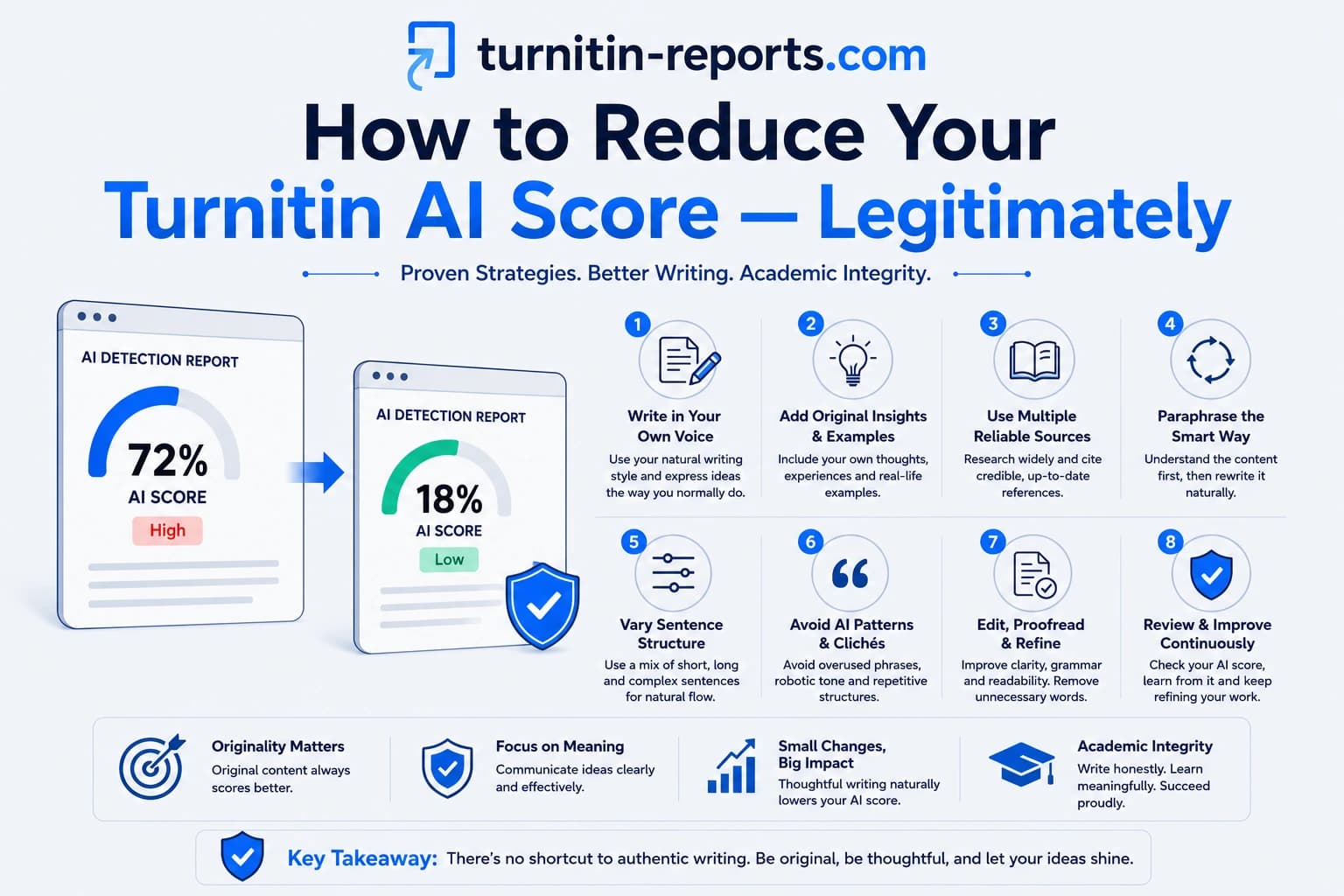
Vary your sentence length — this is the most effective single change. Read through your flagged passages and count the syllables in consecutive sentences. If they are all roughly the same, break them up. Insert a short sentence. Split a long one in two. Combine two short ones into a complex construction. If every sentence takes roughly the same breath to say aloud, that uniformity is what Turnitin is detecting.
Rewrite flagged passages from scratch in your own words. Do not change individual words in a flagged sentence — rewrite the whole thing. Close the document, think about what you were trying to say, then write it fresh without looking at the original. This breaks both the word-level predictability and the sentence structure simultaneously.
Add detail that only you could have written. Specific examples from your research, a particular data point you found interesting, your own interpretation of a source rather than a neutral summary, a comparison you made yourself. AI writing is generic by nature — it speaks in generalities. Specific, concrete detail breaks the statistical pattern.
Add hedging and uncertainty where appropriate. AI writing sounds uniformly confident. Phrases like “this may suggest,” “it is possible that,” “I think,” or “we cannot be certain” — used where they genuinely reflect your thinking — signal authentic human judgment rather than algorithmic certainty.
Replace AI vocabulary with your own phrasing. Search your document for “delve,” “tapestry,” “underscore,” “pivotal,” “it's worth noting,” and similar phrases. Do not swap in a synonym — rewrite the entire sentence from scratch.
Engage critically with your sources. Dropping a citation without explanation looks AI-generated. Explaining why a specific source matters, what it gets right, and what it leaves out — in your own evaluative voice — is something AI does poorly and something Turnitin recognises as human.
Break up structural repetition. If every paragraph follows the same argumentative template, restructure some of them. Start a paragraph with the evidence instead of the claim. Let one paragraph ask a question rather than answer one. Structural variety signals a human mind working through a problem rather than a model generating text to a template.
Read the entire document aloud. Every sentence where you stumble, pause, or think “I would never actually say this” should be rewritten. This catches unnatural transitions, overly formal constructions, and mechanical rhythm that visual reading misses. If it sounds like a Wikipedia article, it will score like one.
Why Grammarly can increase your AI score
This is one of the least discussed risks in this area. Grammarly's rewrite and rephrase features standardise syntax — they smooth all sentences into a uniform, professional style. That standardisation reduces burstiness and creates the low-perplexity, even-cadence pattern that AI detectors look for. Grammarly makes your writing more consistent; Turnitin interprets consistency as evidence of machine generation.
If you use Grammarly, limit it to spelling and punctuation correction only. Do not use its sentence rewrite or rephrase suggestions — those are the features that homogenise your prose in exactly the way Turnitin flags.
What not to do — AI humanizer tools
AI humanizer tools claim to rewrite AI-generated text so that detectors cannot identify it. There are two strong reasons to avoid them.
First, they do not reliably work. Most humanizers swap words and rearrange phrases without changing the underlying sentence structure — the predictability chains and rhythm that Turnitin actually detects. Running a passage through QuillBot typically brings the average Turnitin AI score to around 41%, and only about one in four processed passages drops below the 20% threshold. The other three are still flagged.
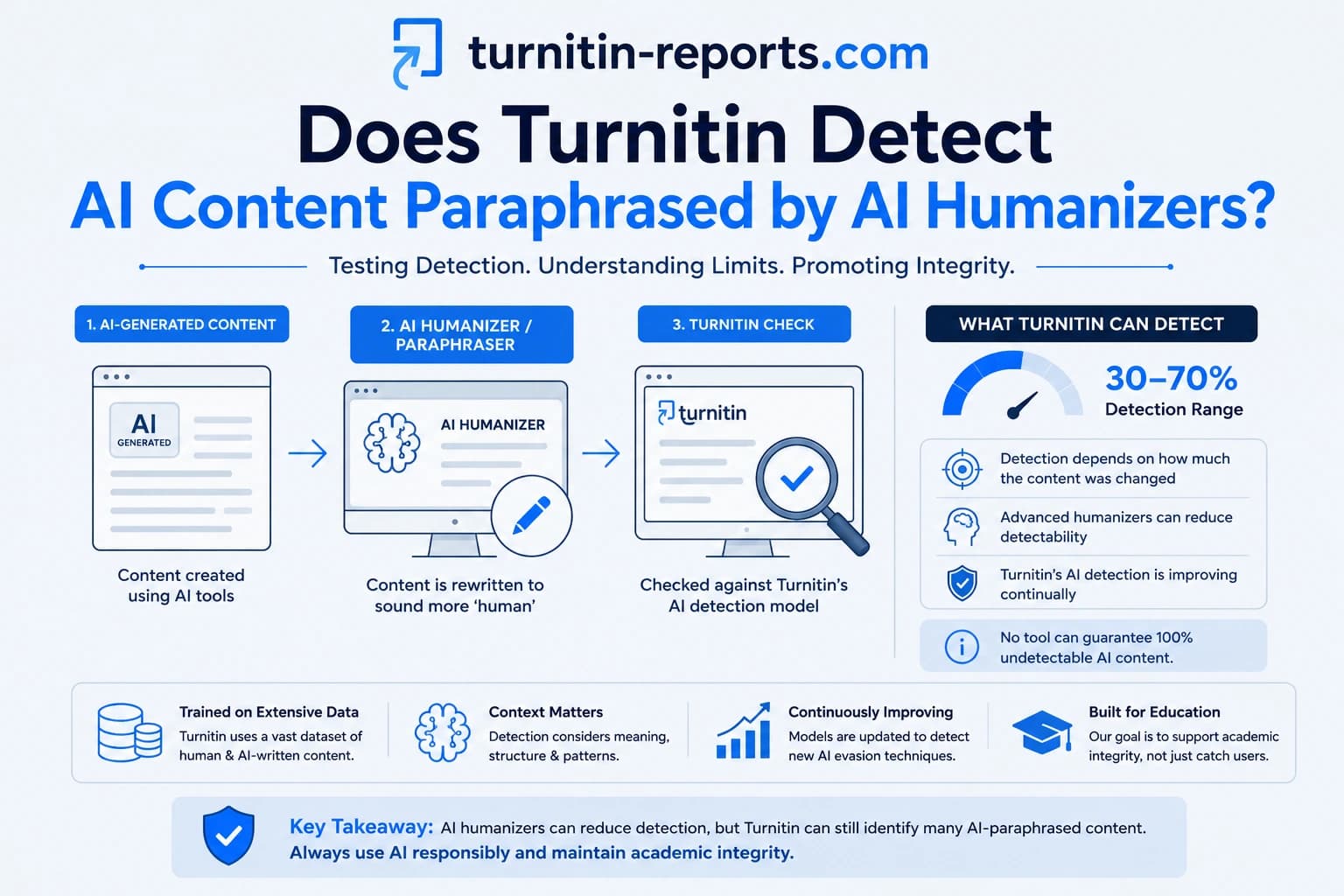
Second, Turnitin now detects them. Since August 2025, Turnitin has a dedicated bypasser detection layer trained on the statistical signatures of leading humanizer tools. PlagAiReport explains in detail why structural patterns from the original AI output persist even after humanizer processing — meaning the shortcut rarely holds up. When it fires, your report does not just show AI content — it shows AI content that someone tried to hide. Most institutions treat active concealment more seriously than the underlying AI use. Our post on whether Turnitin detects AI humanizers covers this in full detail.
The resubmission window — how to use it
If you receive your AI report before the deadline, you have a genuine opportunity to revise and resubmit. Turnitin's official resubmission policy works as follows:
- Resubmissions are only possible before the assignment deadline — once the due date passes, you cannot overwrite your submission
- You can resubmit up to three times within a 24-hour period; each of the first three generates a new AI report immediately
- After the third resubmission, you must wait 24 hours before submitting again, and the report takes 24 hours to generate
- Resubmitting overwrites your previous version — instructors see only your latest submission
Do not waste all three same-day resubmissions with minor edits. Make substantive revisions first — work through the flagged passages fully — then resubmit. Save additional attempts for genuinely revised versions, not incremental tweaks.
How to identify which passages were flagged
When you open your AI Writing Report in Turnitin, flagged text is highlighted in cyan for likely AI-generated sentences and purple for sentences that appear to have been AI-generated and then AI-paraphrased. Turnitin only displays highlights for scores of 20% and above — if your score shows as *%, no highlighting appears.
Focus your rewriting effort on the cyan-highlighted passages. For each one: close the report, think about what you were trying to communicate in that section, and write a fresh version without referring to the original. Then read it aloud. If it still sounds robotic, do it again. Changing words is not enough — you need to change the structure.
What score is actually safe
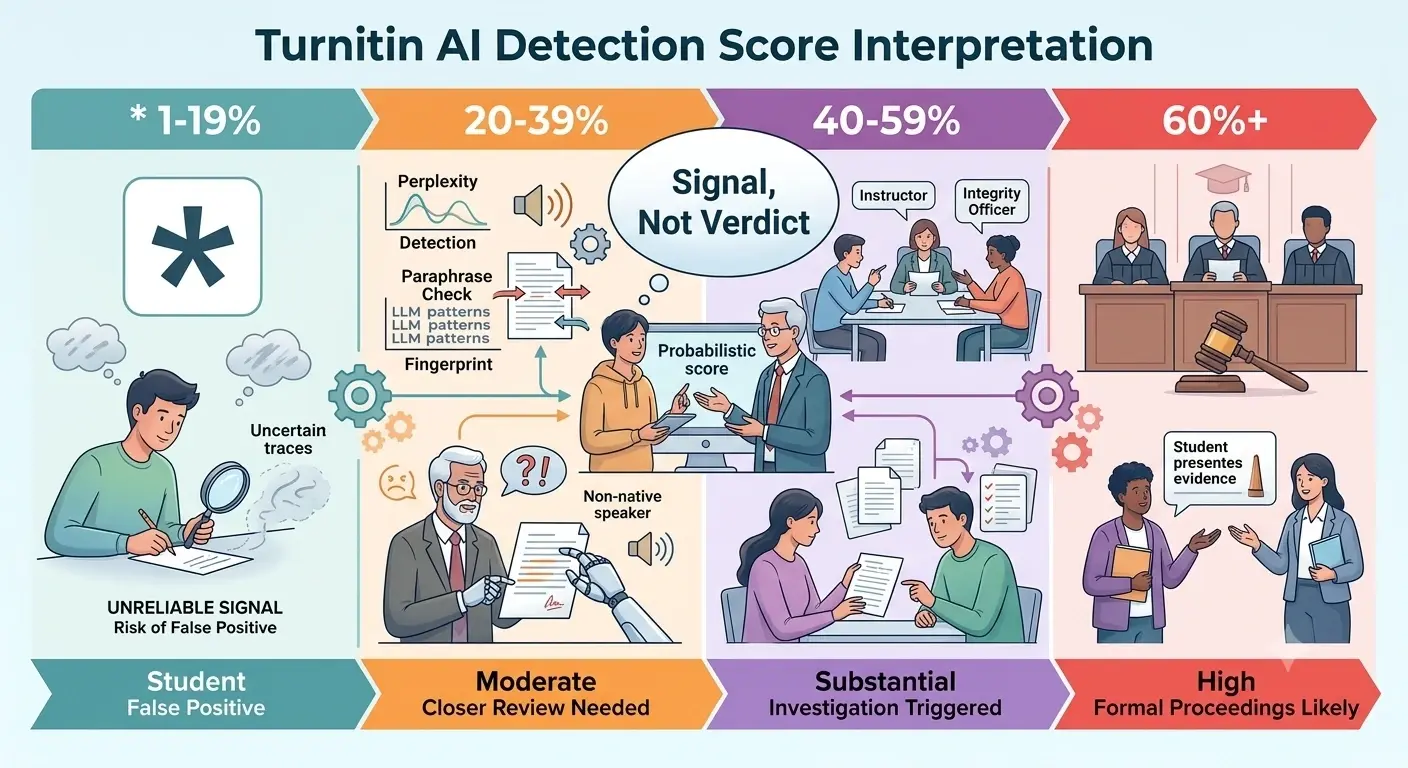
There is no universal threshold. Turnitin itself states: “one size does not fit all when it comes to the permissible use of AI writing.” The company does not recommend any numerical cutoff and treats scores below 20% as less reliable, displaying them as *% to signal measurement noise.
In practice, institutional responses vary. Scores below 20% are generally not acted on. Scores between 20–50% often trigger a conversation or request for draft evidence. Above 50%, many institutions escalate to a formal review. Above 80%, formal misconduct proceedings are common at institutions that act on AI scores at all. Check your institution's specific academic integrity policy — the consequence of a given score is entirely an institutional decision, not a Turnitin one.
Turnitin's own guidance to educators is explicit: the score “should not be used as the sole basis for adverse actions against a student” and should be treated as “step one of a conversation” rather than a verdict. If you wrote your work and can show the evidence — drafts, research notes, version history — a high score is something you can address. Our full guide on how accurate Turnitin AI detection actually is covers false positive rates and what to do if you believe you've been wrongly flagged.
Frequently asked questions
Can I lower my Turnitin AI score by rewriting?
Yes, if you rewrite substantively — restructuring sentences, varying length and rhythm, removing AI-typical vocabulary, and adding specific personal detail. Changing individual words without changing sentence structure has little effect because Turnitin is measuring statistical patterns across the whole passage, not individual word choices.
Does Turnitin require a minimum word count for AI detection?
Yes. Turnitin requires a minimum of 300 words of qualifying text to generate an AI score. Below this threshold, no AI report is produced. For submissions between 300 and approximately 500 words, scores are less stable and carry a higher false positive risk — a legitimate point to raise with your instructor if your submission is short.
Will Grammarly increase my Turnitin AI score?
Grammarly's rewrite and rephrase features can increase your AI score by standardising your sentence structure and reducing the natural variation in your prose. Spelling and punctuation correction has minimal impact. If you use Grammarly, avoid its sentence restructuring suggestions.
How many times can I resubmit before the deadline?
You can resubmit up to three times within a 24-hour window before the deadline, with new AI reports generated immediately for each. After the third resubmission, a 24-hour wait applies before another attempt is possible. Resubmissions are not available after the deadline.
What do the cyan and purple highlights mean in the AI report?
Cyan highlights indicate sentences Turnitin identified as likely AI-generated. Purple highlights indicate sentences identified as both AI-generated and AI-paraphrased — meaning a paraphrasing or humanizer tool appears to have been used on them. Both appear only when the overall document score is 20% or above.
Is a 20% AI score bad?
It depends on your institution. Turnitin does not classify any score as automatically acceptable or unacceptable. Scores below 20% display as *% and are treated as unreliable by Turnitin itself. A score of exactly 20% is the minimum that shows as a specific number and may or may not trigger a review depending on your institution's policy. Check your university's academic integrity guidelines for the specific thresholds they apply.
Ready to check your paper?
Get your Turnitin report in minutes.
Same report your institution generates — delivered privately, fast.