Turnitin Flagged My Essay as AI — But I Wrote Every Word Myself
It's happening to thousands of students — Turnitin returns a high AI score on work that's entirely human-written. Here are the real cases, why it happens, and exactly what to do if it happens to you.
“Turnitin flagged my essay as AI-generated but I wrote every word myself.” This is one of the most common panicked messages students post on Reddit, in university Facebook groups, and in academic integrity forums — and it is happening more frequently, not less. Behind each post is a student facing a zero on an assignment, an academic misconduct investigation, or in some cases a suspension that upends their entire academic career. Here is what is actually happening, who it is happening to, and what the evidence shows about fighting back.
This is not rare
Australian Catholic University recorded nearly 6,000 alleged academic misconduct cases in 2024 — approximately 90 percent AI-related. A substantial share were dismissed after investigation. The scale of false accusations became significant enough that ACU ultimately abandoned Turnitin's AI detection tool entirely.
On Reddit's r/college and r/Students, threads about Turnitin false positives appear regularly. The pattern in the comments is consistent: students sharing that they were flagged despite having no AI involvement, others asking what to do, and a recurring theme of professors treating the score as a verdict rather than an indicator. The volume of these posts reflects a structural problem, not isolated incidents.
A documented review of Turnitin false positives from 2025 and 2026 found cases where students whose work was written before ChatGPT existed were classified as AI-generated, and at least one case where a professor's own writing was flagged at 100% AI — demonstrating the detector has no special insight into what is and is not machine-generated.
Real cases, real consequences
These are not hypothetical scenarios. They are documented cases with named students and institutional records:
Orion Newby, Adelphi University (2024–2026). Newby, a freshman with Level 2 Autism Spectrum Disorder, submitted a World Civilizations paper in November 2024. His professor ran it through Turnitin, which returned a 100% AI-generated score. The university launched an academic integrity investigation. Newby denied using AI. He had received grammar help from a university tutor, and submitted independent reviews from Grammarly and ZeroGPT that classified his essay as human-written. Turnitin's own originality report showed only 4% overlap with existing sources. In February 2026, a New York state Supreme Court judge ruled Adelphi's finding was “without valid basis and devoid of reason” and ordered the school to expunge his record. Inside Higher Ed called it a groundbreaking ruling — the first time a court ordered a university to reverse an AI plagiarism finding.
Thierry Rignol, Yale School of Management (2024–ongoing). Rignol, a French-born EMBA student, submitted a 30-page final exam in May 2024. A teaching assistant flagged it as potentially AI-generated. Yale suspended him for a year and gave him a failing grade. Rignol denied any AI use and filed a lawsuit against Yale, alleging he was coerced into a false confession, denied due process, and discriminated against as a non-native English speaker. He demonstrated that text written by Yale's own president passed through GPTZero was flagged as AI-generated. His case remains in litigation.
Haishan Yang, University of Minnesota (2024). Yang, a Chinese international student and PhD candidate in health economics, was expelled in November 2024 after faculty accused him of using AI on an exam. He denies the claim and filed a lawsuit accusing the university of violating his due process rights. Three of the five major AI detection lawsuits filed since September 2024 involve non-native English speakers — a detail that is not coincidental.
Marley Stevens, University of North Georgia (2024). Stevens used only Grammarly's standard grammar and spell-check features on her criminal justice paper. Turnitin flagged it as AI-generated. She received a zero, lost her HOPE Scholarship eligibility, was placed on academic probation, and was required to pay $105 for a cheating seminar. Fast Company covered the case as part of broader reporting on how grammar tools trigger AI detection.
Why it happens — the actual mechanism
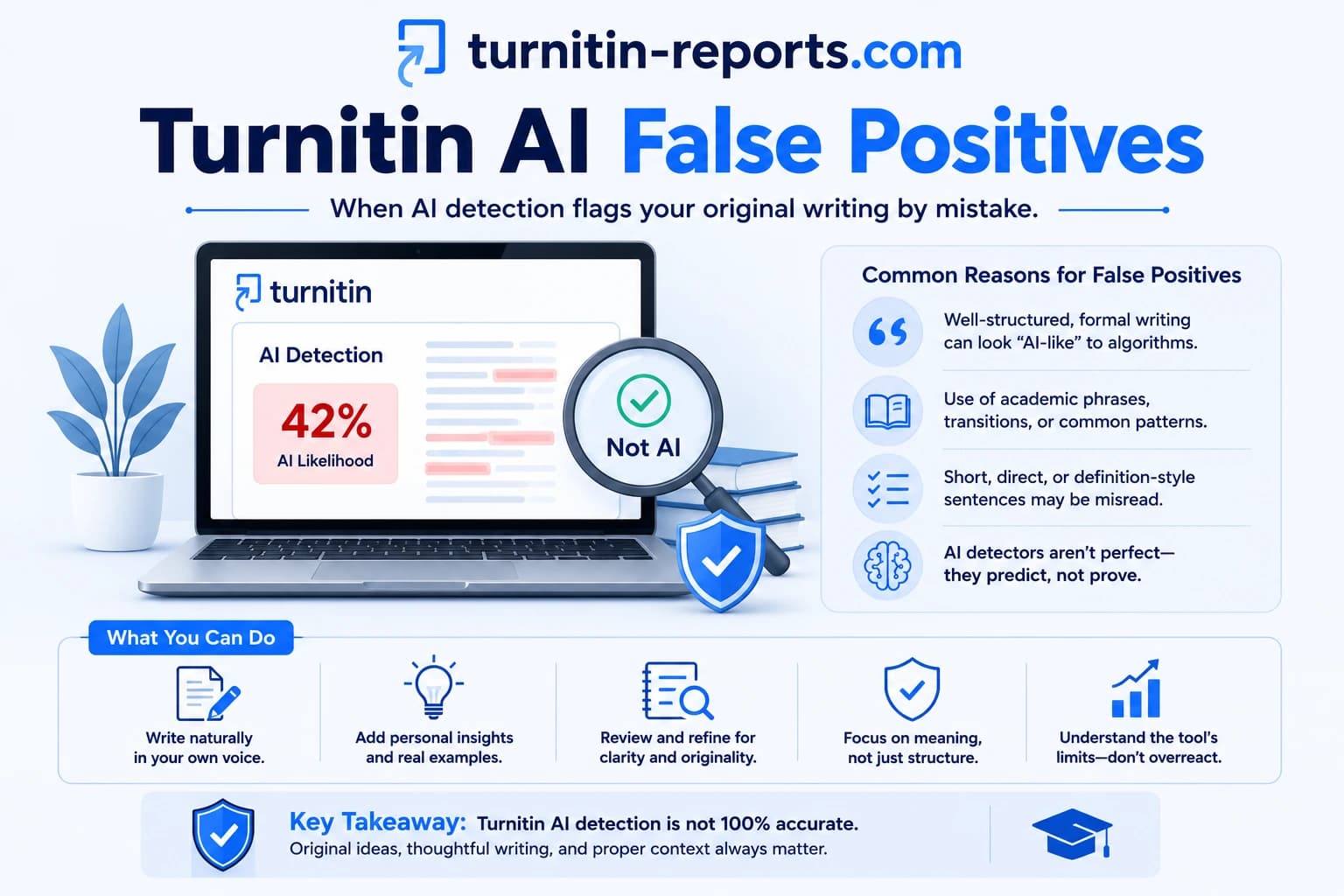
Turnitin's AI detector does not compare your text against a database of known AI output. It measures statistical patterns — specifically, how predictable your word choices are (perplexity) and how uniform your sentence lengths are (burstiness). AI-generated text scores low on both because language models optimise for fluent, predictable output. The problem is that certain human writing styles produce the same low perplexity and low burstiness:
- Non-native English writers tend to use simpler vocabulary and more rigid sentence structures — patterns that detectors read as machine-like. The Stanford HAI study found that seven major AI detectors misclassified non-native English essays as AI-generated at an average false positive rate of 61.3% — even essays written under timed exam conditions with no AI access.
- Students with very structured writing styles — clear topic sentences, consistent paragraph structure, formal transitions — can produce text that registers as low perplexity simply because good academic writing follows predictable patterns.
- Students who used grammar tools heavily — including standard Grammarly edits — can have their natural sentence variation flattened into a uniform style that detectors flag.
- Short submissions — under 300–500 words — are less stable for detection, with higher rates of both false positives and false negatives.
Turnitin's own blog post on false positives acknowledges the issue and explicitly states that the AI Writing Report “should not be used as the sole basis for adverse action against a student.” That statement matters — it is Turnitin telling institutions not to do exactly what many of them are doing.
What to do if you are flagged
The cases above show a pattern: students who won their appeals or lawsuits had documentation. Students who didn't, struggled.
- Gather your drafts immediately. Version history from Google Docs, Word AutoSave, or any cloud storage that shows the evolution of your document over time is the most compelling evidence available. It shows your writing process — something AI generation cannot replicate.
- Get a second opinion from another detector. GPTZero and Copyleaks are free to use. If your work scores 0% on both, that is additional evidence to present. Orion Newby submitted ZeroGPT and Grammarly reports alongside his appeal.
- Request the full Turnitin report. Ask your instructor or institution to share the complete AI Writing Report — not just the percentage. The highlighted passages give you specific sentences to address.
- Cite Turnitin's own policy. Turnitin has publicly stated the AI score should not be used as sole evidence of misconduct. Referencing this in your appeal shifts the burden back toward the institution to produce corroborating evidence.
- Know your rights. In the Newby case, the court found the university violated due process. If your institution proceeds to a formal hearing, you are entitled to present evidence and respond to the allegation.
Our post on Turnitin AI false positives covers which writing styles are most at risk and what the appeal process typically looks like in detail.
Frequently asked questions
Can Turnitin wrongly flag human-written work as AI?
Yes — and Turnitin acknowledges this. The AI Writing Report measures statistical patterns in text rather than matching against known AI output, which means well-structured, clean, or formulaic human writing can trigger the same flags as AI-generated content. Independent studies have found overall false positive rates between 4% and 8%, with rates exceeding 60% for non-native English speakers in some tests.
What happens if Turnitin flags your work as AI when you didn't use AI?
Your instructor or institution will typically initiate an academic integrity review. The outcome depends heavily on your institution's policies and what evidence you can provide. Students who have documented their writing process — drafts, notes, version history — have the strongest cases. Turnitin itself states the AI score should not be used as the sole basis for adverse action, so you have grounds to appeal if your institution treats it as definitive proof.
Have any students won cases against universities over Turnitin false positives?
Yes. In February 2026, Orion Newby became the first student to win a court ruling reversing an AI plagiarism finding, after a New York state Supreme Court judge found Adelphi University's use of Turnitin's 100% AI score as evidence was without valid basis. Additional cases involving students at Yale and the University of Minnesota remain in litigation.
Is there any writing style that is more likely to be falsely flagged?
Yes. Non-native English speakers face the highest false positive risk — Stanford research found detectors misclassify non-native English essays as AI-generated at an average rate of 61.3%. Students with very structured writing, those who use grammar tools heavily, and those submitting shorter pieces (under 300 words) are also at elevated risk. The detector cannot distinguish between “writes like a machine” and “was written by a machine.”
Ready to check your paper?
Get your Turnitin report in minutes.
Same report your institution generates — delivered privately, fast.