Understanding Your Turnitin Similarity Score: What Every Percentage Means
Your Turnitin similarity score just came back — but what does it actually mean? This guide explains every percentage range, the colour coding, and the critical difference between similarity and plagiarism.
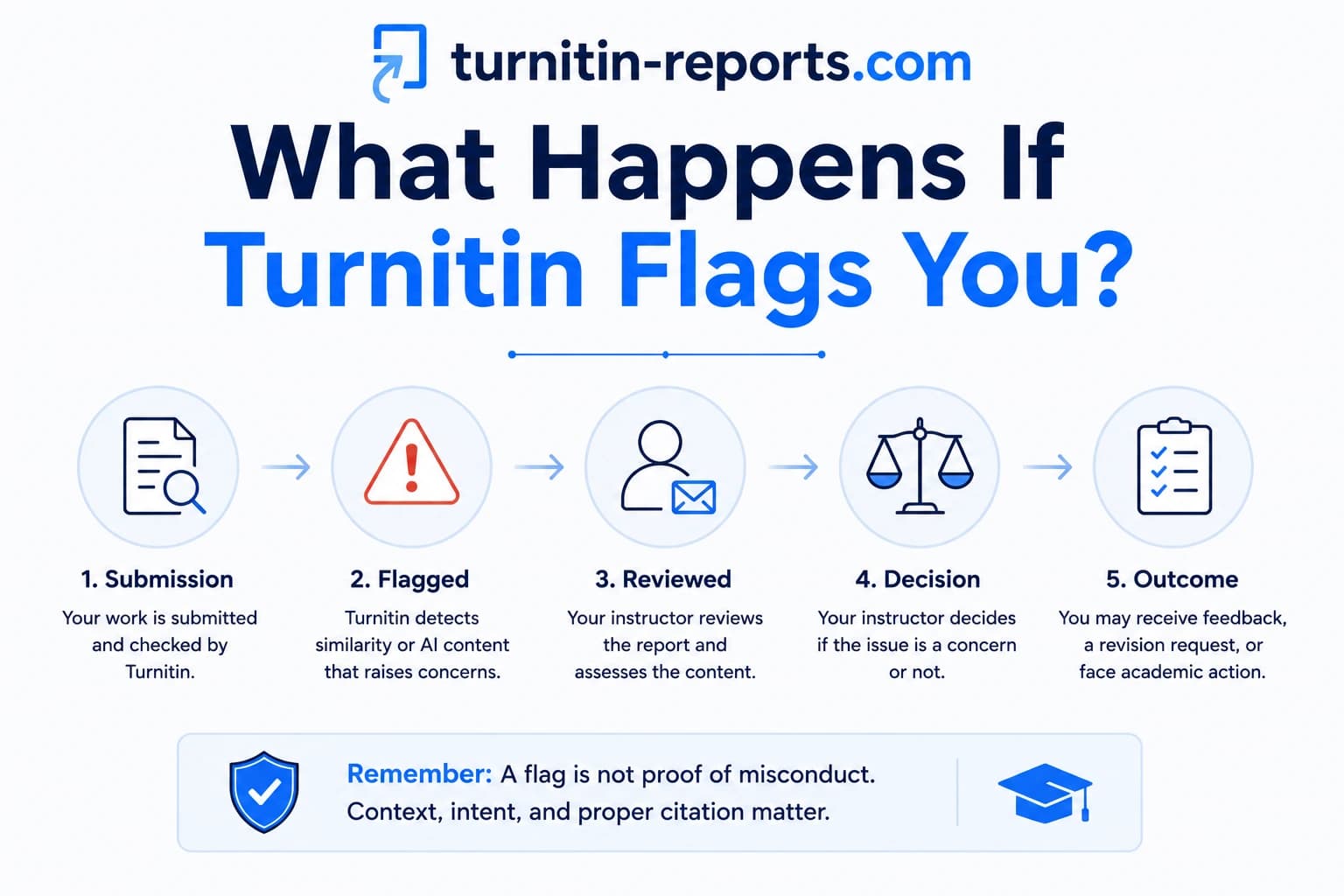
Your assignment is submitted. A few hours later, Turnitin returns a number — say, 28% — highlighted in yellow. Your stomach drops. Does that mean you plagiarised? Are you in trouble? Should you be panicking?
Probably not. But understanding what that number actually means — and what it doesn't — is one of the most useful things you can learn as a student. This guide breaks down exactly how the Turnitin similarity score works, what every percentage range means, and what you should do if yours comes back higher than expected.
What the similarity score actually measures
The Turnitin similarity score is a percentage representing how much of your submitted text matches content already in Turnitin's database. The calculation is straightforward: matching words divided by total words, multiplied by 100.
What makes the number significant is the scale of that database. Turnitin's comparison database contains:
- Over 45 billion indexed web pages — live and archived
- Over 1.9 billion student paper submissions from institutions worldwide
- More than 130 million academic articles from books and journals
- Content from 47,000+ publications, covering 91% of the top 10,000 most-cited academic journals
When Turnitin scans your document, it compares every sentence against all of this. Any text that matches — whether it's a direct quote from a journal, a sentence from a website, or a phrase that appears in another student's previously submitted paper — gets flagged and counted toward your similarity percentage.
Crucially, the score does not measure plagiarism. It measures textual overlap. Those are very different things, and the distinction matters enormously.
Similarity is not the same as plagiarism
This is the single most important thing to understand about your Turnitin report. Turnitin itself is explicit on this point: the software identifies matching text, but it cannot determine whether plagiarism has occurred. That judgement requires a human being.
Consider these examples of text that will show up as similarity matches but are entirely legitimate:
- A direct quotation from a journal article, correctly formatted with quotation marks and a citation
- Your bibliography — every student citing the same sources will match every other student who did the same
- A well-known definition or standard academic phrase used across the discipline
- A description of a standard experimental method in a science paper
- Text from your own previously submitted draft (if your institution stores submissions)
A paper with a 35% similarity score and every match traced back to properly cited sources is not plagiarism. A paper with a 6% score where that 6% is a lifted paragraph with the author's name removed is. The percentage alone tells you nothing about academic integrity — context is everything.
As Turnitin's official guidance states: “There is no fixed number to receive as a score. Every school, every department, and every assignment can have different expectations.”
What the colours in your report mean
The similarity percentage appears in a colour that gives you a quick visual read of the range:
- Blue (0%) — No matching text detected at all
- Green (1–24%) — Low similarity; generally considered acceptable
- Yellow (25–49%) — Moderate similarity; warrants a closer look
- Orange (50–74%) — High similarity; likely to be reviewed
- Red (75–100%) — Very high similarity; almost always triggers a formal review
These colours are a starting point, not a verdict. A yellow score with all matches traced to a properly formatted bibliography and a few direct quotes is far less concerning than a green score with a single concentrated match in the body of the essay.
What every score range means in practice
0–10% — Very low
Your document has minimal overlap with existing sources. This is typically what you see in heavily original analytical writing, creative work, or papers that paraphrase thoroughly and cite correctly. For most assignments at most institutions, this range raises no concerns whatsoever.
10–25% — Generally acceptable
This is the range most undergraduate papers land in when properly cited. Matches at this level are usually a mix of quoted material, bibliography entries, and common academic phrases. Most universities treat this as unremarkable. If your matches are scattered across citations and properly attributed sources, you are in a solid position.
25–50% — Needs closer inspection
This range gets more attention — but it doesn't automatically signal a problem. A literature review or a primary-source-heavy legal analysis might legitimately sit here. What matters is where the matches are coming from. If the similarity is concentrated in your bibliography and quoted material, applying Turnitin's built-in exclusion filters (more on this below) will typically bring the number down significantly. If the matches are clustered in the body of your essay and trace back to a single uncited source, that's a different conversation.
50%+ — High, requires action
A score above 50% will almost always trigger a manual review by your instructor. Even here, context matters — a paper heavily quoting primary legislation or reproducing extensive data tables may have a legitimate explanation. But if you're seeing a score in this range without a clear reason, it's worth going through your report carefully before your institution does.
Common reasons scores come back higher than expected
Students are often surprised by a high similarity score on work they wrote themselves. Here are the most common culprits:
- Bibliography not excluded. Reference lists are the single biggest driver of inflated scores. Every student citing the same papers will match every other student who did — applying Turnitin's bibliography filter removes this entirely.
- Direct quotes not filtered. If you've used extensive direct quotations, enabling the quotation marks exclusion filter shows you the similarity score for your own original writing, separate from quoted material.
- Thin paraphrasing. Swapping a few words in a sentence while keeping the same structure is still detectable as a match. True paraphrasing requires restructuring the idea, not just the vocabulary.
- Common academic phrasing. Phrases like “this study aims to examine” or “the results indicate that” appear in thousands of papers. These short matches add up.
- Self-matching. If you submitted an earlier draft through Turnitin or a similar platform, your revised version may match your own previous submission.
Using exclusion filters to see your real score
Before drawing conclusions from your similarity score, apply Turnitin's exclusion filters:
- Exclude quotes — removes all text in quotation marks from the similarity calculation
- Exclude bibliography — removes your reference list
- Exclude small matches — ignores matches below a word threshold you set (default is 8 words)
A paper with a raw score of 38% can easily drop to 14% after these filters are applied — revealing that the original score was driven almost entirely by proper citations, not problematic overlap. The filtered score is a much better reflection of how much of your own writing matches external sources.
How to lower your similarity score legitimately
If your score is higher than you'd like and the matches trace back to real issues rather than citations, here is how to address it:
- Paraphrase properly. Don't rearrange words — restructure ideas. Read the source, close it, then write what you understood in your own words. Always cite the original.
- Reduce direct quotes. Reserve quotations for language that is essential to cite verbatim — a famous formulation, a legal definition, a statistic. Everything else should be paraphrased.
- Add more of your own analysis. The more original thinking you contribute — your interpretation, critique, synthesis across sources — the lower your similarity percentage will be as a proportion of total words.
- Check your citation formatting. Properly formatted citations that Turnitin can recognise as references get filtered out. Inconsistent formatting can cause some citations to be counted as body text.
What you should never do: character substitution, hidden text, or image-based workarounds. Turnitin's current detection catches these, and attempting them converts a potential similarity concern into a confirmed academic integrity violation.
See your score before your institution does
The most effective way to manage your similarity score is to know what it is before your actual submission goes in. At AIPlagGuides, you can run your document through Turnitin's official platform — the same system your university uses — and receive your full similarity report privately, typically within minutes.
You get the exact same output your institution would see: the percentage, the colour indicator, every flagged passage, and the source it matched against. If the score is higher than you expected, you have time to review the report, apply the exclusion filters, identify any real issues, and revise before submission. A similarity report costs $1.50, or $2.70 bundled with an AI detection report.
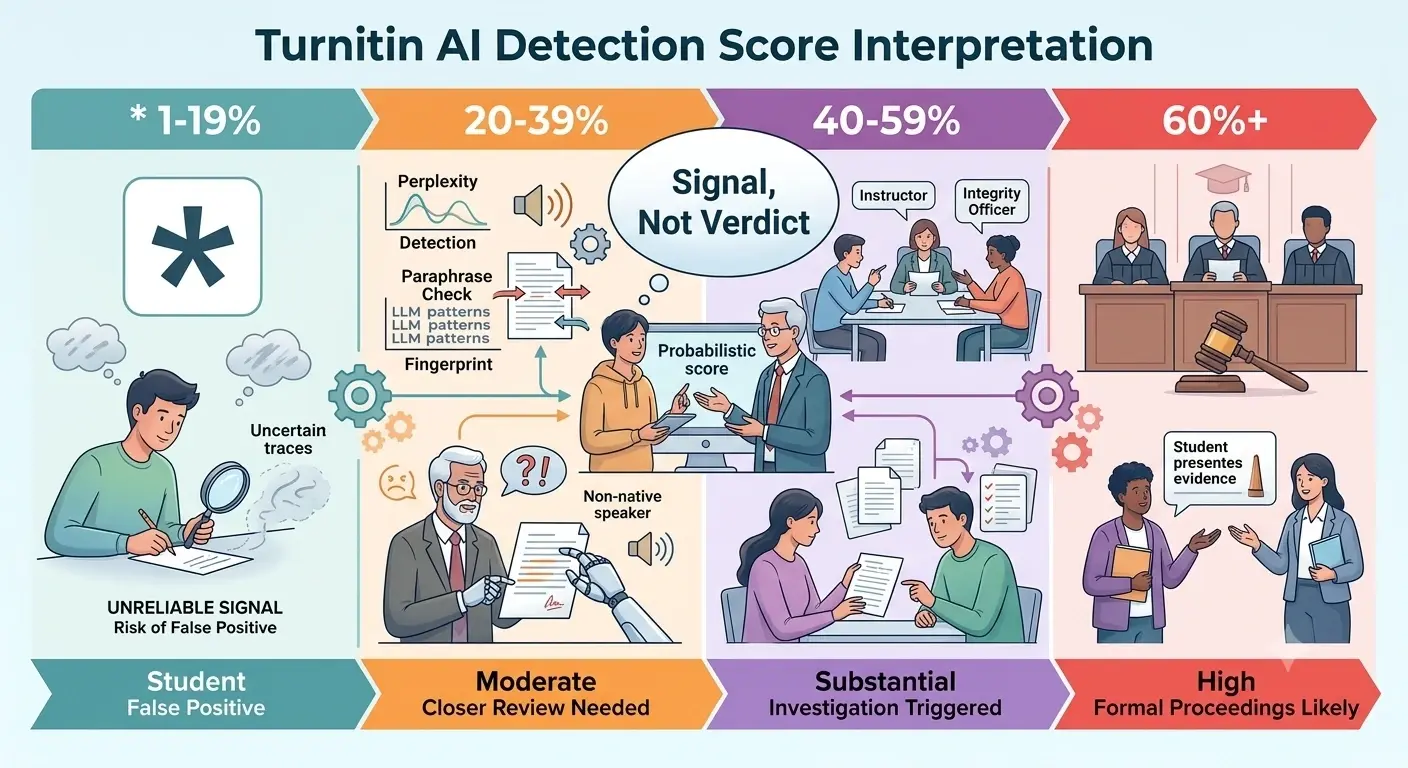
If your institution also checks for AI writing, you may want to read our guide on what the AI detection percentage means — the two reports work independently and measure very different things.
Frequently asked questions
What is a good Turnitin similarity score?
There is no universal answer. Most undergraduate institutions treat scores below 15–25% as unremarkable. Graduate-level work is often held to stricter standards — 10% or lower is common for theses and dissertations. The only definitive answer comes from your institution's own policy, which is worth checking before you submit.
Will a high similarity score automatically fail me?
No. A high score triggers a review — it does not determine the outcome. Your instructor will examine where the matches come from, whether sources are properly cited, and what your institution's policy says. Students with high scores from properly cited material regularly pass with no issue.
Does my bibliography count toward the score?
By default, yes — but it can be excluded using Turnitin's bibliography filter. Once excluded, reference list matches are removed from the percentage. Most instructors apply this filter when reviewing reports, so the number they act on is typically lower than the raw score you see.
Do properly cited quotes count as similarity?
Yes, by default. Turnitin flags all matching text regardless of whether it is quoted and cited. Applying the quotation marks exclusion filter removes properly formatted direct quotes from the calculation, giving you a cleaner picture of your original writing's similarity.
Can I submit the same paper twice?
If your institution stores student submissions in Turnitin's database (most do), submitting the same or very similar work to a second assignment will produce a high match against your own previous submission. This is sometimes called self-plagiarism. Check your institution's policy on reusing prior work before doing so.
Ready to check your paper?
Get your Turnitin report in minutes.
Same report your institution generates — delivered privately, fast.