What Happens If Turnitin Flags You? The Full Process Explained
A high Turnitin similarity score is not an accusation — it's the start of a human review. Here's exactly what happens after a score comes back high, what your institution can and can't do, and what to do if you're flagged.
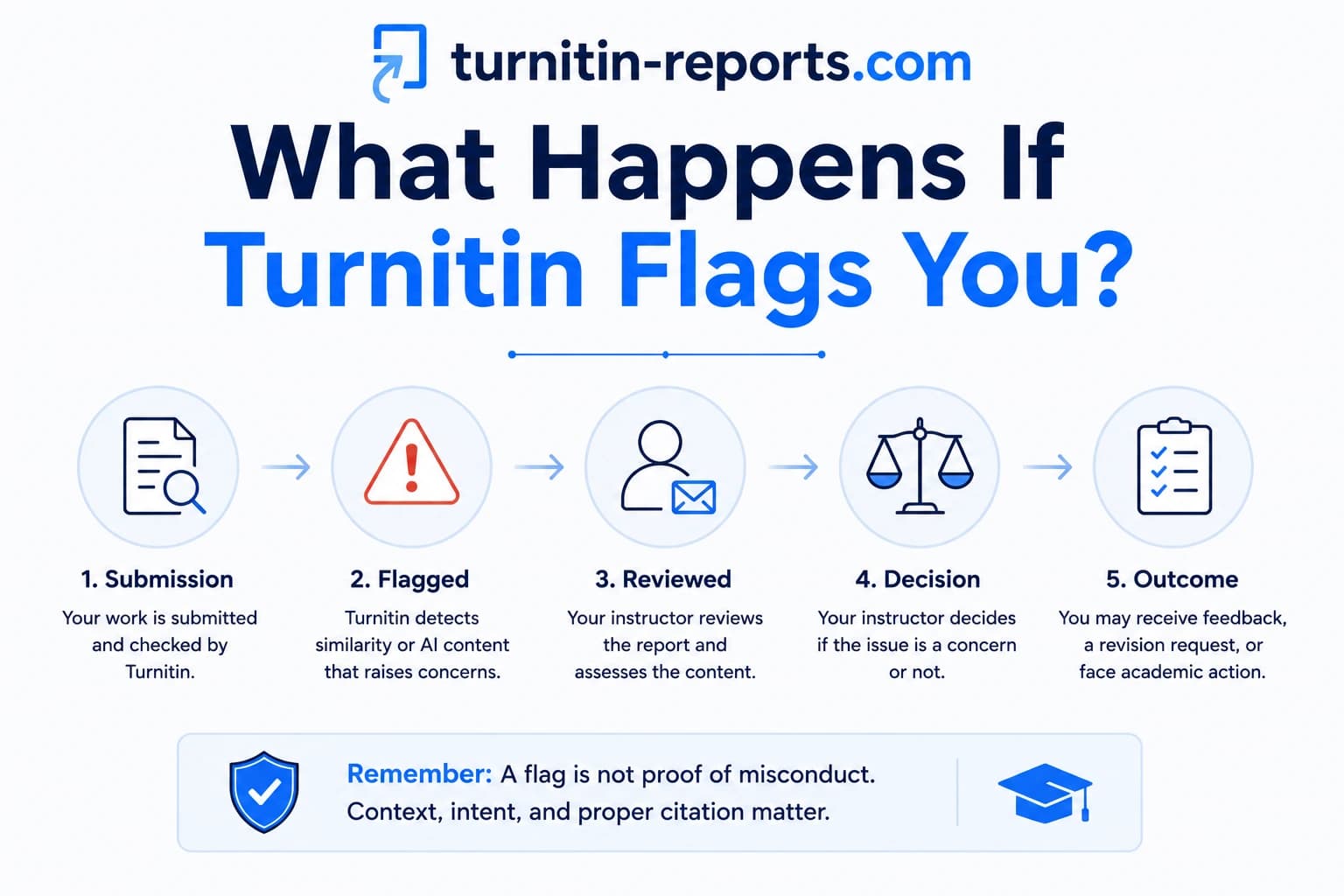
Your Turnitin report came back with a high similarity score and now you're not sure what happens next. The most important thing to understand first: Turnitin does not flag you for plagiarism. It flags similarity. The two are not the same thing, and the difference matters enormously for what actually happens after a high score comes back.
Turnitin flags similarity — not plagiarism
Turnitin's Similarity Report identifies text in your paper that matches text in its database — web pages, academic journals, and over 1.6 billion previously submitted student papers. It calculates what percentage of your submission overlaps with those sources and highlights the matching passages. That is all it does.
Plagiarism is defined as presenting someone else's work or ideas as your own without proper attribution. That is an academic judgement — a determination made by a human being after reviewing context, intent, and the nature of the matching text. Turnitin produces a score. It does not make that judgement. A 40% similarity score could mean your bibliography wasn't excluded, that you quoted sources heavily, or that your paper uses standard terminology common in your field. It could also indicate a genuine problem. The score alone tells nobody which it is.
This distinction matters practically: no institution can issue a penalty based on a Turnitin score alone. The score is where a conversation may begin. It is not where it ends. If you want to understand exactly what every score range means before any of this happens, our guide to understanding your Turnitin similarity score explains each percentage band in detail.
What your instructor does with a high score
When an instructor sees a high similarity score, their first step is to open the full report and examine it manually. They look at which passages are flagged, which sources they match, and whether the matches make sense in context. Specifically, they consider:
- Whether flagged text is properly cited. Quoted material with attribution is expected to match sources. This is not plagiarism — it is correct academic practice.
- Whether the bibliography is inflating the score. Reference lists generate high matches if the bibliography exclusion filter was not applied. An instructor can re-run the report with this filter to see what the body-of-work score actually is.
- Whether common phrases are driving the number. Standard academic terminology, widely-used definitions, and field-specific language appear across many papers and generate matches that have no integrity implications.
- Whether the writing in non-flagged sections is consistent. A sudden shift in writing quality or style between flagged and unflagged sections is a stronger signal of a problem than the score itself. Instructors who know a student's writing from seminars or earlier work can often identify inconsistencies that no algorithm would catch.
- Whether the matches are from a single source or scattered across many. A large block of text matching one specific source looks very different from scattered short matches across dozens of sources. The former raises more concern.
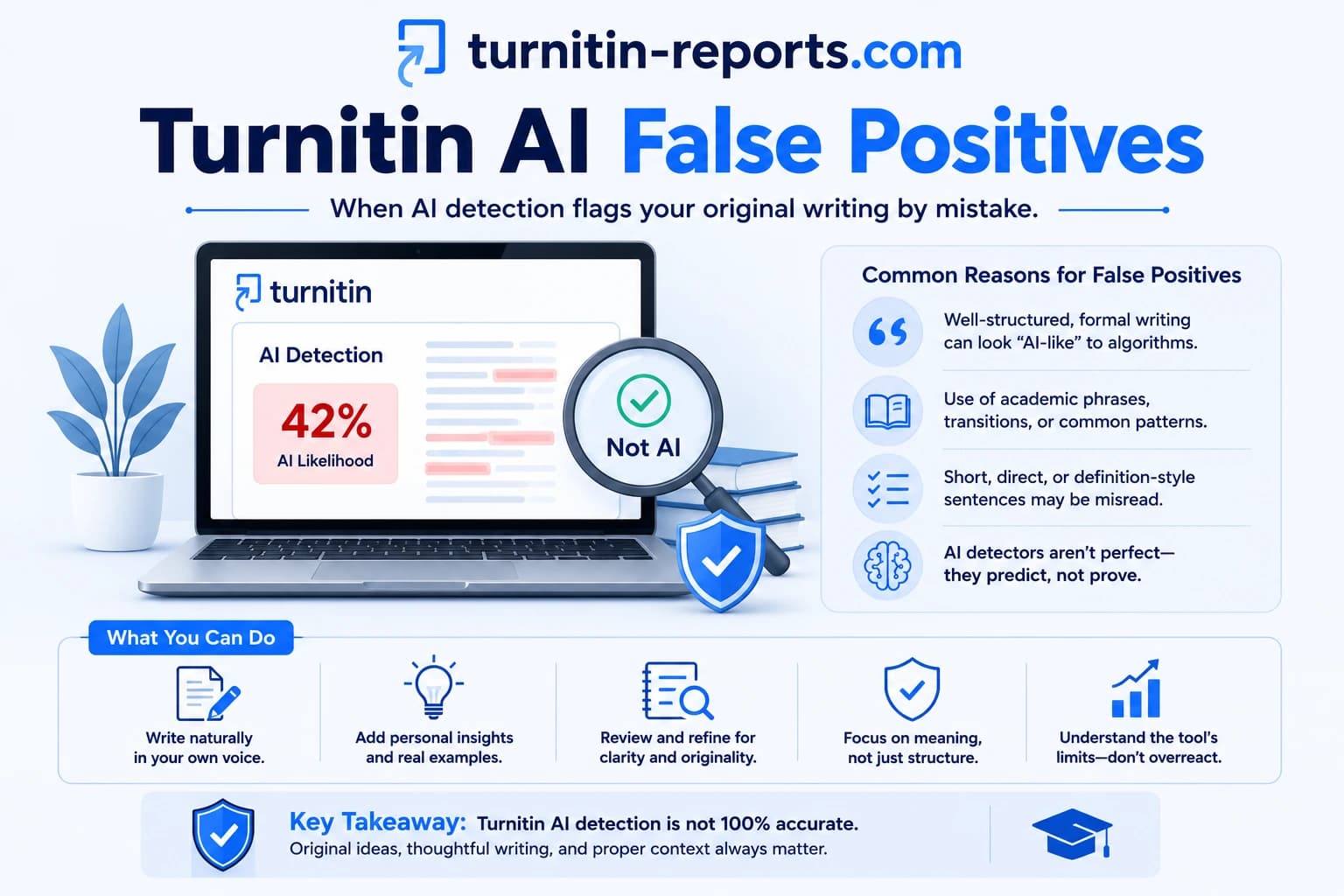
Most experienced instructors deal with high similarity scores regularly and understand that many are entirely benign. A score alone rarely triggers a formal process without further investigation. The same logic applies to AI detection — a high AI score is not an automatic finding, and false positives are a documented problem. Our post on Turnitin AI false positives explains the causes in detail.
The academic misconduct process
If an instructor believes there is a genuine problem after reviewing the report, the process typically follows these stages — though the specifics vary by institution. Universities like UC San Diego and Stanford publish their full processes publicly, and most follow a similar structure:
- Initial conversation with the instructor. Most instructors will speak with you directly before escalating anything formally. This is your opportunity to explain context — where you sourced material, how you cited it, whether a grammar tool may have altered your phrasing, or whether your bibliography was not excluded from the scan. This conversation is important. Do not skip it or avoid it.
- Referral to the academic integrity office. If the instructor decides the concern warrants escalation, the case is referred to your institution's academic integrity office or student conduct office. You will typically receive written notice at this stage. This formally begins the institutional process.
- Investigation and evidence gathering. The academic integrity office reviews the submission, the Turnitin report, any prior work, and any evidence you provide. You will usually be invited to respond in writing and to submit supporting materials — drafts, research notes, browser history, version history from Google Docs or your word processor.
- Hearing or review panel. Most institutions give students the right to present their case before a decision is made. This may be a formal hearing with a panel or a written review process. You can typically bring supporting documentation and, at some institutions, an advisor or student advocate.
- Decision and outcome. The committee or officer determines whether a violation occurred and, if so, what the consequence is. You will receive written notification of the finding.
- Appeals. If you disagree with the outcome, most institutions allow a formal appeal — typically within 10 to 30 days of the decision. Appeals can challenge procedural errors in how the case was handled, introduce new evidence that was not previously available, or argue that the penalty was disproportionate to the violation.
What the consequences look like
Consequences vary significantly depending on the severity of the violation, whether it is a first offence, and your institution's specific policies. Most institutions operate on a graduated scale:
- Minor or first offence: A zero on the assignment, a requirement to resubmit revised work, a formal educational warning, or mandatory academic integrity training. At many universities, a first minor offence results in no permanent record notation.
- Moderate violation: A failing grade for the entire course, a formal notation on your internal student record, or both. Some institutions distinguish between unintentional violations (poor citation practice, accidental over-quoting) and intentional ones.
- Serious or repeat violation: Suspension, an academic misconduct notation on your official transcript, or expulsion. In professional programmes — medicine, law, education — a misconduct finding can also affect licensing, registration, or professional body membership.
Intent matters significantly. There is a meaningful difference between accidentally over-quoting without proper citation formatting and deliberately submitting purchased work. Committees consider the nature of the violation, the evidence of intent, and the student's prior record. It is also worth noting that reusing your own previous work without disclosure — known as self-plagiarism or double submission — is treated as a separate category of misconduct at most institutions. Our guide on whether Turnitin can detect self-plagiarism covers that scenario in full.
What to do if you are flagged
If your score comes back high or you receive a notification about a potential integrity concern, here is what to do:
- Get the full report. Ask your instructor to share the complete Similarity Report so you can see exactly which passages are flagged and what they matched against. You cannot respond effectively to an allegation if you only know the score — you need to know the specific sources and passages.
- Gather your writing evidence immediately. Collect earlier drafts, research notes, browser history, Google Docs version history, and any other documentation that shows your writing process. Version history in particular is difficult to fabricate and is often persuasive to an instructor or panel. Do this before any formal meeting takes place.
- Respond calmly and promptly. Ignoring an initial query from your instructor or delaying a response to a formal notice makes the process harder and can itself be viewed negatively. Engage early, be honest, and ask questions about what the process will look like.
- Read your institution's academic integrity policy. Know your rights before any meeting. Most policies are published on your university's website and outline exactly what the process involves, what evidence you can submit, and what you are entitled to at each stage. Institutions like Columbia University publish detailed student guidance on what the process looks like from the student's perspective.
- Consider seeking support. Many universities have a student ombudsman, student advocate, or academic advice service that can help you understand the process and prepare your response without taking sides. Using these services is not an admission of guilt.
The best way to avoid this entirely
The simplest way to avoid a high-score situation is to check your paper through Turnitin before you submit. Seeing your similarity score before your instructor does gives you time to apply exclusion filters, identify genuinely uncited passages, and make corrections while you still have the opportunity. A score that surprises you after submission is a problem you have to manage reactively. The same score before submission is just feedback you can act on.
If your institution's assignment portal allows draft submissions with resubmission enabled, use them. If not, and you want to know what Turnitin will show before your deadline, our guide on how to get a Turnitin report online explains your options.
Frequently asked questions
Does a high Turnitin score automatically mean I'm accused of plagiarism?
No. A high similarity score triggers a review by your instructor, not an automatic accusation. Many high scores have entirely legitimate explanations — cited quotes, a long bibliography, or common academic phrasing. Plagiarism is a finding made by a person after reviewing the full report in context, not a determination made by the software.
What score is high enough to cause a problem?
There is no universal threshold. Different institutions and different instructors treat scores differently. Some review anything above 20%; others only escalate above 40% or higher. The content of the flagged sections matters more than the number itself — a 30% score driven entirely by bibliography and cited quotes is very different from a 15% score with one uncited block of body text.
Can I be expelled for a first offence?
Expulsion for a first offence is rare and is typically reserved for the most serious cases — such as submitting entirely purchased work, fabricating data, or impersonating another student. Most first offences result in a grade penalty or a formal warning. Repeat violations carry progressively more serious consequences at virtually every institution.
What if my score is high because of my reference list?
This is one of the most common causes of inflated scores. Ask your instructor to apply the bibliography exclusion filter and regenerate the report. In many cases the underlying body-of-work score is substantially lower once the reference list is excluded. Raise this immediately if you believe it is the cause — it is a straightforward technical point that most instructors will check without hesitation.
Ready to check your paper?
Get your Turnitin report in minutes.
Same report your institution generates — delivered privately, fast.