What Does Turnitin Check? A Complete Guide to Its Database
Turnitin checks against 1.9 billion student papers, 54 billion web pages, and tens of millions of academic articles. But it also misses a lot. Here's exactly what it checks, what it skips, and what a 0% score actually means.
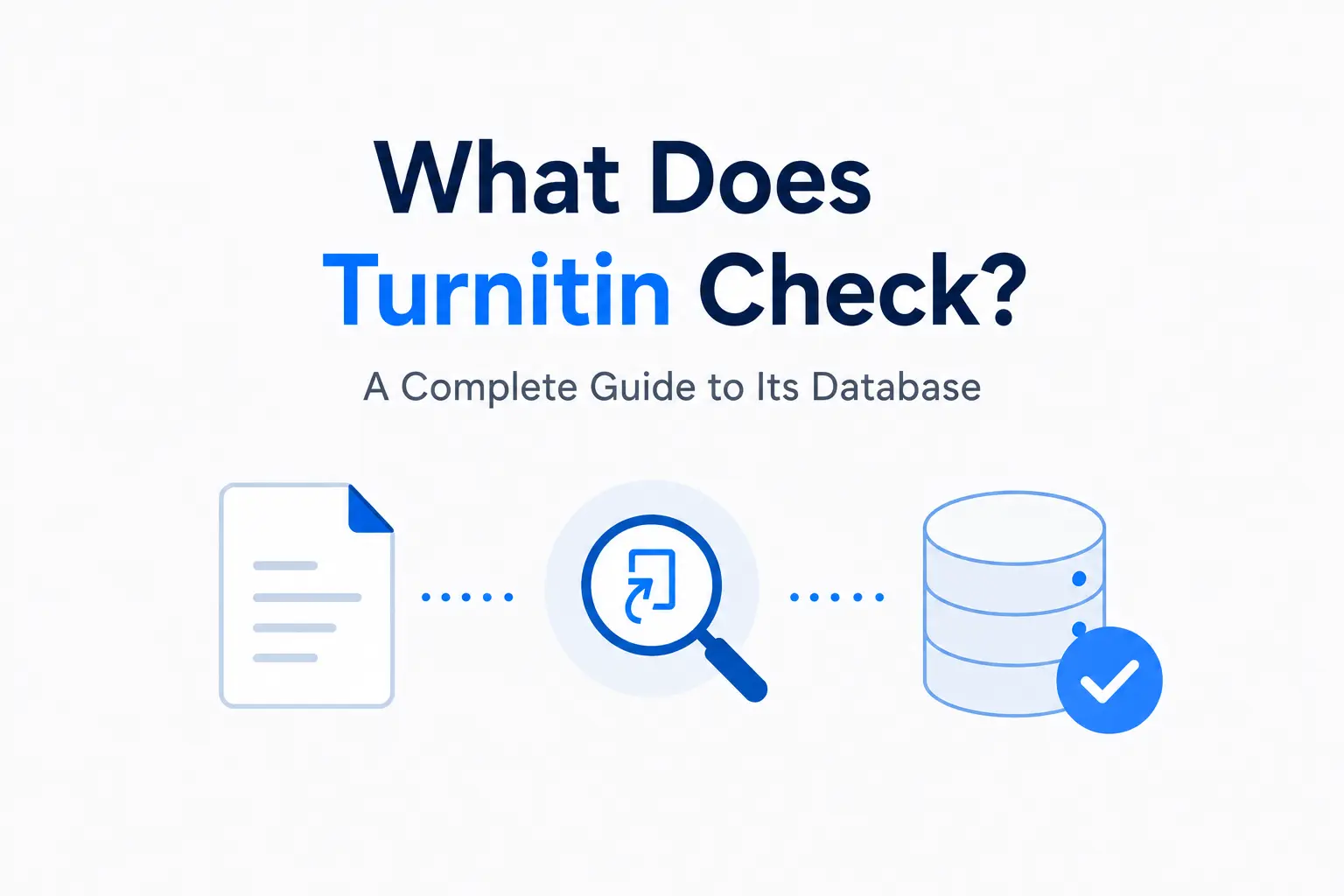
Most students know Turnitin checks for plagiarism — but far fewer know exactly what it checks against, what it misses, and what instructors can choose to exclude. Understanding the database gives you a clearer picture of what your similarity score actually means and why a 0% score does not always mean what you think it does.
The three main databases
Turnitin runs every submission simultaneously against three separate content sources:
- Student paper repository. Over 1.9 billion previously submitted student papers from institutions worldwide. This is Turnitin's most powerful detection source — it means a paper submitted at one university can be matched against work submitted at any other Turnitin-connected institution anywhere in the world, going back decades. Whether your own submission gets added to this repository depends on how your instructor has configured the assignment.
- Internet content. Over 54 billion current and archived web pages, including Wikipedia, news sites, blogs, and any publicly accessible content indexed by Turnitin's web crawl. Wikipedia is fully indexed. Major news publications are indexed. Public blogs are indexed. Social media posts (Twitter, TikTok, Instagram) are generally not directly indexed, but if the same content has been republished elsewhere on the web, that copy will be detected.
- Academic publications. Licensed content from thousands of academic publishers including Elsevier, Springer Nature, Wiley, Taylor & Francis, and IEEE, covering tens of millions of full-text journal articles. Turnitin also partners with CORE, which contributes over 135 million open access research records. This includes content behind paywalls — publishers grant Turnitin read-only access to full article text specifically for comparison purposes. Our post on how Turnitin checks against published papers covers this database in detail.
What Turnitin checks in your submission
Within your submitted document, Turnitin processes:
- Body text — all written prose in the main document
- Footnotes and endnotes — included in similarity checking for PDF submissions
- Text within tables — editable, highlightable text inside tables is processed
- Reference lists and bibliographies — included by default, though instructors can apply an exclusion filter to remove them from the score
- Headers and footers — may be included depending on file format and how text is extracted
What Turnitin does not check
Several types of content are outside what Turnitin can process:
- Images embedded as images. Charts, graphs, diagrams, and photographs embedded as image files are not analysed. Turnitin processes text, not image content. An image of a passage of text is invisible to the similarity engine.
- Mathematical equations. Complex equations rendered as images or standard notation are generally not matched. Only equations written as plain text would be processed.
- Scanned PDFs. If your PDF is a scan — an image of a page rather than a document with selectable text — Turnitin either rejects it or produces a 0% score that reflects nothing about your actual content. Our guide on whether Turnitin checks PDF files explains exactly how to test whether your PDF is text-based or image-based.
- Handwritten work. Turnitin cannot process handwriting. Only typed, selectable text is analysed.
- Print-only books. Only digitised, electronically available sources are in the database. Books that exist only as physical print editions or as image scans with no electronic text are not covered.
- Private or restricted content. Anything behind a login, a firewall, or a private course system that Turnitin's crawler cannot access is not in the database.
- Social media posts. Twitter, TikTok, Instagram, and similar platforms are not directly indexed. If the same content appears on an indexed public webpage, that version may be detected — but the original social media post itself will not be.
What instructors can exclude
Several elements of your submission can be excluded from the similarity calculation through filters that instructors control. These do not change what Turnitin detects — they change what gets counted in the reported score:
- Bibliography exclusion. Removes your reference list from the similarity calculation. For papers with many citations, this can reduce the reported score by 5–15 percentage points. Turnitin automatically identifies reference lists in English-language submissions using machine learning.
- Quote exclusion. Removes passages in quotation marks from the score, allowing the instructor to see your original writing score without properly cited direct quotes inflating the number.
- Small match exclusion. Removes matches below a configurable word threshold, filtering out common academic phrases and boilerplate sentences that appear across many papers.
Students can toggle these filters in their own report view to understand what is driving their score. However, only the instructor can apply them permanently to the official report. Our guide on understanding your Turnitin similarity score explains how to use these filters to interpret your result accurately.
Does Turnitin check other languages?
Yes — Turnitin's similarity checking supports 176 languages. The web database includes billions of non-English pages: over 3.7 billion in Simplified Chinese, 2.7 billion in Spanish, 2.7 billion in German, and content across dozens of other languages. Turnitin's database content page confirms the multilingual scope of its web index.
Turnitin also offers a Translated Matching feature, which compares non-English submissions against the English-language database — detecting content that has been translated from English into another language to avoid detection. AI detection, however, is limited to three languages: English, Spanish, and Japanese. Our post on Turnitin AI detection language support covers what this means for international students.
What a 0% score actually means
A 0% similarity score means Turnitin found no text matches in its database — it does not mean your paper contains no borrowed ideas or unattributed content. Several legitimate sources of plagiarism fall outside what Turnitin can detect:
- Sources that are not digitised or not in Turnitin's database
- Publishers not part of Turnitin's licensing agreements
- Very recently published content not yet indexed
- Ideas paraphrased so thoroughly that no textual overlap remains — Turnitin detects text patterns, not ideas
Turnitin is a powerful detection tool, but it has coverage limits. As its own scope makes clear, the database is large but not exhaustive. Academic integrity means citing your sources regardless of whether Turnitin can detect them.
Frequently asked questions
Does Turnitin check Wikipedia?
Yes. Wikipedia is a publicly accessible web page and is fully indexed by Turnitin's web crawler. Any text copied from a Wikipedia article will be detected if it matches the indexed version. Wikipedia also uses Turnitin's iThenticate tool internally to check content submitted to its own platform.
Does Turnitin check your reference list?
Yes, by default. Your bibliography and reference list are included in the similarity calculation unless an instructor applies the bibliography exclusion filter. This is a common reason for inflated similarity scores — a long reference list matching publication database entries can add several percentage points. Toggle the exclusion filter in your report view to see your body-of-work score without the reference list.
Can Turnitin detect content from books?
Yes, for books that have been digitised and are part of Turnitin's licensed content. Major academic publishers contribute book content through licensing agreements. Print-only editions that have never been digitised are not in the database. The coverage is strongest for academic books and textbooks from major publishers, and weaker for older or niche publications.
Does Turnitin check social media posts?
Not directly. Social media platforms like Twitter, TikTok, and Instagram are not indexed by Turnitin. However, if the same content from a social media post has been republished on a public blog, news site, or web page that Turnitin does index, that republished version can be detected. The social media post itself will not appear as a source in the Similarity Report.
Ready to check your paper?
Get your Turnitin report in minutes.
Same report your institution generates — delivered privately, fast.