Can Your Professor Report You Based on a Turnitin AI Score Alone?
Turnitin itself says its AI score should not be the sole basis for adverse action against a student. Here's what that means for your rights, what proper due process looks like, and how to fight back if your professor treats the number as a verdict.
One of the most anxious questions students post on Reddit after getting a high Turnitin AI score is: “Can my professor actually report me based on this number alone?” The answer — backed by Turnitin's own published guidance, court rulings, and university policies — is that a score alone should never be sufficient. But what “should” happen and what actually happens are not always the same thing. Here is what the rules say, what your rights are, and how to respond if a professor treats the score as a verdict.
What Turnitin itself says
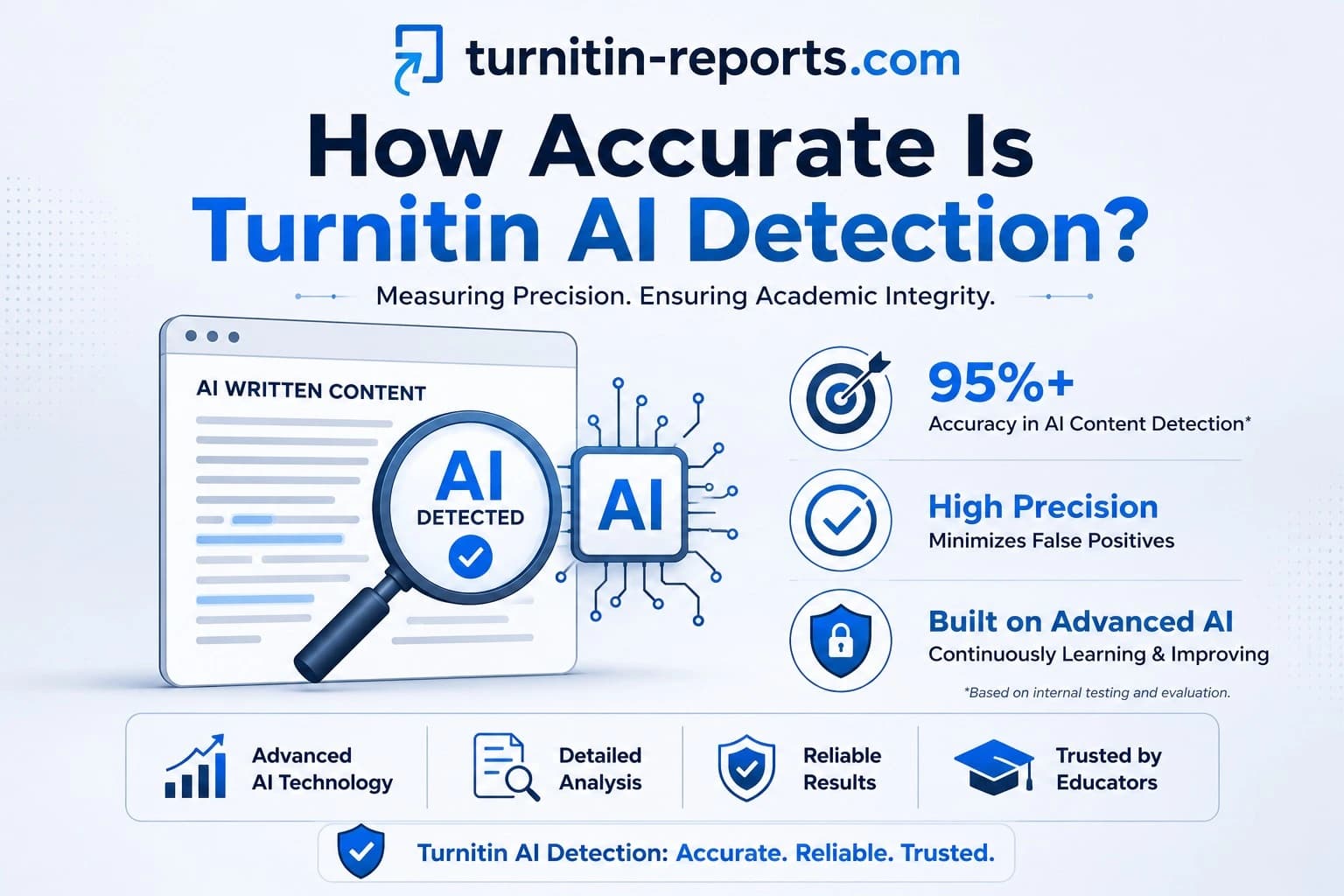
Turnitin has been unambiguous in its own documentation: the AI Writing Report guide states that the tool “should not be used as the sole basis for adverse action against a student.” The company explicitly instructs educators to treat the AI score as a starting point for conversation — not as evidence of misconduct. Turnitin further states that the detector “may not always be accurate” and that it “takes further scrutiny and human judgment” before any conclusion about academic misconduct can be reached.
This is not buried in fine print. It is in the primary documentation that institutions access when they activate the AI Writing Report. When a professor uses the score as the sole basis for a report, they are acting contrary to the guidance of the tool they are relying on.
The standard of proof in academic misconduct cases
Academic misconduct findings in most institutions operate on a “balance of probabilities” standard — meaning the institution must show it is more likely than not that misconduct occurred. A Turnitin AI score does not meet this standard on its own for two reasons:
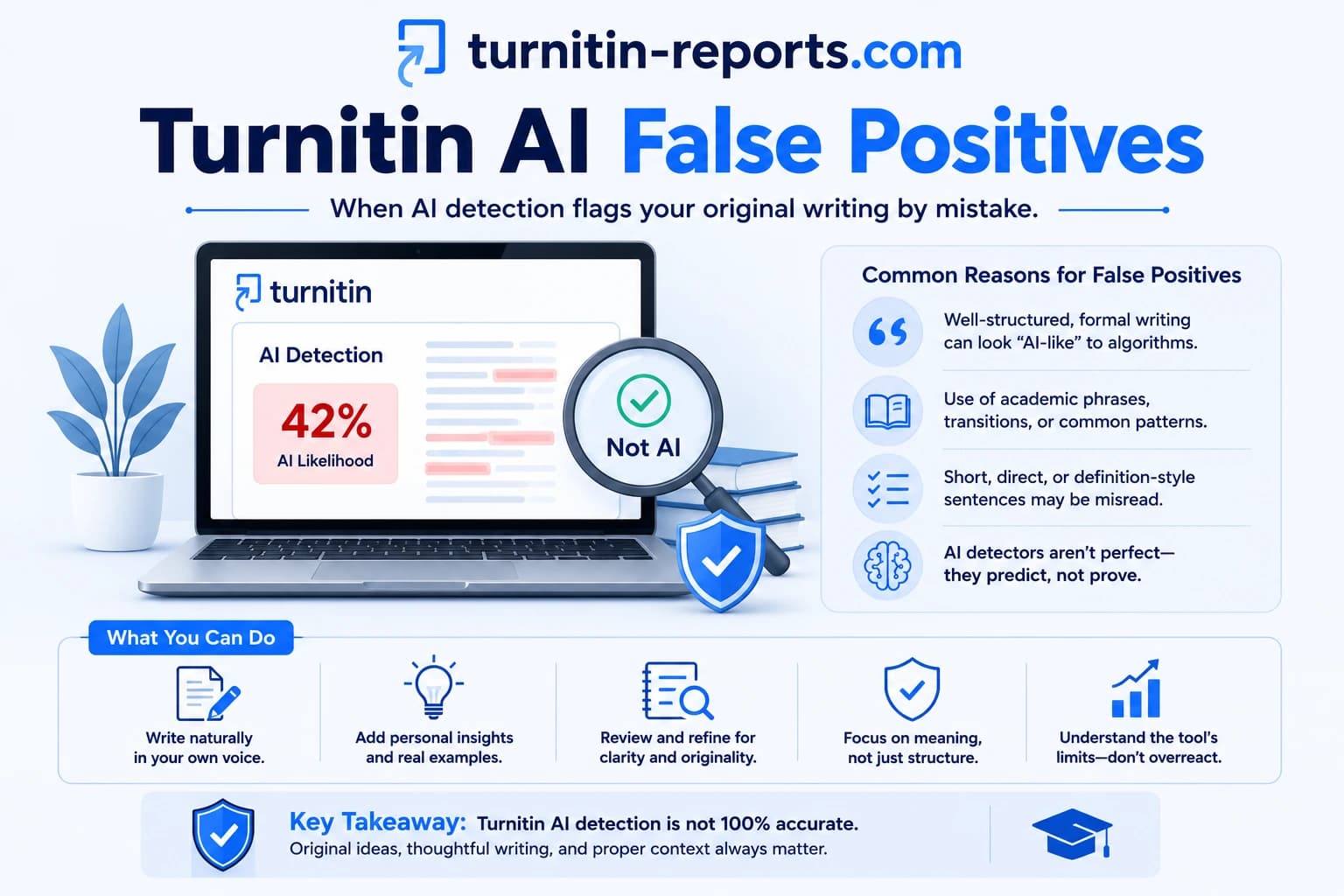
- The detector has a known false positive rate. Turnitin's own data show a 4% sentence-level false positive rate, with independent studies measuring overall false positive rates between 4% and 8% — and exceeding 60% for non-native English speakers. A tool that wrongly flags human writing at that rate cannot serve as sole evidence of misconduct.
- The score reflects statistical patterns, not intent or authorship. A high AI score tells you the text has certain statistical properties. It does not tell you who wrote it, under what conditions, or whether any AI was involved. Without corroborating evidence — suspicious citations, sudden change in writing quality, drafts that cannot be produced — the score is inconclusive.
A review of documented Turnitin false positives notes that once a detector score appears, the burden often shifts in practice — students are pushed to prove they did not use AI, rather than the institution being required to prove they did. This burden reversal is itself a procedural problem that students can challenge.
What universities are actually doing
Institutions that have examined the issue carefully have moved away from treating AI scores as actionable evidence:
- Johns Hopkins University moved to an “advisory only” policy for AI detection in early 2025. Professors can run work through detectors, but results can only be used to initiate a conversation — not to file a formal charge.
- Vanderbilt University paused institution-wide AI detection after its Technology Advisory Committee found “significant accuracy limitations that create unacceptable risk of false accusations.”
- The University of Sydney has explicitly stated that a Turnitin AI score “would not be the only evidence relied upon in an academic integrity case.”
These are not fringe positions — they reflect a growing institutional consensus that AI detection scores require corroboration. Our post on why universities are disabling Turnitin AI detection covers the full picture of how institutions are responding.
What corroborating evidence looks like
For a misconduct finding to be defensible, most academic integrity officers will look for corroborating evidence beyond the AI score. This can include:
- A sudden and unexplained improvement in writing quality compared to previous submissions
- Inconsistencies between the submitted work and the student's demonstrated knowledge in class discussions or oral assessment
- Inability to produce any drafts, notes, or evidence of a writing process
- Suspicious metadata — a document created and completed in minutes, or with no revision history
- Text that references events, sources, or facts inconsistently with the student's course knowledge
A high AI score combined with none of these additional indicators is a weak misconduct case. A professor who reports a student on the AI score alone, without seeking any of this corroborating evidence, is on procedurally shaky ground — as the Orion Newby case at Adelphi University demonstrated when a court ruled the university's finding was “without valid basis and devoid of reason.”
Your rights if you are reported
If your professor has referred your case to an academic integrity office on the basis of a Turnitin AI score, you have specific rights at every stage:
- The right to see the evidence against you. You are entitled to know what evidence the institution is relying on — including the full AI Writing Report, not just the percentage. Request the complete report with highlighted passages.
- The right to respond before any finding is made. Most institutional policies require that a student be given the opportunity to respond to the allegation before a formal finding. If this step was skipped, that is a procedural violation.
- The right to present counter-evidence. Bring your drafts, your version history from Google Docs or Word, your research notes, your browser history. Run your work through GPTZero or Copyleaks and bring those results. This is what saved Orion Newby — he brought independent AI assessments that contradicted Turnitin's score.
- The right to appeal. Every institution with a formal academic integrity process has an appeals pathway. Appeals committees tend to apply higher scrutiny to AI detection evidence than individual professors do, particularly as awareness of false positives grows.
Legal guidance published by education law firm Nesenoff & Miltenberg notes that if a school relied solely on an AI detection report or treated it as conclusive evidence of misconduct, that lack of fairness can justify a formal appeal or even a legal challenge. The Newby case established judicial precedent that courts can and will intervene when universities act on AI detection scores without adequate due process.
For a detailed breakdown of which writing styles get flagged and how to document your defence, our post on Turnitin AI false positives covers the full process.
Frequently asked questions
Can a professor give you a zero just because of a high Turnitin AI score?
Technically a professor can assign a zero, but doing so based solely on a Turnitin AI score contradicts Turnitin's own guidance and most institutional academic integrity policies. If you believe you received a zero without adequate evidence or due process, you have the right to appeal. Bring drafts, version history, and any independent AI detector results that support your case.
Does Turnitin report students to professors automatically?
No. Turnitin provides the AI Writing Report to whoever has instructor access to the assignment — typically the professor or teaching assistant. The report does not automatically trigger a referral to an academic integrity office. It is the professor who decides whether to act on the score and whether to report the student. Turnitin is a tool; the decision to report is entirely human.
What is the strongest evidence to use when contesting a Turnitin AI accusation?
Version history showing your document evolving over time is the most compelling evidence — it shows a writing process that AI generation cannot replicate. Combine this with research notes, outline drafts, and independent AI detector results from GPTZero or Copyleaks. The Orion Newby case showed that submitting independent assessments that contradict Turnitin's score can be decisive.
What if my professor refuses to hear my appeal?
If your professor has escalated the case to an academic integrity office, the appeal process moves to that level — not back to the professor. If the institution itself refuses to follow its own due process, you may have grounds for a formal complaint or, in severe cases, legal action. Courts have shown willingness to intervene when universities impose sanctions without adequate evidence, as the Newby ruling demonstrated.
Ready to check your paper?
Get your Turnitin report in minutes.
Same report your institution generates — delivered privately, fast.