Does a Turnitin Flag Go on Your Permanent Record?
A Turnitin flag and a permanent record entry are two completely different things — and most students never face the second. Here is exactly how the two-tiered record system works, who can see what, when a finding actually reaches your transcript, and what your rights are under FERPA, GDPR, and the Australian Privacy Act.
When a Turnitin report comes back with a high similarity score or an elevated AI writing percentage, the first question many students ask is not “what do I do next” but “is this going on my permanent record?” The short answer is: the score itself never does. What can affect your record is the institutional decision that follows — and the path from a Turnitin flag to a lasting record entry is longer, slower, and far less automatic than most students assume.
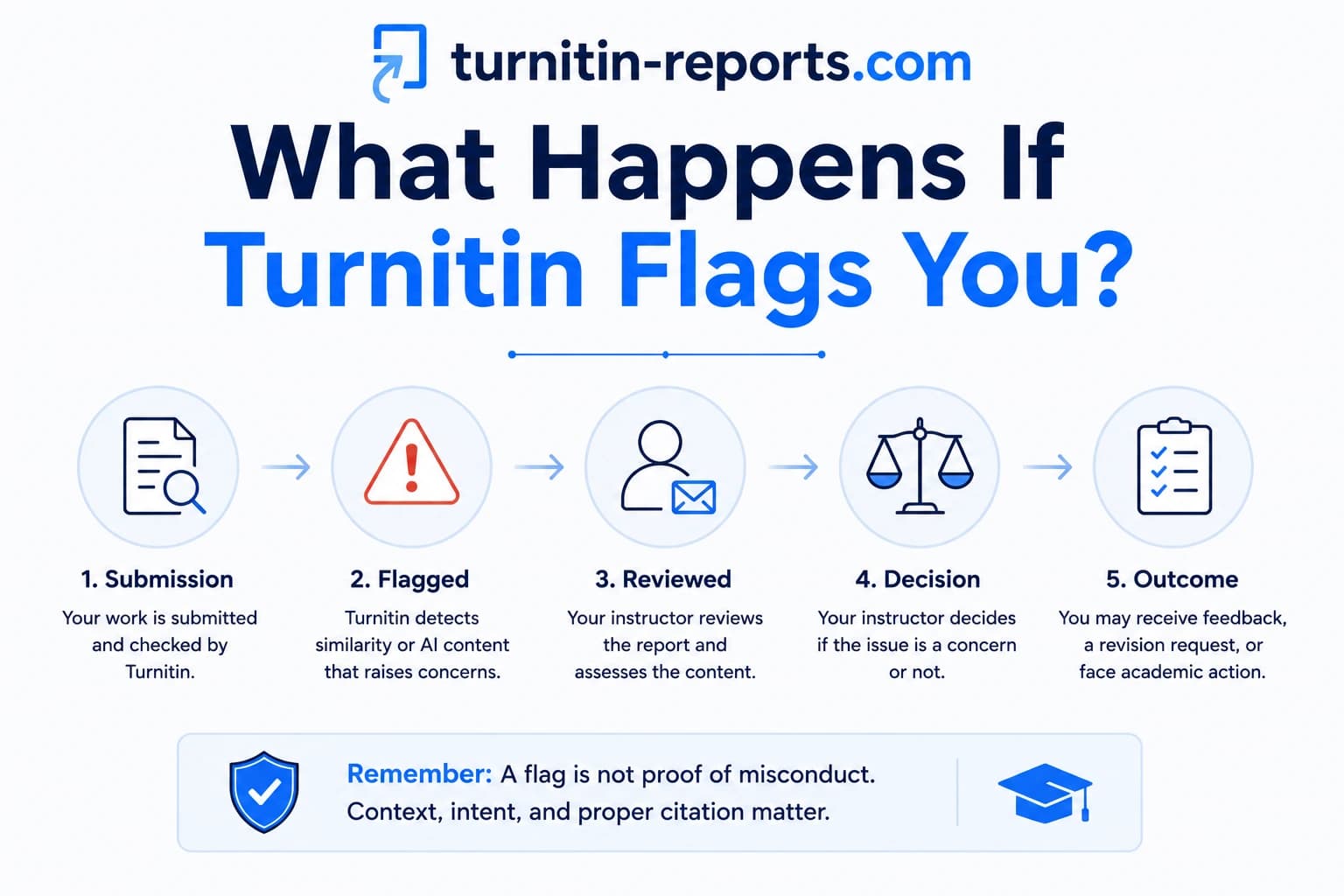
This post maps the full journey: what Turnitin actually stores, how universities separate internal disciplinary files from official transcripts, who can see which layer, and what your rights are under FERPA, GDPR, and the Australian Privacy Act. If you want to understand what happens when Turnitin flags you at each stage of the process, read that alongside this one.
A Turnitin flag is not a misconduct finding
Turnitin produces two outputs that instructors review: a similarity score and, where enabled, an AI writing percentage. Both are analytical signals — they indicate that something in your submission warrants a closer look. Neither constitutes a finding of misconduct.
The distinction matters because the entire question of permanent records depends on it. A Turnitin flag triggers a human review process. That review can conclude in several ways: the instructor decides the score is explained by quoted material and properly cited sources; the instructor flags it for a second opinion; or the instructor escalates it to the academic integrity office. Only that last path — escalation and a formal investigation — has any chance of producing a record entry, and even then, the outcome of the investigation is what determines whether a record entry is made, not the Turnitin score itself.
Understanding what your similarity score actually means is therefore the first step in assessing your actual exposure. A 35% similarity score on a heavily cited literature review is not the same situation as a 35% score on a personal reflection paper. Turnitin does not make that distinction — your instructor does.
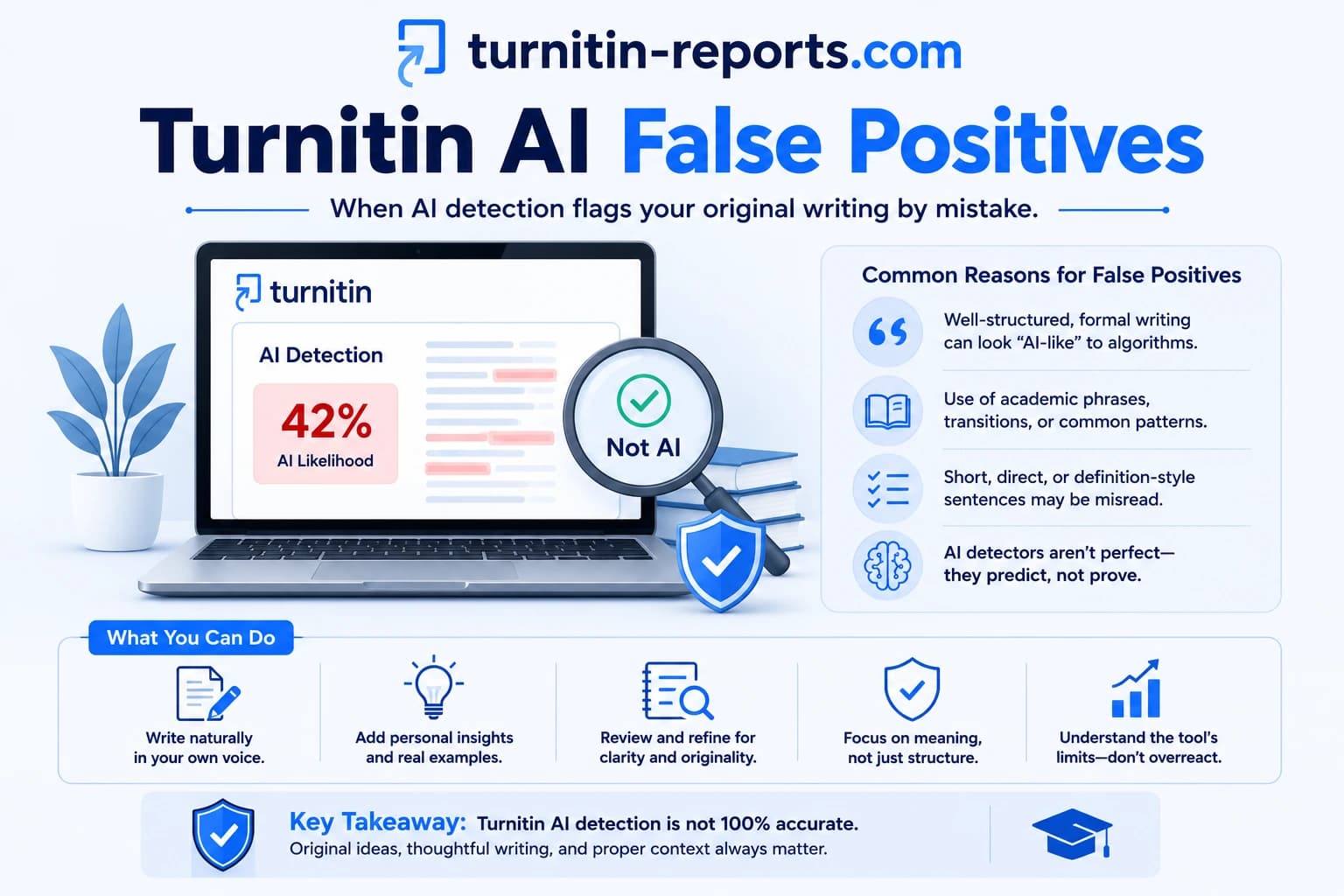
It is also worth noting that Turnitin AI false positives are documented and occur at meaningful rates, particularly for non-native English writers and students whose writing style is naturally concise or formal. An elevated AI score alone is not evidence of anything — it is one data point that must be evaluated alongside the student's other work, writing history, and any supporting documentation they provide.
What Turnitin itself keeps — and what it doesn't
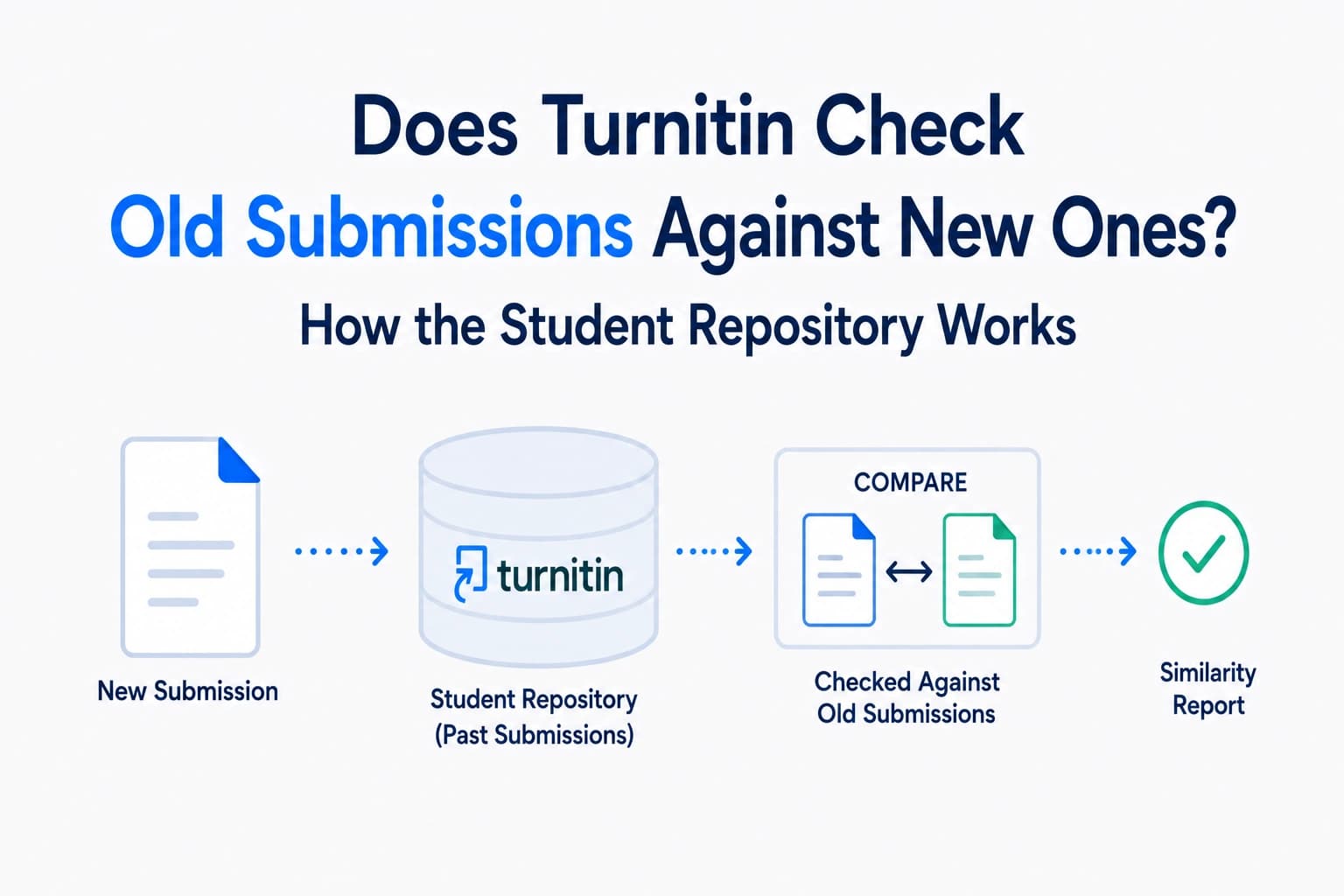
Turnitin stores two categories of data from each submission: the submitted paper text (which may be added to its global repository, depending on the assignment settings your institution uses) and submission metadata — the student name, submission date, file details, and similarity or AI scores. For more on how long Turnitin stores your submitted papers, the short version is that institutional repository papers are retained for as long as the institution's contract continues; non-repository submissions are deleted after processing.
What Turnitin does not store: misconduct outcomes, sanctions, appeal results, or any institutional decision about what the score means. Turnitin has no knowledge of whether a student was investigated, warned, or cleared. It has no interface with university disciplinary systems, no connection to transcript databases, and no relationship with immigration authorities, employers, or graduate admissions offices. It is a text-analysis tool. The record-keeping that matters happens entirely within your institution.
The two-tiered record system
Universities maintain two separate record systems relevant to misconduct, and understanding the difference is the most practically important thing to grasp about this topic.
Tier one: the internal disciplinary file
When a formal misconduct investigation is opened, the institution creates an internal disciplinary file. This file records the allegation, the evidence reviewed, the student's response, the outcome, and the sanction if any was imposed. This file is confidential. It is accessible to the academic integrity office, relevant administrators, and the student themselves — but it is not shared externally without the student's written consent (in the US under FERPA) or equivalent legal basis.
Critically, an internal disciplinary file is not the same thing as your academic transcript. Most first-time minor violations — a warning, a required revision, a grade reduction on a single assignment — result only in an entry in this internal file. The file has no visibility to anyone outside the institution and does not travel with you when you graduate, transfer, or apply elsewhere.
The UC San Diego academic integrity process is a representative example of how this works in practice: first-time violations resolved at the instructor or department level typically result in an internal record only, without transcript notation. Escalated or repeated violations are handled at the office level and may carry transcript consequences.
Tier two: the official academic transcript
The official transcript is what employers, graduate schools, and licensing boards request. It records your enrollment, courses, grades, degree, and — in cases of serious or repeated misconduct — formal notations. This is the record that travels.
A transcript notation is a much higher threshold than most students realise. The Stanford Honor Code, for instance, distinguishes between internal sanctions and transcript notations. A finding that results in a grade of “No Credit” or a course failure for misconduct may be recorded on a transcript. A finding that results in a warning or required resubmission typically is not. Suspension and expulsion are always noted, because they affect enrollment status — but these are the most severe outcomes, reserved for serious or repeated violations.
The practical reality is that the vast majority of students who are investigated for academic misconduct — including those flagged by Turnitin — experience outcome at tier one. Their name appears in an internal file, a sanction is imposed at the course level, and nothing appears on their transcript.
Who can actually see your records
There are four distinct audiences, each with access to different layers:
- Your instructor sees the Turnitin report — similarity score and AI percentage — for submissions to their assignment. They do not see your records from other courses or previous investigations unless the integrity office informs them.
- The academic integrity office sees the internal disciplinary file, including any prior findings. This is why repeat violations are treated more seriously — the integrity office has institutional memory that individual instructors do not.
- External parties (employers, grad schools, licensing boards) see only what appears on your official transcript, unless you provide additional consent or documentation. They cannot access internal disciplinary files.
- Visa sponsors and immigration authorities are in a specific category for international students. Immigration bodies do not receive disciplinary records directly — but the enrollment consequences of serious sanctions (suspension, expulsion) trigger mandatory reporting in the US, UK, and Australia. This is the pathway through which a misconduct finding can have immigration consequences, and it is covered in detail in our post on visa and immigration consequences for international students.
When does a finding appear on your official transcript
There are three outcome levels that correspond to progressively more serious record consequences:
Level one — verbal or written warning, required revision. Handled at the course or department level. No transcript notation. Internal file entry only, often with a note that no further action is required if the student completes the remediation. This is the most common outcome for first-time, low-severity cases.
Level two — internal formal finding with grade consequences. The integrity office has been involved, a formal finding has been made, and the sanction affects a grade or course outcome. The internal disciplinary file is updated with a formal record. Whether this appears on the transcript depends on institutional policy — many universities do not notate transcripts for single-course sanctions, even formal ones, unless the student is on academic probation or has a prior record.
Level three — suspension, expulsion, or degree revocation. These always result in a transcript notation because they affect enrollment status. A period of suspension is recorded; an expulsion results in withdrawal notation. Degree revocation, the rarest outcome, removes the degree from the transcript retroactively.
For context on how common each level is: most academic integrity offices report that 60–80% of cases they handle result in level one or level two outcomes, with the majority at level one. Level three outcomes are reserved for egregious, repeated, or coordinated violations.
Graduate schools, employers, and professional licensing
Graduate school applications commonly include a question asking whether you have been subject to academic discipline. This question is answered on the honor system — graduate admissions offices do not independently verify disciplinary history beyond requesting transcripts. A first-time minor violation that produced only an internal record and no transcript notation typically does not require disclosure, because the question refers to formal disciplinary findings, not internal warnings.
If a finding did result in a transcript notation, disclosure is required and honesty is the only viable strategy. Admissions committees are accustomed to evaluating students with prior violations — context, time elapsed, demonstrated growth, and strong letters of recommendation all carry weight. A single documented incident from three years ago, handled responsibly, is rarely disqualifying for graduate admission on its own.
Employers who conduct background checks access criminal records and employment verification — not university disciplinary files. FERPA in the US and GDPR in the UK explicitly prohibit institutions from disclosing disciplinary records to third parties without written student consent. An employer asking “did you have any academic misconduct findings?” on an application form is asking for voluntary disclosure, not accessing a database.
Professional licensing boards — for law, medicine, engineering, and other regulated professions — are the most demanding audience. Bar applications, medical licensing applications, and engineering certifications typically ask about disciplinary history in broad terms, and some explicitly ask about academic misconduct. For students pursuing licensed professions, any formal finding (including internal ones, in some jurisdictions) may require disclosure to the licensing board. The board then evaluates the finding in context. Nondisclosure of a finding that is later discovered is treated far more seriously than the original violation.
Can misconduct records be removed or expunged
Expungement processes vary by institution and jurisdiction, but they exist and are used more often than students realise.
For transcript notations, most institutions with expungement policies remove notations five to seven years after graduation, provided no further violations occurred during enrollment or in the intervening period. Some institutions allow earlier petition if the student demonstrates rehabilitation and the original sanction was at the lower end of severity. The transcript reversion is typically applied prospectively — institutions that are already holding a copy of an earlier transcript do not receive an updated version.
For internal disciplinary files, retention periods vary. Many institutions retain internal records for the duration of enrollment plus five to ten years, or until graduation plus a fixed period. After that, records are destroyed or anonymized in the ordinary course of records management. Students in the UK have the right under GDPR to request access to their personal data held by the institution, and in some circumstances to request erasure — though institutions are permitted to retain records they have a legitimate interest in keeping. The UK ICO guidance on education data covers the interaction between GDPR and legitimate institutional record-keeping in detail.
Students who believe a finding on their record is inaccurate — including students who were flagged by Turnitin and whose case was decided on the basis of a score alone — may have grounds to petition for review. A finding that was made without following proper procedure, or that relied exclusively on automated detection without corroborating evidence, is a candidate for appeal even after the initial outcome. The appeal process is the right route for challenging the finding itself; expungement is the route for addressing records after a finding that was properly made but has since aged out of relevance.
FERPA, GDPR, and your privacy rights
Three legal frameworks govern how your academic records — including misconduct records — can be held, shared, and accessed.
In the United States, the Family Educational Rights and Privacy Act (FERPA) gives students the right to inspect their education records, request amendment of inaccurate records, and require written consent before the institution discloses records to third parties. Disciplinary records are education records under FERPA, with narrow exceptions (records made by law enforcement in the course of a law enforcement investigation are not education records). Employers, graduate schools, and licensing boards cannot obtain your disciplinary records from the institution without your consent.
In the United Kingdom, GDPR and the Data Protection Act 2018 apply. Students have the right to access personal data held about them (subject access requests), the right to rectification of inaccurate data, and a qualified right to erasure. The ICO's education guidance confirms that universities must be able to justify the legal basis for retaining personal data — legitimate interest, legal obligation, or the performance of a public task — and must not retain it longer than necessary. Routine disciplinary records, where the matter is resolved, typically do not meet the threshold for indefinite retention.
In Australia, the Privacy Act 1988 and the Australian Privacy Principles govern how universities handle personal information. Students have the right to access personal information held about them and to request correction of inaccurate information. Australian universities are also subject to the record-keeping requirements of TEQSA, which specifies minimum retention periods for student records — typically seven years after the student leaves the institution. The privacy right to access operates alongside, not in place of, those minimum retention obligations.
The practical implication across all three frameworks is the same: your disciplinary records are not a public document. They are held by the institution, accessible to you, and shared with third parties only in defined circumstances with appropriate legal basis. A Turnitin flag is a much earlier stage than any of these frameworks even begin to apply — it is internal tool output, not a record at all.
Frequently asked questions
Does a high Turnitin score go on my permanent record?
No. A Turnitin similarity or AI score is a tool output that only your instructor and institution see. It is never transmitted to any external body, does not appear on your transcript, and disappears from view once the instructor closes the assignment. What can affect your record is the institutional decision made after reviewing that score — and most institutions do not open a formal misconduct proceeding on the basis of a borderline score alone.
Can employers see academic misconduct findings?
In the United States, FERPA prohibits institutions from disclosing disciplinary records to employers without your written consent. Employers who conduct background checks access criminal records, not university disciplinary files. The exception is if you voluntarily disclose the finding or if a professional licensing board requests it. In the UK, GDPR provides equivalent protection. Employers conducting reference checks typically receive dates of attendance and degree classification — not misconduct history.
Will a misconduct finding affect graduate school applications?
It depends on the severity of the finding and whether it appears on your transcript. Most graduate school applications ask whether you have been subject to academic discipline — this question refers to formal findings, not open investigations or verbal warnings. A first-time minor infraction handled internally, without a transcript notation, typically does not need to be disclosed. A formal finding that resulted in suspension or a transcript mark does need to be disclosed honestly, and most graduate admissions committees evaluate context, timing, and evidence of growth.
Can a misconduct record be removed after time?
For transcript notations, most institutions have an expungement process: typically five to seven years after graduation with no further violations. Internal disciplinary file records are retained longer but are not publicly visible. Under GDPR in the UK, you have a right to request erasure of personal data, subject to exceptions for legitimate institutional record-keeping. Under FERPA in the US, you have a right to review your records and to request amendment of inaccurate entries, but not automatic erasure of accurate ones.
Do international students have different record-keeping implications?
Yes, significantly. The academic misconduct record itself is governed by the same privacy frameworks as for domestic students. What differs is that the sanctions following a misconduct finding — particularly suspension or expulsion — trigger mandatory reporting to immigration authorities in the US, UK, and Australia. The record itself is not the problem; the enrollment consequence is. This is why international students need to act faster in the appeal process, before any institutional report to the immigration authority is filed. Our post on visa and immigration consequences for international students covers this in full.
Ready to check your paper?
Get your Turnitin report in minutes.
Same report your institution generates — delivered privately, fast.
Related articles
Does Turnitin Keep Your Paper Forever? What Actually Happens After You Submit
7 min read · July 9, 2026