Does Turnitin Flag Your Own Previous Work in a Dissertation? The Full Postgraduate Guide
Submitting a dissertation chapter that overlaps with your own coursework — or including a published article in a thesis-by-publication — creates a Turnitin problem that is very different from ordinary self-plagiarism. Here's how the detection fires, what universities require, and how to handle it.
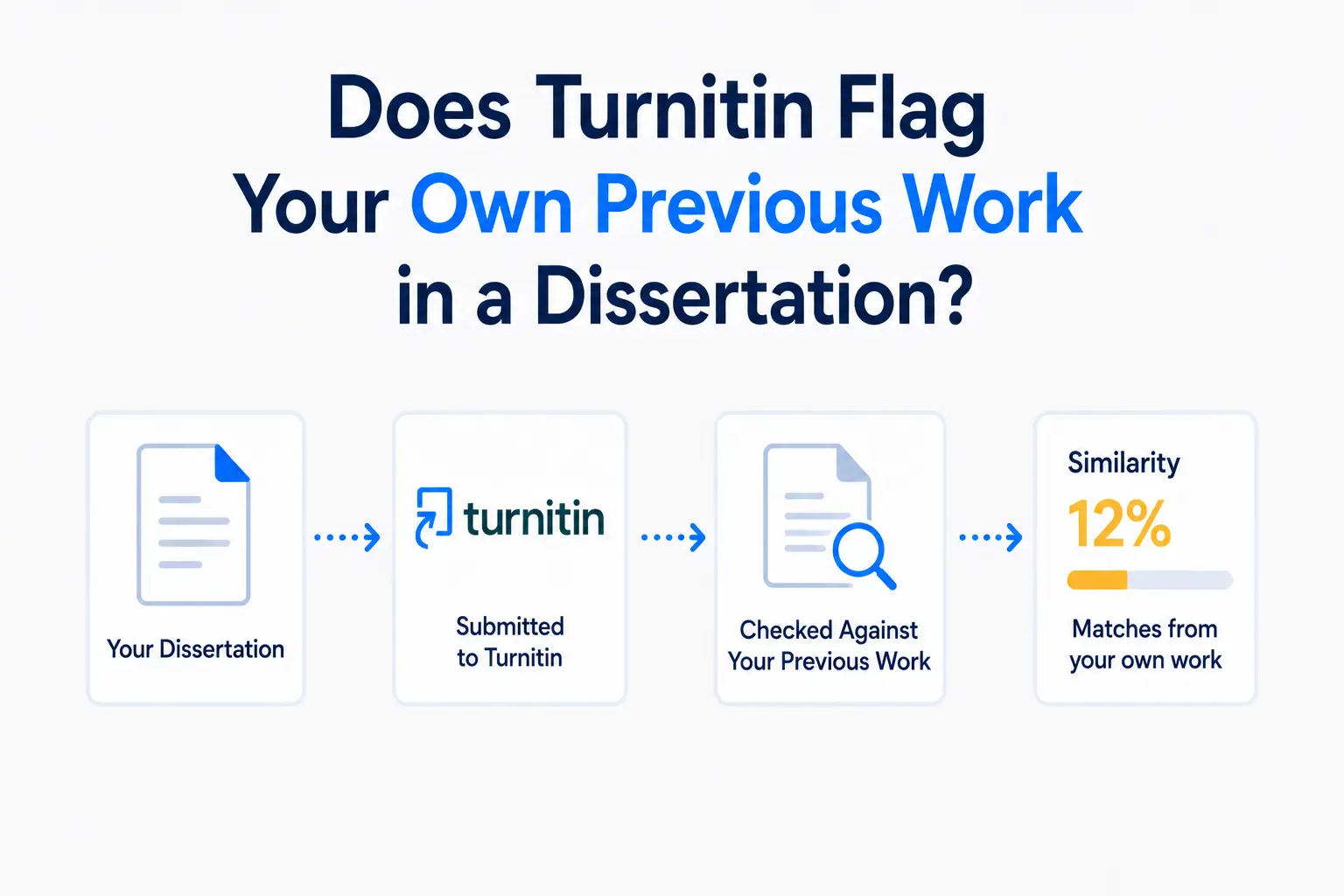
Submitting a dissertation chapter that overlaps with a piece of coursework you submitted two years ago, or including a published journal article as a chapter of your PhD thesis, creates a Turnitin similarity problem that is categorically different from ordinary self-plagiarism. The detection mechanism is the same — Turnitin finds the stored version of your previous work in its repository and flags the overlap — but the institutional context, the acceptable responses, and the practical solutions are all different. This guide is specifically for postgraduate researchers, final-year undergraduates writing extended projects, and anyone navigating the thesis-by-publication model.
How the cross-submission match fires technically
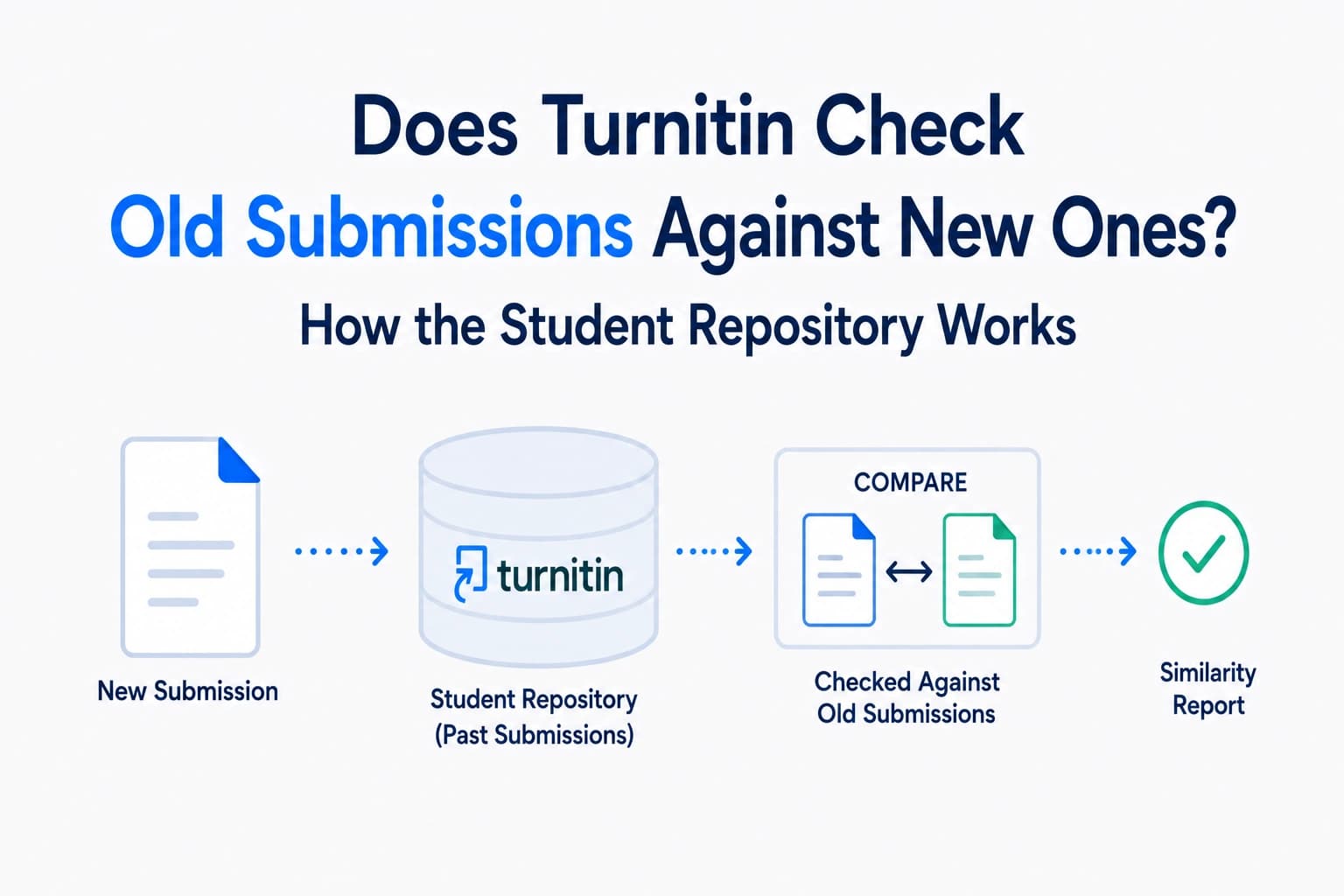
When you submit a piece of coursework through Turnitin and the assignment is configured for repository storage, that paper is added to Turnitin's database permanently. If your dissertation chapter later covers the same territory — even if it is substantially rewritten — the previously stored version of your coursework appears in your Similarity Report as a match under the “student papers” source category.
The critical technical detail is that Turnitin does not automatically exclude cross-class matches. According to Turnitin's own help documentation on self-matching, an automatic exclusion only occurs when a student submits the same paper to multiple assignments within the same class. Submit that paper to a different class — or a different institution, or years later — and the stored version can and will appear as a match in your dissertation report.
What supervisors can do manually: using the filters and exclusions panel in the Similarity Report, a supervisor or administrator can exclude specific matching sources from the reported percentage. This means a supervisor who recognises a match as your own prior coursework can exclude that specific match and recalculate your score without it. This is done on a case-by-case basis by the examiner, not automatically.
The No Repository setting for draft chapters
Many supervisors are unaware of this option, but it is one of the most useful tools available for protecting postgraduate students from unnecessary self-match problems. When an instructor sets a Turnitin assignment to “No Repository,” papers submitted to that assignment are scanned against the database but not stored in it.
For dissertation supervision, this means: if your supervisor creates draft-review assignments in Turnitin using the No Repository setting, you can submit in-progress chapters for similarity feedback without those drafts being indexed. Your final submission then scans against the database without competing against your own drafts. Only the final submission — if configured for repository storage — enters the database.
Students cannot control this setting. It is instructor-only. If you are submitting draft chapters regularly and are concerned about self-matching across multiple drafts, ask your supervisor explicitly which repository setting they are using for the draft submission assignments. As our post on how Turnitin stores submitted papers explains, the storage decision is made at the assignment level, not the student level.
Thesis by publication — the highest-risk scenario
In a thesis by publication (also called a paper-based or manuscript thesis), students compile previously published or accepted journal articles as individual chapters of their dissertation. This creates a compounded detection problem that is worth understanding in detail before you submit.
When your article was submitted to a journal, reviewed, and published, Turnitin indexed that published version in its database of academic publications. When you then submit a dissertation chapter that is identical or substantially similar to that article, Turnitin matches that chapter against two distinct sources simultaneously: the original student paper stored from when you may have run it through Turnitin during writing, and the published journal article in the academic publications database. Supervisors at multiple UK universities have flagged this dual-indexing problem to their students directly.
Critically, this is not academic misconduct. All major publishers explicitly permit authors to reuse their own published work in a thesis or dissertation. The University of Southampton Library's guide on reusing your own material in theses confirms that Elsevier does not count thesis publication as prior publication; Nature Portfolio grants authors the right to reuse their article's Version of Record in a thesis; IEEE and Springer both permit it subject to proper attribution. MIT Libraries' guidance on theses and article publishing confirms the same for the major publishers researchers encounter.
What this means practically: if you are submitting a thesis by publication, your similarity score for the chapters derived from published papers will likely be high — potentially 70–100% on those chapters — and this is expected and acceptable. Your examiner and your institution's academic integrity office should already understand this if they are familiar with the thesis-by-publication model. UCL's Doctoral School, for example, requires only that a Doctoral Candidate Thesis Declaration Form be embedded after the title page disclosing the published material — not that the similarity score be artificially reduced.
The literature review and upgrade report problem
The most commonly flagged section of a dissertation for self-plagiarism is not a chapter that originated as a published article — it is the literature review. Here is why: most postgraduate researchers write a literature review early in their research, first in a research proposal, then in a longer upgrade report (sometimes called a confirmation report, transfer report, or annual review). By the time they write the dissertation literature review, they have refined and expanded the same material two or three times over several years.
Because each of these earlier documents may have been submitted through Turnitin, the stored versions can each produce separate similarity matches against the final dissertation. The literature review chapter ends up flagged against the research proposal and the upgrade report simultaneously.
Institutional responses vary. UCL explicitly excludes upgrade reports from its definition of self-plagiarism for doctoral candidates — meaning carrying text forward from your upgrade into your thesis is not treated as an integrity issue at UCL. Oxford University requires that any passage “quoted or closely paraphrased from your own prior work” be cited as you would cite any other source. Check your specific institution's policy, because the treatment of upgrade reports and research proposals is not uniform.
Text recycling vs. self-plagiarism — the methods exception
Academic integrity discourse has begun to distinguish between self-plagiarism (presenting previously submitted work as new, without disclosure) and text recycling (reusing your own published text in a later work, with appropriate disclosure). The distinction matters for PhD students.
The widely cited analysis by Professor Pat Thomson (University of Nottingham) distinguishes between sections where text recycling is and is not defensible. Her position, shared by many academic integrity researchers: methods sections are the one section where reusing your own text is sometimes the academically correct choice, because accurate scientific communication requires that methodology be described precisely and consistently. Changing the wording of a methods section for stylistic variation can introduce ambiguity about whether a different procedure was followed.
Dr Sarah Eaton's analysis of self-plagiarism in thesis and dissertation publishing reinforces this: the issue is not about identical text per se, but about proper attribution and disclosure. A methods section carried forward verbatim from a previous paper, cited correctly, is transparent and permissible under most institutional policies. The same text carried forward without disclosure is where the problem arises.
What universities actually require
Institutional requirements for disclosing previously published material in a dissertation vary considerably:
- UCL: A Doctoral Candidate Thesis Declaration Form embedded after the title page, itemising each published work included. Upgrade reports excluded from self-plagiarism definition.
- Oxford: Citation of any passage quoted or closely paraphrased from your own prior work, exactly as you would cite any other source. No special form required, but the expectation is that the text be treated as a quotation and attributed.
- University of Missouri: The Office of Academic Integrity explicitly frames the distinction around whether the student is “misleading the professor by passing off the assignment as new academic work.” A dissertation that incorporates thesis chapters with disclosure does not fall into this definition.
- Harvard Extension School: Requires prior written permission of all instructors before submitting substantially similar work across courses — relevant for coursework that will later appear in a thesis.
- Glasgow: Acknowledges that “self-plagiarism is a complex and sometimes misunderstood issue” and notes the tension between integrity rules and the expectation that researchers publish their work. Disclosure is the operative requirement.
Acceptable similarity scores for dissertations
There is no universal acceptable percentage for a dissertation. The expectation differs from coursework in two important ways: first, dissertations are expected to engage more extensively with primary and secondary sources, which can legitimately increase the similarity score; second, examiners reviewing a dissertation typically contextualise the report rather than applying a rigid threshold.
General institutional guidance clusters around: PhD dissertations under 10–15% for non-thesis-by-publication submissions, with examiners expected to use judgment. Thesis-by-publication submissions can legitimately far exceed these figures for the chapters derived from published articles. The examiner's role is to review the highlighted matches in the report, determine which are legitimate (properly cited quotations, published material disclosed in the thesis declaration, standard methodological language) and which are not. As our post on understanding your Turnitin similarity score explains, the number on its own does not determine whether a finding of academic misconduct is made — the content of the matches does.
Pre-submission checklist for postgraduate researchers
- Identify all prior submissions — list every piece of coursework, conference paper, upgrade report, and published article that overlaps materially with any dissertation chapter.
- Ask your supervisor about draft submission settings — confirm that any ongoing draft chapter reviews are set to No Repository so that drafts do not self-match at final submission.
- Check your institution's thesis submission guidelines — specifically whether a thesis declaration form is required and whether upgrade reports are included in or excluded from the self-plagiarism definition.
- Cite your own prior work — any passage carried forward from a previously published article should be cited as you would cite any other source. “As described in [your published article]” is sufficient; it converts the match from an integrity concern into a properly attributed reference.
- Run a pre-submission check and review matches — when you receive your Similarity Report, go through the “student papers” matches first. For each one, confirm whether it is your own prior work or someone else's. If it is your own, make sure it is disclosed and attributed. Your examiner will do the same review and will expect that you can account for each flagged match.
- For thesis-by-publication chapters — ensure the thesis declaration form itemises each included publication, with full citation, journal name, and a statement that you are the author and publisher permission has been verified.
Frequently asked questions
Can Turnitin flag my dissertation for self-plagiarism if the overlap is with my own coursework?
Yes. If your coursework was submitted through a Turnitin assignment with repository storage enabled, that paper is in the database. When you submit a dissertation chapter covering similar material, Turnitin will match it against the stored coursework and flag the overlap as a similarity match — even if the text has been substantially revised. The label in your report will be “student papers.” Supervisors can manually exclude individual matches after reviewing them, but the initial report will show the overlap.
Does including a published article as a dissertation chapter count as self-plagiarism?
No, provided you disclose it. All major publishers permit authors to reuse their own published work in a thesis or dissertation. Academic integrity policies at most institutions distinguish between undisclosed reuse (which is misconduct) and disclosed reuse with proper attribution (which is standard practice in thesis-by-publication models). Check your institution's specific guidelines — most require a declaration form itemising included publications — and ensure each included article is properly attributed.
My literature review was written first as a research proposal. Will Turnitin flag it?
If your research proposal was submitted through Turnitin with repository storage enabled, yes — it will appear as a match in your dissertation similarity report. The treatment of this match depends on your institution. UCL explicitly excludes upgrade reports from its self-plagiarism definition. Most institutions require disclosure and citation of your own prior work. Check your institution's policy and discuss with your supervisor whether the proposal submission should be excluded from the report's percentage before examination.
What is an acceptable Turnitin similarity score for a PhD dissertation?
There is no universal figure. Most institutional guidance for standard (non-thesis-by-publication) PhD submissions clusters around under 10–15%, but examiners are expected to review the content of matches rather than apply a rigid cutoff. Thesis-by-publication submissions can legitimately score much higher for chapters derived from published papers — what matters is disclosure, attribution, and whether each match has a legitimate academic explanation the examiner can verify.
Ready to check your paper?
Get your Turnitin report in minutes.
Same report your institution generates — delivered privately, fast.