How to Lower Your Turnitin Similarity Score — Legitimately
A high similarity score often has legitimate causes — your bibliography, quoted sources, or standard academic phrasing. Here's how to identify what's driving it, reduce it through better writing, and what tricks to avoid.
Your Turnitin similarity score came back higher than you expected. Before you panic, it is worth understanding what the score actually measures — and why so many high scores have entirely legitimate explanations. Turnitin does not decide whether plagiarism occurred. It identifies text that matches sources in its database and produces a percentage. That percentage alone tells nobody whether misconduct happened. A 40% score with a long bibliography and heavily quoted sources may be completely fine. A 10% score with one uncited paragraph could be a problem. The score is a starting point, not a verdict.
That said, a high score is still worth investigating — both to understand what is driving it and to fix anything that genuinely needs fixing before your final submission. This guide walks through the real causes of high similarity, the methods that legitimately bring the score down, and the shortcuts that make things significantly worse.
Why similarity scores come back high
A high similarity score is often the result of completely normal academic writing practices. The most common legitimate causes are:
- Direct quotations. Even perfectly cited quotes with quotation marks still register as matches because the text is identical to the source. Over-relying on block quotes is one of the most consistent drivers of a high score. A 2,000-word essay with four or five long block quotes can easily reach 20–30% on quotes alone.
- The bibliography or reference list. Full citations match the same publication details listed in Turnitin's journal and web database. A long reference list — especially one with many co-authors and long journal titles — can add five or more percentage points on its own.
- Standard academic phrases. Phrases like “this study examines,” “according to research,” “the results suggest,” and “it can be concluded that” appear across millions of papers. Turnitin flags these matches, but they have no academic integrity implications.
- Standardised methodology or definitions. Describing a widely-used research protocol, a statutory legal definition, or a clinical diagnostic criterion often requires language that is near-identical across papers in the same field. These are legitimate matches.
- Assignment prompt text. If an instructor's question or brief is embedded in your document, those words may match previous iterations of the same assignment submitted by other students.
- Self-plagiarism from prior submissions. If you submitted a related paper at the same institution, Turnitin may flag your current work against your own earlier submission stored in the repository. Our guide on whether Turnitin can detect self-plagiarism explains how that detection works in detail.
Understanding what is actually driving your score matters before you do anything else. If most of the highlighted material is your bibliography and properly cited quotes, the fix requires no rewriting — just the right exclusion filters applied by your instructor. If the flagged content is body text you didn't properly paraphrase or attribute, you need to revise.
Use Turnitin's exclusion filters first
Before you start rewriting anything, use Turnitin's built-in exclusion filters to see what your score looks like without the items that legitimately inflate it. There are three filters:
- Exclude Bibliography. Removes the entire reference list from the similarity calculation. Turnitin's algorithm automatically identifies the bibliography section using machine learning for English-language papers, or by looking for standard headings like “References” or “Works Cited.” Depending on how many sources you cite, this filter alone can drop your score by 5–15 percentage points.
- Exclude Quotes. Removes text enclosed in standard quotation marks or formatted as block quotes from the similarity calculation. If you have substantial properly attributed direct quotes, enabling this filter shows your score based on your original writing only.
- Exclude Small Matches. Filters out matched segments below a minimum word-count threshold. The system default is 8 consecutive words — only matches of 8 or more words appear in the report. Short boilerplate phrases, common transitions, and standard terminology get filtered out, leaving only substantive matches for review.
One important caveat: students can toggle these filters temporarily in their own Similarity Report view, but this does not change the official score your instructor sees. Only instructors can apply these filters permanently to the submission. If your score is being inflated by bibliography matches or properly cited quotes, ask your instructor to apply the relevant exclusions when reviewing the report. This is standard practice and is entirely appropriate to request.
Genuine techniques to lower your score
The following methods reduce your similarity score by making your writing more original — not by hiding matches from the detector.
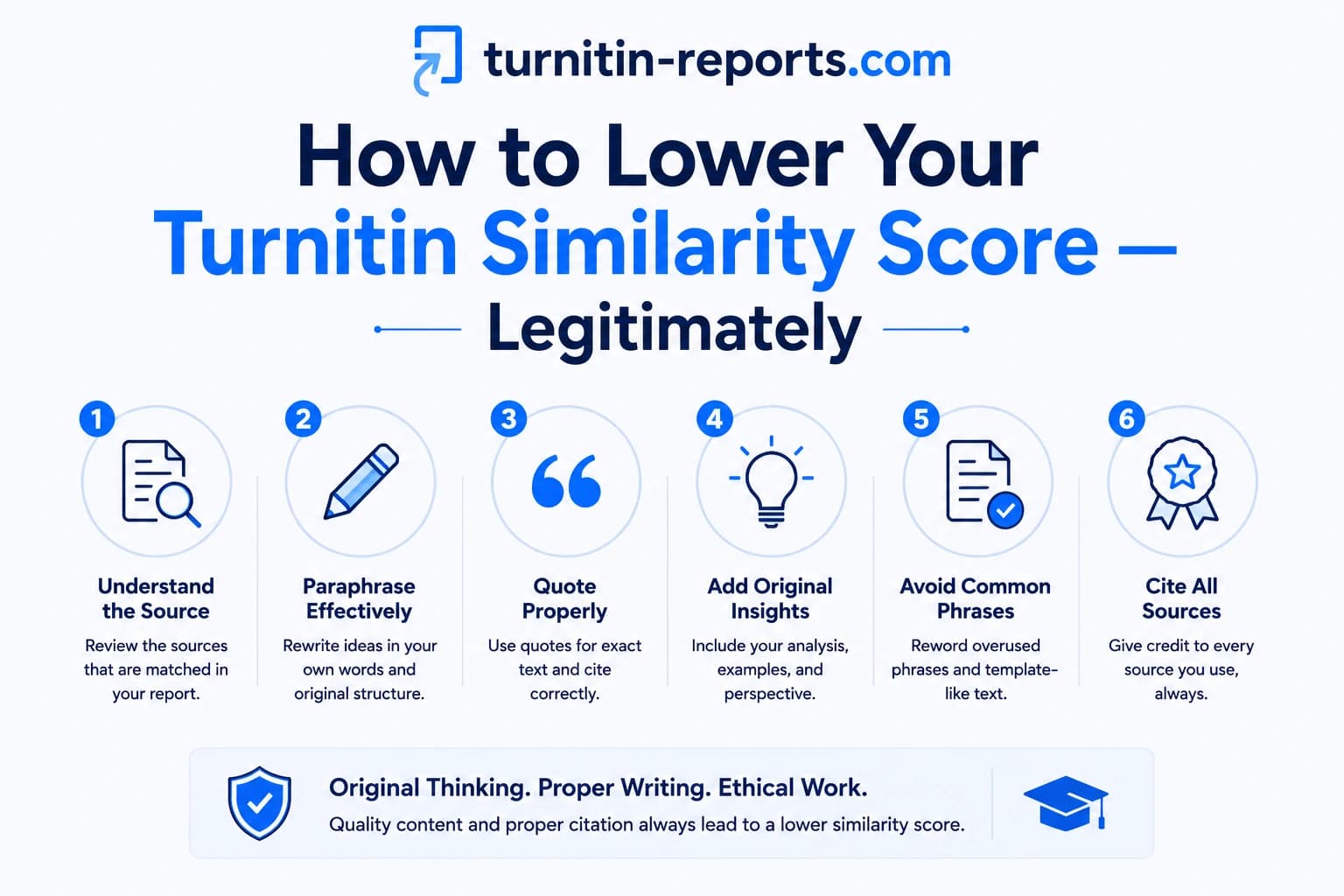
Paraphrase correctly using the read-close-write method. Real paraphrasing is not swapping individual words with synonyms while keeping the same sentence structure. Read the source passage carefully, close the document entirely, write the idea from memory in your own words, then add the citation. Your sentence structure, vocabulary choice, and phrasing should all be yours. Turnitin uses semantic analysis alongside string-matching, which means it still flags paraphrases that preserve the original structure even when most words have been changed.
Keep direct quotes to a minimum. A practical guideline: direct quotes should make up no more than 10% of your total word count. Reserve them for definitions, legal text, or passages where the exact wording is analytically important. Convert longer block quotes into tight paraphrases with in-text citations — the idea stays attributed, and the match disappears.
Synthesise across multiple sources. Instead of drawing one idea from one source, pull the same concept from three or four sources and write a synthesis paragraph that compares where authors agree, differ, or build on each other. The paragraph-level reasoning and structure become original even when the underlying facts are drawn from existing work.
Revise flagged sections specifically. Open your Similarity Report and identify the highlighted passages. Use the source breakdown to understand what each match is against, then revise those sections using the read-close-write method. Do not rewrite sections that are not flagged — focus effort precisely where the matches are.
Format direct quotes correctly. When you do quote directly, always use standard quotation marks. This allows the Exclude Quotes filter to work when your instructor applies it. Improperly formatted quotes — presented without quotation marks as though they are your own words — will not be excluded by that filter, and create a much more serious problem than a high similarity score.
Remove embedded prompt text. If you copied the assignment question or brief into your document as a reference while writing, delete it before submission. This text often matches previous submissions at your institution where the same assignment was used.
What not to do
There are techniques students attempt to game the similarity score. None of them work as expected, and several actively make the situation worse.
White text / hidden text. Inserting white-coloured text invisible against a white background to artificially inflate the word count or confuse the algorithm. Turnitin's Flags Insight Panel explicitly detects text whose colour matches the background colour. Instructors receive a flag count and the exact document locations. The similarity score may dip slightly, but a visible alert directs the instructor to look more closely at the submission.
Character substitution. Replacing common Latin letters with visually identical characters from other alphabets — for example, Cyrillic characters that look like Latin ones — to break Turnitin's word-matching. Turnitin detects unusual character sets and reports the count and location of substituted characters in the Flags Panel. This is visible to instructors before they read a single word of the paper.
Automated paraphrasing tools. Running text through QuillBot or similar synonym-substitution tools. Turnitin launched dedicated AI paraphrasing detection that specifically identifies text patterns consistent with automated spinning. The combination of unnatural synonym choices and preserved sentence structure is algorithmically detectable. Submitting AI-spun text as your own writing is also an academic integrity violation at most institutions, independent of the similarity score it produces.
The common failure in all these approaches is that they address the displayed number, not the underlying writing. Even if a technique temporarily reduced the similarity percentage, it does not change what an instructor sees when they read the paper. Attempted manipulation of a submission is treated as academic misconduct at most institutions — and is often a more serious charge than the original high score ever would have been.
What score is actually acceptable
There is no single universal threshold. Different institutions set their own policies, different instructors apply different judgements, and the type of assignment matters as much as the number. A literature review is expected to engage extensively with existing work and will naturally produce higher similarity than a personal reflective essay. A legal analysis quoting statutory text will score differently from a creative writing submission.
As a general orientation: scores below 15% are rarely scrutinised. Scores between 15–25% may be reviewed depending on what is driving them. Scores above 25–30% are more likely to prompt a closer look, though they are not automatically a problem. What matters in every case is what the flagged content actually is — whether the matches are properly attributed quotes and standard phrasing, or body text that appears without citation.
If you want to understand what each score band means in practice, our guide to understanding your Turnitin similarity score covers every percentage range in detail.
Frequently asked questions
Does properly citing my sources lower my similarity score?
Not directly. Citations tell readers where an idea came from, but the text of a paraphrase — even a cited one — is still compared against Turnitin's database. What citations do is ensure that when an instructor reviews a match, they can see it is properly attributed. To lower the score itself, paraphrase using your own sentence structure, or ask your instructor to apply the bibliography and quotes exclusion filters.
What does the “Exclude Bibliography” filter actually remove?
It removes the entire reference list from the similarity calculation. For papers citing many sources, this can reduce the score by 5–15 percentage points. Only instructors can apply this filter permanently; students can toggle it temporarily in their own report view, but that does not change the official score the instructor sees.
Can I use QuillBot to lower my similarity score safely?
No. Automated paraphrasing tools replace words with synonyms while preserving sentence structure, which Turnitin's AI paraphrasing detection is specifically designed to catch. Beyond the detection risk, submitting text processed by a paraphrasing tool as your own original writing is an academic integrity violation at most institutions regardless of what the similarity score shows.
Does a high similarity score automatically mean I plagiarised?
No. Turnitin's own guidance makes clear that similarity is not synonymous with plagiarism. The score is a starting point for instructor review, not a finding of misconduct. A high score caused by correctly cited quotes and a long bibliography is not a problem. Whether a match is plagiarism is a judgement made by a person after reviewing the full report in context.
Ready to check your paper?
Get your Turnitin report in minutes.
Same report your institution generates — delivered privately, fast.