Turnitin Showing 100% AI — What It Actually Means and What to Do
A 100% AI score on Turnitin does not mean your paper was definitively AI-generated. It means every passage scored above the detection threshold — which can happen to entirely human-written work. Here are the five causes, what the score does not prove, and exactly how to respond.
Receiving a 100% AI score on Turnitin is the number that triggers the most panic — and also the number that is most misunderstood. It does not mean your entire essay was definitively written by AI. It means that across your submission, every passage Turnitin's model evaluated was statistically consistent with AI-generated text. That distinction matters enormously, because a 100% score can arise from multiple very different situations — and responding to it correctly depends on understanding which one you are dealing with.
What Turnitin is actually measuring
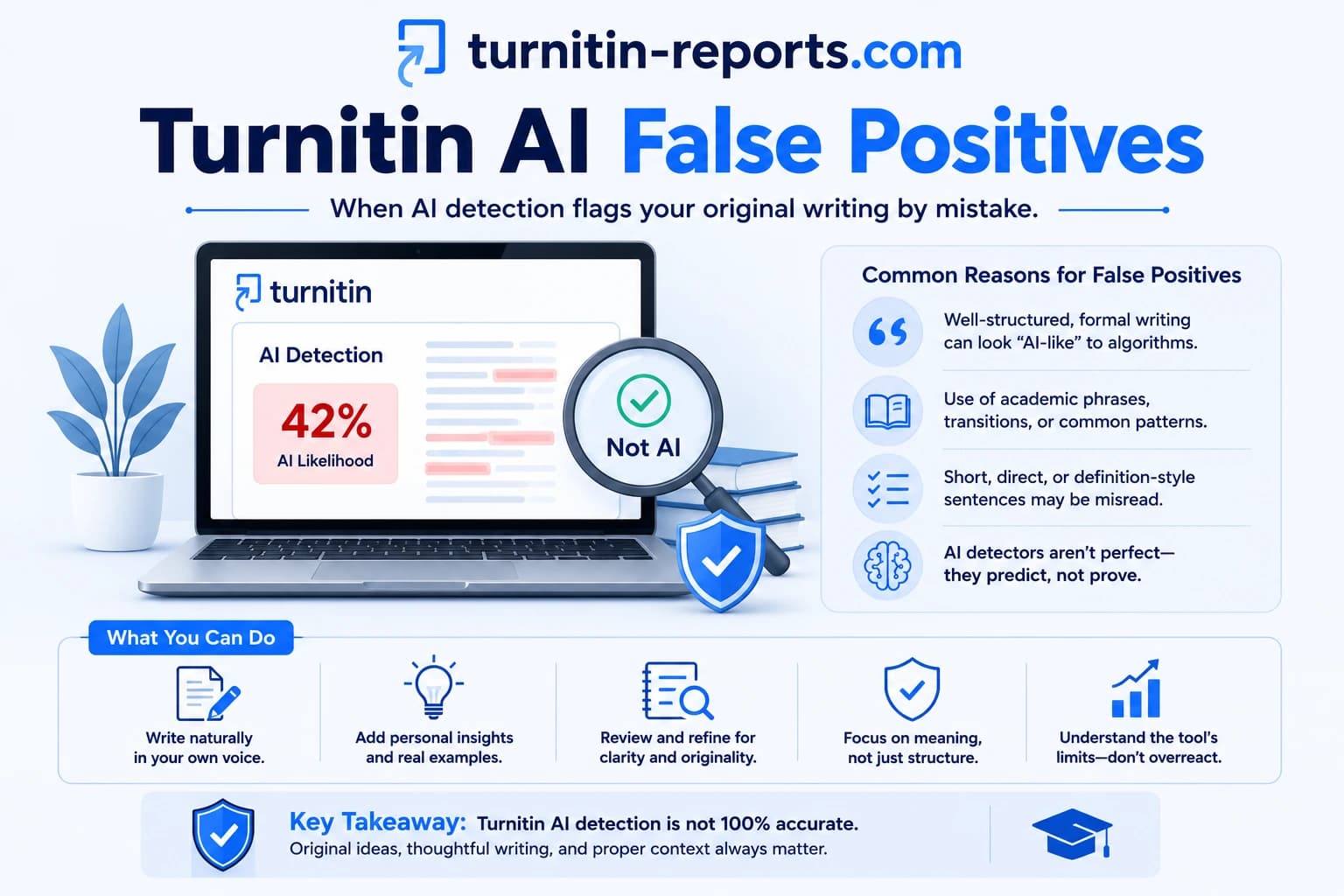
Turnitin's AI Writing Report does not identify AI text by matching it against a database of known AI output. It measures statistical properties of the text — specifically, how predictable the word choices are (perplexity) and how uniform the sentence lengths are (burstiness). AI-generated text tends to score low on both metrics because language models optimise for fluent, predictable output.
A 100% AI score means that when the model evaluated every passage across your document, every passage scored above the threshold for AI-generated content. It does not mean Turnitin found proof that an AI tool was used. It means the text reads statistically like AI output throughout, with no passages that deviate toward the higher variation patterns of human writing. As Turnitin's own blog on false positives states, the AI score should not be used as the sole basis for adverse action against a student.
Situations that produce a 100% score
A 100% AI score can arise from several distinct situations — some involving actual AI use, some not:
1. Fully AI-generated submission
The most straightforward case: a student submits text that was entirely generated by a language model such as ChatGPT, Gemini, or Claude, without any human editing. Raw, unmodified AI output produces the cleanest possible statistical fingerprint and typically scores very high — often 90–100%. This is what Turnitin's model performs best at detecting.
2. Heavily formatted or templated writing
Certain types of human writing produce the same low-perplexity, low-burstiness patterns that AI generates — not because AI was used, but because the writing style itself is highly regularised. Examples include:
- Technical lab reports with standardised methodology sections
- Executive summaries written in corporate style
- Legal memos following strict formal templates
- Cover letters and applications written in a polished, formulaic register
Orion Newby's case at Adelphi University — where a court ruled in his favour — involved a 100% AI score on a paper he had written himself, receiving grammar help from a university tutor. His writing style was structured and polished in a way that the detector read as AI-generated.
3. Grammar tool heavy editing
Accepting extensive rewrite suggestions from Grammarly, ProWritingAid, or similar tools can flatten natural variation in sentence structure and word choice, pushing the statistical profile of your text toward the AI range. A paper that was fully human-written but extensively edited by a grammar tool can sometimes score at 100% because the editing has removed the “noise” that human writing normally exhibits. Our post on why Grammarly triggers Turnitin AI detection covers this in detail.
4. Non-native English writing
Students who write in English as a second or third language tend to use more uniform vocabulary, simpler sentence structures, and more predictable grammatical patterns — not because they are using AI, but because these are features of writing in a language you are still developing fluency in. Stanford HAI research found that seven major AI detectors misclassified non-native English essays as AI-generated at an average false positive rate of 61.3%. A 100% score for a non-native English speaker does not mean their work is more likely to be AI-generated — it means the detector is less reliable for their writing profile.
5. Short documents
Turnitin's model is less stable on short submissions. A document with fewer than 300–500 words provides limited statistical signal, and the model's confidence interval is wider. Short formal texts — abstracts, executive summaries, short answer responses — can score 100% simply because there is not enough variation in a brief, focused piece of writing.
What 100% does not mean
A 100% AI score does not mean:
- That Turnitin has proof you used an AI tool
- That your submission was definitely AI-generated
- That you will automatically face academic misconduct proceedings
- That you cannot dispute the result
Turnitin's AI Writing Report guide is explicit: the tool is designed to be a starting point for a conversation between instructors and students, not a verdict. The score requires human judgment to interpret.
What to do if you receive a 100% score
The appropriate response depends on your situation:
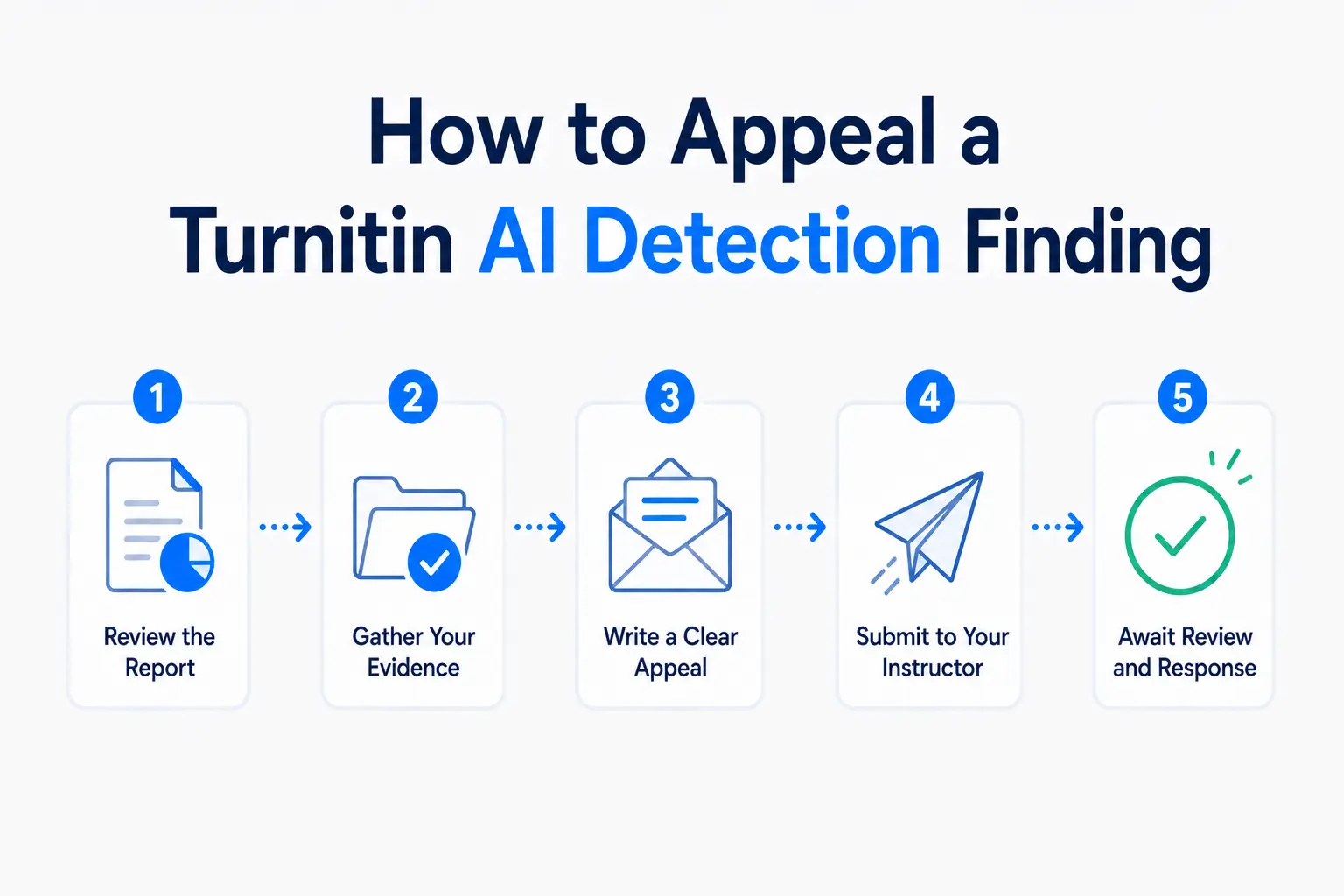
If you did not use AI: Document your writing process immediately. Version history from Google Docs (File → Version History → See version history) or Word's AutoSave history shows your document evolving over time — something AI generation cannot replicate. Run your submission through GPTZero and Copyleaks and save those results. Gather your research notes, outline, and any drafts. Our post on what to do when Turnitin flags work you wrote yourself covers the full defence process, including how students in documented cases like Orion Newby successfully contested a 100% score.
If you used AI for research but wrote the text yourself: The distinction between using AI as a research tool and using it to generate submitted text is important — and increasingly recognised in institutional policies. Document what you actually did. Many institutions now have policies that distinguish between permitted and unpermitted AI use, and a 100% AI score on text you wrote after reading AI-generated research notes is a different situation from submitting that AI output directly.
If you did use AI to generate the text: The 100% score is likely accurate. At this point the question is institutional — what your university's policy states, what the consequences are, and whether disclosure before a formal finding is possible. Turnitin's own guidance to institutions recommends conversation before sanction.
Frequently asked questions
Does a 100% AI score on Turnitin mean I will be expelled?
No. A 100% AI score is a report output — it does not automatically trigger any disciplinary action. Your institution's academic integrity office determines what happens next. Turnitin explicitly states the score should not be used as sole evidence of misconduct. Many students with high AI scores — including 100% scores — have successfully demonstrated through drafts and version history that their work was human-written.
Can a human-written paper score 100% AI on Turnitin?
Yes. Documented cases exist, including Orion Newby's 100% score on a paper a court later ruled was “without valid basis” to flag. Non-native English speakers, students who use grammar tools heavily, and students writing in highly structured formats are at elevated risk of high false positive scores. A 100% score does not prove AI authorship.
Why does Turnitin show 100% instead of something like 94% or 87%?
The AI Writing Report generates a score based on what percentage of your submission's passages are classified as AI-generated. A 100% score means every evaluated passage exceeded the AI classification threshold — there were no passages with human-like variation that brought the average down. This can happen with raw AI output, but also with very uniformly written human text that lacks the natural variation the model looks for.
Should I talk to my professor before they see the 100% score?
If you did not use AI and you know your score is 100%, proactively speaking to your instructor before they contact you can work in your favour — it demonstrates transparency and gives you the opportunity to provide context. Bring your version history and any evidence of your writing process. A student who comes forward with documentation is in a much stronger position than one who is called in without preparation.
Ready to check your paper?
Get your Turnitin report in minutes.
Same report your institution generates — delivered privately, fast.
Related articles