How to Appeal a Turnitin AI Detection Finding — The Complete Process
Appeals succeed in over 60% of documented cases when properly evidenced. Courts have ruled in students' favour. Here's the complete process: what to do in the first 24 hours, what evidence actually works, who to contact at each stage, and what the legal backstop looks like.
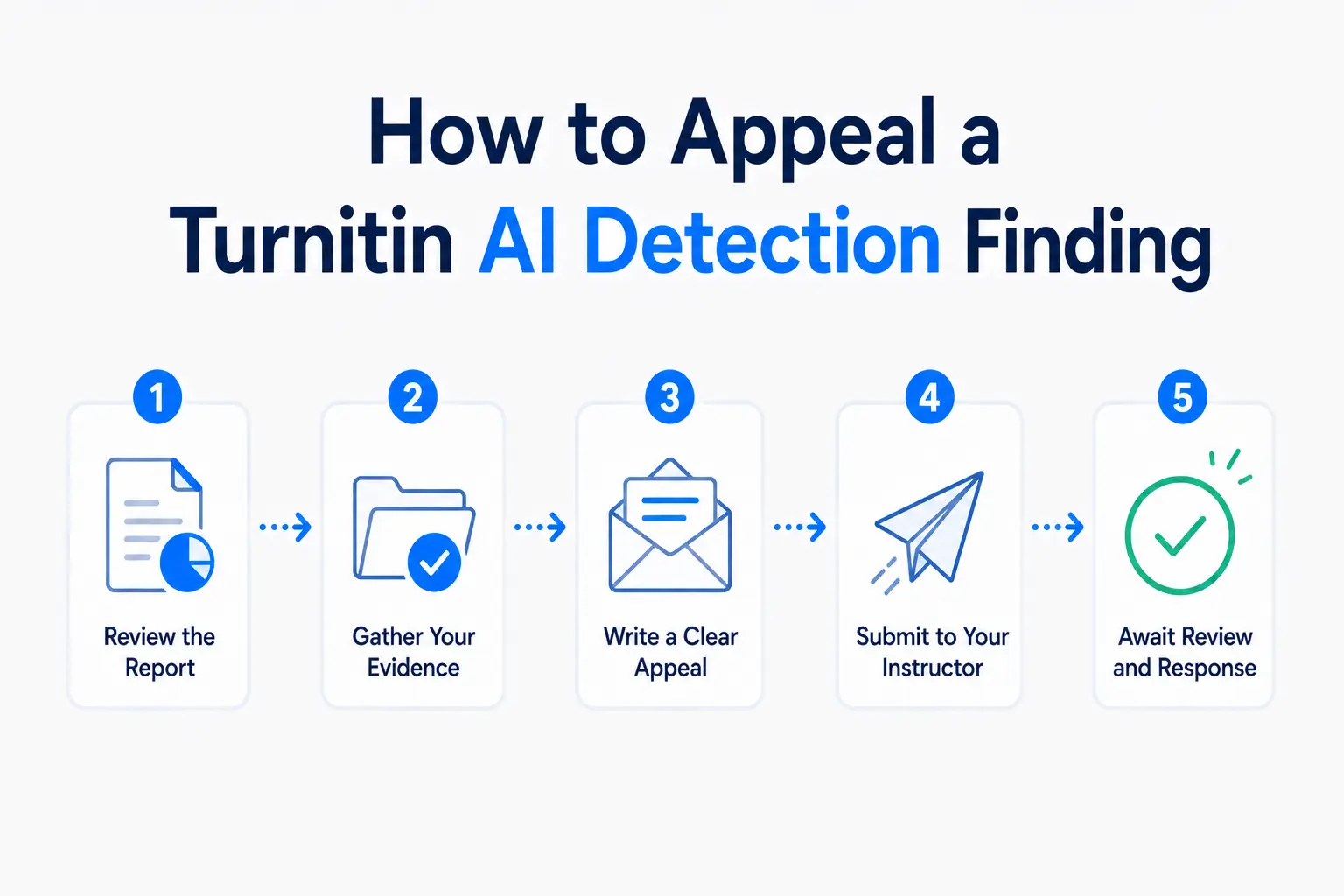
If your work has been flagged by Turnitin's AI Writing Report and you did not use AI, you have options — and they are stronger than most students realise. Courts have ruled in students' favour, appeals have succeeded in over 60% of documented cases when properly evidenced, and Turnitin itself has published guidance that directly supports your right to contest an AI detection finding. This post is the complete process: what to do first, what evidence to gather, how to present your case, and what happens at each stage.
The first 24 hours — what to do immediately
Before you do anything else, two things are critical:
1. Do not delete anything. Do not delete any drafts, emails, browser tabs, notes, or files related to the assignment. The evidence that will help you most is the trail of your writing process — and that trail can disappear if you are not careful. This includes:
- All draft versions of your document
- Research notes, annotated sources, and outline documents
- Emails or messages with your instructor about the assignment
- Browser history from the period when you were researching
- Any course materials or prompts you were responding to
2. Access your version history immediately. In Google Docs, go to File → Version History → See version history. In Microsoft Word, check AutoSave history or OneDrive version history. Take screenshots or export this history. A document that shows dozens of edits across multiple sessions over several days is compelling evidence of genuine writing — AI generation leaves no such trail.
Gather your evidence
The most successful appeals before institutional panels — and the cases that have won in court — share a common pattern: the student arrived with layered evidence that told a clear story of their writing process. Build the same case:
- Version history screenshots or exports. Show the document changing over time with timestamps. Multiple editing sessions across multiple days is nearly impossible to fake retroactively.
- Independent AI detector results. Run your submission through GPTZero and Copyleaks — both are free. Save the full results, not just the headline score. Orion Newby submitted ZeroGPT and Grammarly reports contradicting Turnitin's 100% score, and a court found this persuasive.
- Research materials. Annotated PDFs of your sources, handwritten notes, highlighted textbook pages — any physical or digital evidence that you engaged with the source material yourself.
- Drafts and outlines. Early rough drafts, bullet-point outlines, and planning documents show the messiness of real writing. AI generation has no equivalent of a half-formed first draft with crossed-out ideas.
- Turnitin's own guidance. Download or print Turnitin's blog post on false positives and the AI Writing Report guide, both of which state explicitly that the AI score should not be the sole basis for adverse action. Instructors and panels are often unaware of these documents.
Request the full report
You are entitled to see the full AI Writing Report — not just the overall percentage. Request it from your instructor or institution if you have not already been given access. The full report shows which specific passages were flagged and how severely, allowing you to address the highlighted sections specifically rather than just disputing the overall number.
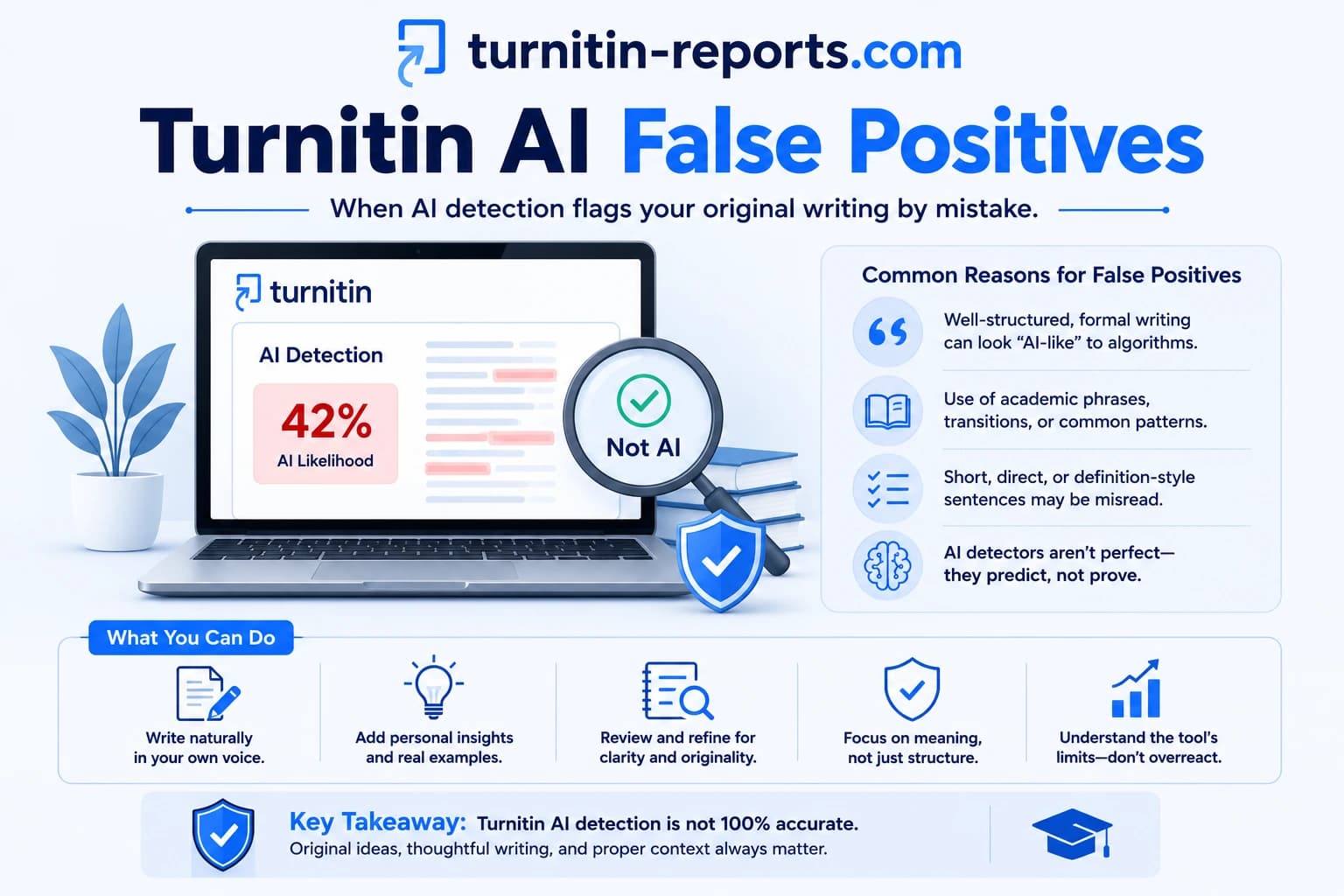
Look at the highlighted passages and ask yourself: are there specific phrases or sentences that might have triggered the detection? Common false positive triggers include passages written in a very formal academic register, sections describing standard methodology or definitions, and passages that follow a predictable citation-heavy structure. Being able to explain the specific passages in context strengthens your case.
Who to contact and when
According to guidance on appealing AI detection false positives, you have the right to respond to an allegation before any finding is made and before any sanction is imposed. The sequence typically looks like this:
- Instructor level. Most cases start here. Contact your instructor directly, explain that you believe the detection is a false positive, and ask to meet to discuss your evidence. Many cases are resolved at this stage — professors who understand the limitations of AI detection are often willing to review additional evidence before escalating.
- Academic integrity office. If your instructor has already referred the case, it moves to a formal academic integrity process. This typically involves a written notice of the allegation and a hearing. You have the right to present your evidence at this stage.
- Student ombudsman or advocate. If your institution has an ombudsman or student affairs advocate, contact them. They exist specifically to help students navigate institutional processes and can advise on your rights without taking sides.
- Formal appeal. If an adverse finding is made at the initial hearing, every institution with a formal academic integrity process has an appeals pathway. Appeals are typically heard by a different panel and apply a higher standard of review. According to AdvocatED's guidance on fighting AI detection false positives, appeals succeed in over 60% of documented cases when properly evidenced.
What to say — and how to say it
Whether you are emailing your instructor or presenting to an academic integrity panel, the framing of your case matters as much as the evidence:
- Be specific, not emotional. Present the evidence of your writing process chronologically — draft 1 on date X, research notes on date Y, revision on date Z. Panels respond to concrete timelines, not general protestations of innocence.
- Acknowledge the tool's limitations directly. Reference Turnitin's own documentation. Stating that “Turnitin's own guidance confirms the AI score should not be sole evidence of misconduct” and producing the relevant document shifts the burden of proof back toward the institution.
- Address the specific highlighted passages. If you can explain why specific flagged sentences read as AI-generated — for example, “this passage describes standard methodology using the same terminology found in three textbooks on the reading list” — you demonstrate understanding of the detection mechanism, which is itself credible.
- Know your institution's standard of proof. Academic misconduct findings are supposed to be based on “balance of probabilities” evidence — not on a single algorithmic score. Education law firm Nesenoff & Miltenberg notes that institutions relying solely on an AI report without corroborating evidence are on procedurally weak ground.
The legal backstop
If you exhaust institutional appeals and the finding stands, legal options exist. The Orion Newby case — in which a New York state Supreme Court judge ordered Adelphi University to expunge a student's record after a 100% AI score was used as the basis for an academic integrity finding — established that courts will intervene when due process is not followed. Inside Higher Ed reported this as the first court ruling of its kind. The Yale EMBA case and University of Minnesota case are ongoing, but the legal landscape is developing in students' favour.
Legal action is a last resort, but it is a real option. If your institution has imposed serious sanctions — suspension, expulsion, degree withdrawal — on the basis of an AI detection score alone, the Newby precedent is directly relevant.
Frequently asked questions
Can you appeal a Turnitin AI detection finding?
Yes. Every institution with a formal academic integrity process has an appeals pathway. Before reaching a formal appeal, most cases can be resolved at the instructor or academic integrity office level by presenting evidence of your writing process. Independent AI detector results, version history, and research notes are the most effective evidence. Appeals with proper documentation succeed in over 60% of cases.
What is the best evidence to use in a Turnitin AI appeal?
Google Docs or Word version history showing your document evolving across multiple sessions is the most compelling single piece of evidence. Supplement it with research notes, drafts, independent AI detector results from GPTZero and Copyleaks, and Turnitin's own published guidance stating the AI score should not be sole evidence of misconduct. A layered case built on multiple types of evidence is far stronger than a single argument.
Does Turnitin report academic misconduct to universities automatically?
No. Turnitin provides the AI Writing Report to whoever has instructor access. The decision to act on the score and escalate to an academic integrity process is made by the instructor, not by Turnitin. The report is a tool — the misconduct determination is a human decision.
Has anyone ever won a case against a university over a Turnitin AI false positive?
Yes. In February 2026, Orion Newby won a court ruling against Adelphi University after a New York state Supreme Court judge found the university's use of a 100% Turnitin AI score as evidence was “without valid basis and devoid of reason.” The court ordered the university to expunge his academic record. Additional student lawsuits are ongoing at Yale and the University of Minnesota.
Ready to check your paper?
Get your Turnitin report in minutes.
Same report your institution generates — delivered privately, fast.
Related articles