Turnitin vs Free Plagiarism Checkers: What's the Difference?
Free plagiarism checkers and Turnitin check against completely different databases. Here's why a clean result from a free tool doesn't mean Turnitin will agree — and what you can do about it.
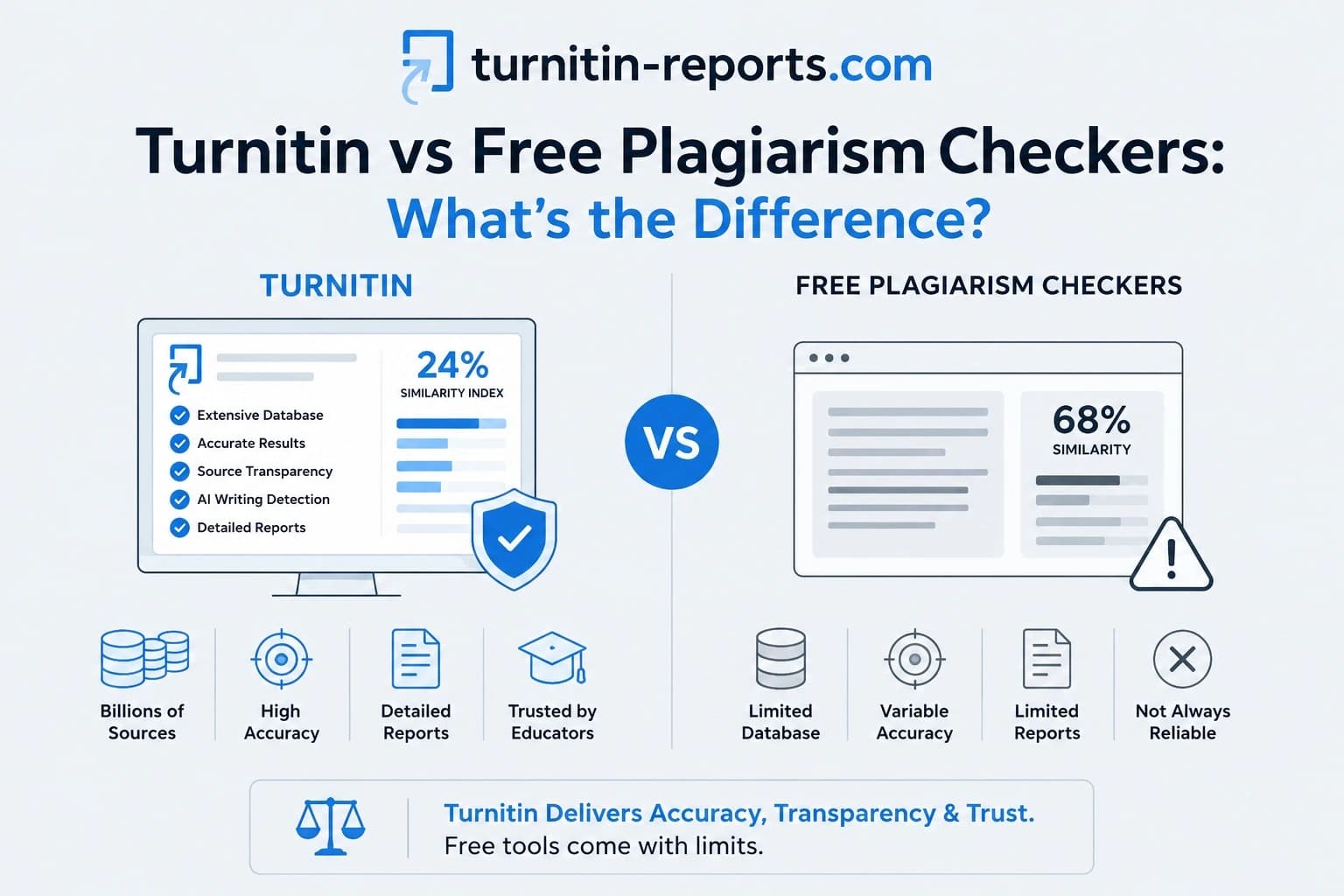
You ran your essay through a free plagiarism checker. It came back clean — 2% similarity, no issues found. You submitted with confidence. Then your university's Turnitin report came back at 31%, with several passages flagged against sources you never even read.
This happens more often than students realise. Free plagiarism checkers and Turnitin are not interchangeable tools. They work differently, check against entirely different databases, and produce results that can diverge dramatically on the same document. Understanding why is the difference between a false sense of security and actually knowing where you stand.
What makes Turnitin different from everything else
Turnitin is not primarily a web scraper. Most people assume it works like a search engine — scanning your text against websites and flagging copied content. That's part of what it does, but it's not the part that matters most.
The real differentiator is Turnitin's student paper repository. When a paper is submitted through an institutional Turnitin account, it is added to a private global archive. That archive now contains over 1.9 billion student submissions from universities around the world, accumulated over more than two decades. Every essay, dissertation, and coursework piece submitted through Turnitin at any of the 16,000+ institutions that use it becomes part of the comparison database for future submissions.
On top of that, Turnitin compares against:
- Over 70 billion current and archived web pages
- More than 69 million academic articles from 47,000+ journals and publishers
- Institutional repositories, theses, and dissertations
- Subscription-based content from major academic publishers that free tools cannot access
No free plagiarism checker has access to any of this. Not the student papers, not the restricted journal content, not the institutional repositories. That gap is what makes a free checker pass and Turnitin catch.
How free plagiarism checkers actually work
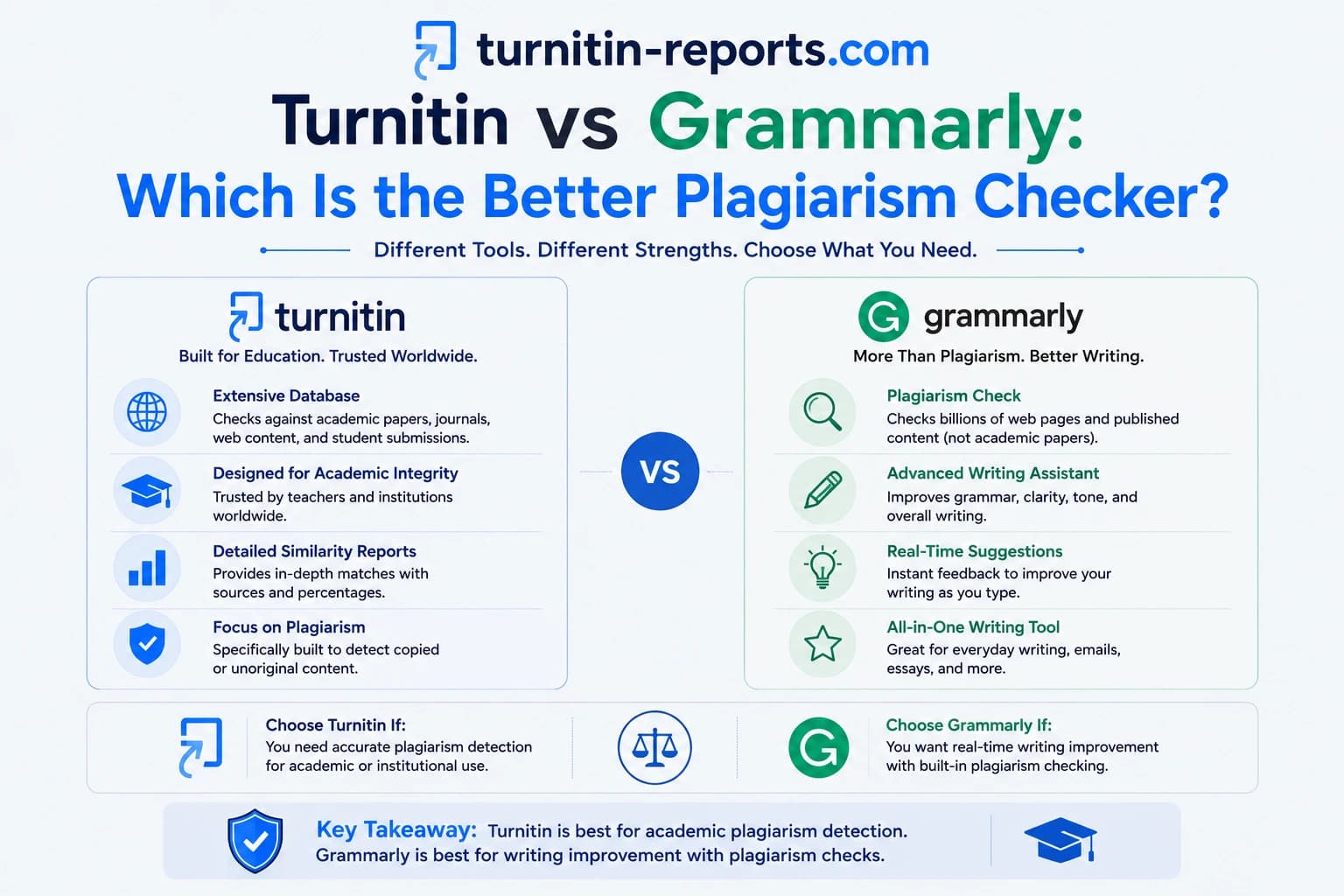
Free tools work by comparing your text against whatever they can index — primarily public web pages and a limited selection of open-access academic content. Some are better than others, but none of them come close to Turnitin's database scope.
Here is how the most commonly used free tools compare:
- Scribbr — The most accurate free option, with an 88% detection rate in independent testing. Good for catching web-based and open-access source matches. Charges per document for full reports and has no access to student paper archives.
- Quetext — Decent free-tier tool with a 53% detection rate, but caps free scans at 500 words — unusable for anything longer than a short assignment.
- Grammarly — Widely used but the free plagiarism check shows minimal results. It checks against web pages only and doesn't surface the detail you need to act on anything.
- DupliChecker — Fast and free, but independent testing found it detected only 7% of plagiarised content that other tools flagged at 25–79%. Effectively unreliable for academic use.
- Copyscape — Designed for detecting copied web content, not academic plagiarism. Useful for bloggers and content creators. No academic database access.
The pattern is consistent: free tools are useful for catching obvious web-based copying. They are not built for, and cannot replicate, what Turnitin does for academic submissions.
The critical differences, side by side
Database access
This is where the gap is most stark. Turnitin holds 1.9 billion student papers submitted by real students at real universities. Free tools have zero access to this. If a paper was previously submitted to any institution using Turnitin — whether it's a paper bought from an essay mill, recycled coursework, or a piece that happens to overlap significantly with another student's work — Turnitin will find it. Free checkers will not even know to look.
Detection accuracy
Turnitin uses advanced pattern-matching that detects paraphrased content, rearranged sentences, and sophisticated text manipulation — not just direct copying. Free tools predominantly match exact or near-exact phrases. A student who copies a paragraph and swaps several words for synonyms will often sail through a free checker. Turnitin's algorithms are trained specifically to catch this kind of rewriting.
What happens to your document
This is a concern many students overlook. When you upload a document to a free plagiarism checker, their data policies vary widely — and many are vague about whether your content is stored, indexed, or used to improve their service. Some tools explicitly retain content for extended periods.
When you use AIPlagGuides to check your paper before submission, your document is processed in non-repository mode — meaning it is scanned against Turnitin's database but never added to it. Your paper cannot be matched against by future submissions, and it is removed from our system once your report is delivered. You get the accuracy of Turnitin with none of the repository risk.
AI detection
Most free plagiarism checkers do not offer meaningful AI writing detection. Turnitin has a dedicated AI detection model that has been updated continuously since its launch, now covering English, Spanish, and Japanese. If your institution uses Turnitin's AI detection, no free tool will tell you what that score will be. You can read more about how that works in our guide on what the AI detection percentage means.
Report detail
Turnitin's similarity report shows you the exact percentage, colour-coded by range, every flagged passage highlighted in context, the specific source each passage matched against, and the proportion of matches coming from each source category. Most free tools give you a single percentage and a list of URLs. That level of detail is not enough to understand what is actually driving your score or what you need to fix.
Four scenarios where free checkers fail and Turnitin catches it
Previously submitted student papers
A student reuses an essay from a previous course, or buys a pre-written paper online. The free checker returns clean results — the content doesn't appear on any public website. Turnitin matches it against its archive of student submissions and flags it immediately. The older that paper is, the more confident the match.
Sophisticated paraphrasing
A student copies several paragraphs from a source and rewrites them using synonyms and restructured sentences. A basic checker sees no match. Turnitin's semantic analysis detects the underlying structure and flags the passages as highly similar to the original source.
Restricted journal content
A student quotes from a paper behind a paywall. The free checker has no access to that journal and returns nothing. Turnitin, through its publisher partnerships, covers 91% of the top 10,000 most-cited academic journals — including the one your source came from.
Collusion between students
Two students at different universities submit papers with overlapping sections. No free tool can detect this — neither paper is on the public web. Turnitin compares every submission against every other submission in its global archive and surfaces the match.
When free checkers are actually worth using
Free plagiarism tools are not useless. They have a specific use case: early-draft checking. Running a first draft through Scribbr or Quetext can catch accidental copying from web sources, help you identify passages you forgot to paraphrase, and give you a rough sense of where your writing relies too heavily on external material.
What they cannot do is tell you what Turnitin will say. For that, you need Turnitin itself. Using a free checker as your final check before submission is the same as testing a smoke alarm with a candle instead of a fire — the conditions aren't equivalent, and what passes one won't necessarily pass the other.
To understand what drives your similarity score and how to read the full report, see our guide on understanding your Turnitin similarity score.
Check with the real thing before you submit
The only way to know what your Turnitin report will look like is to run it through Turnitin. At AIPlagGuides, you get access to the same official Turnitin platform your institution uses — the same database, the same algorithms, the same report format — without needing an institutional account.
A similarity report costs $1.50. A bundle with AI detection is $2.70. Your document is never stored. The report is in your dashboard within minutes. If the score comes back higher than you expected, you still have time to review the flagged passages, revise your work, and recheck — all before your actual submission goes in.
Frequently asked questions
Will a free checker give me the same result as Turnitin?
No. Free checkers and Turnitin check against fundamentally different databases. A free checker cannot access Turnitin's 1.9 billion student papers, restricted journal content, or institutional repositories. The same document can return very different scores from each.
What is the most accurate free plagiarism checker?
Scribbr performs best in independent testing with an 88% detection rate on web-based and open-access content. Quetext is a reasonable free option for shorter texts. Neither is a substitute for Turnitin when it comes to academic submissions, because neither has access to the student paper repository.
Will a free checker store my paper?
Policies vary widely and are often vague. Some free tools retain uploaded content for extended periods or use it to train their services. If you're concerned about your work appearing in another database, read the privacy policy carefully before uploading — or use a service like AIPlagGuides that explicitly processes in non-repository mode.
Why did my free checker say 0% but Turnitin said 25%?
Almost always because the matching content is not on the public web — it is in Turnitin's student paper archive, a restricted journal, or an institutional repository. Free checkers have no visibility into any of these sources. A 0% result from a free tool only means the content doesn't appear on public websites — not that it's original.
Can I use a free checker instead of Turnitin?
As an early-draft check, yes — it's useful for catching obvious issues. As a final pre-submission check, no. Your institution runs Turnitin, so the only meaningful pre-submission check is Turnitin itself.
Ready to check your paper?
Get your Turnitin report in minutes.
Same report your institution generates — delivered privately, fast.
Related articles