Can Turnitin Detect a Bought Essay? What Students Need to Know About Contract Cheating
Turnitin's standard similarity check cannot catch a custom-written essay bought from an essay mill — but a separate Turnitin product called Authorship Investigate can, and human instructors catch what software misses. Here's exactly how contract cheating is detected and what the consequences are.
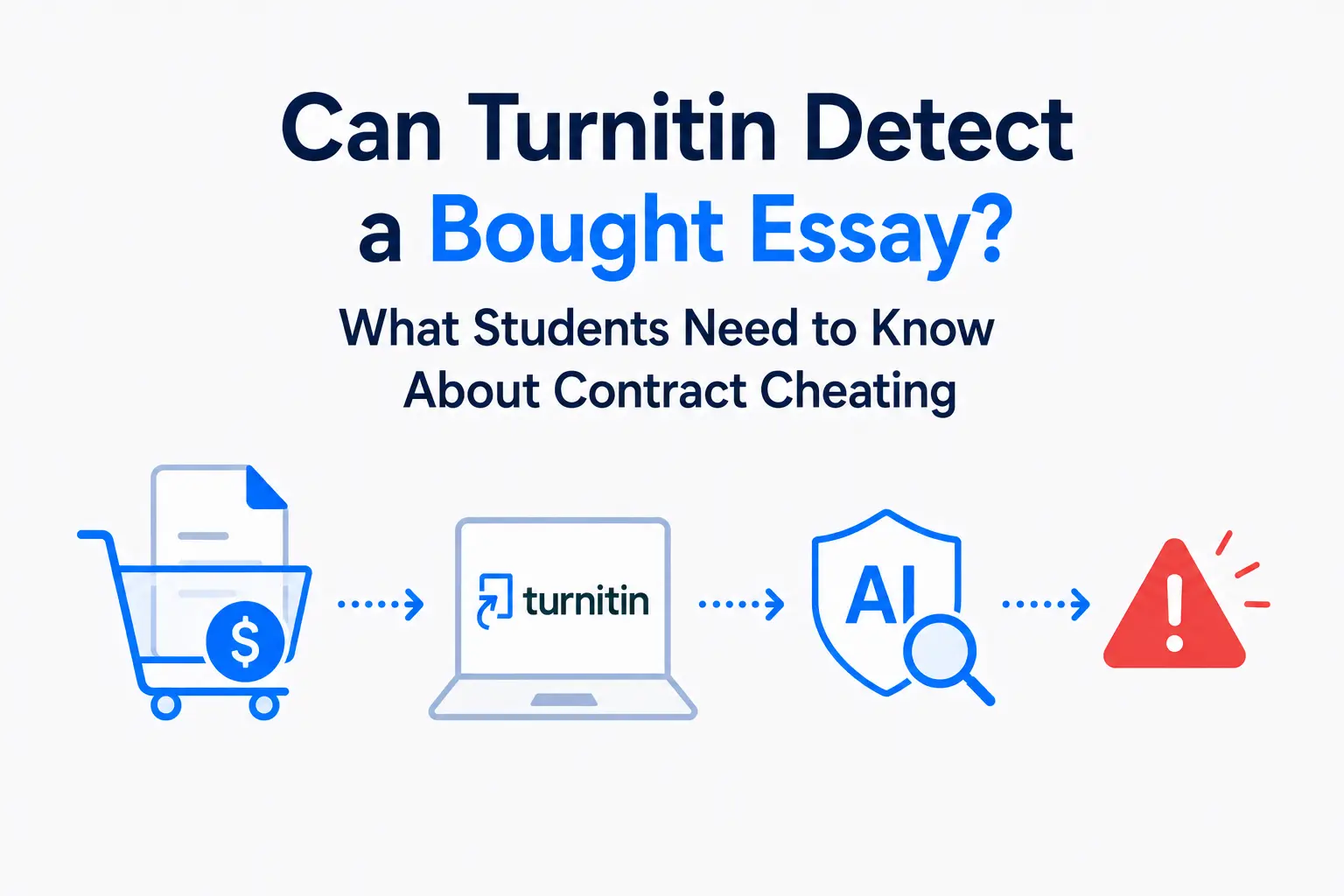
The question students ask is almost always the same: if you buy an essay that was written from scratch by a human writer, will Turnitin catch it? The direct answer is that Turnitin's standard similarity report will not — a custom-written essay that has never been submitted anywhere before does not exist in any database. But that is not the whole picture. Turnitin has a separate product built specifically for detecting bought essays, institutions use human signals that software cannot replicate, and the legal landscape around essay mills has changed substantially in the past three years. This post covers all of it.
What Turnitin's standard similarity report does not catch
Turnitin's Similarity Report works by comparing submitted text against three databases: previously submitted student papers, published academic content, and internet content. A custom-written essay ordered from an essay mill and written from scratch by a human writer will not exist in any of those databases. Turnitin acknowledges this directly on its own blog: the similarity check cannot detect original essays written from scratch, even if bought online.
This is the fundamental limitation of database-matching plagiarism detection — it finds text that matches something it has already seen. A genuinely original piece of writing, regardless of who actually wrote it, produces a low similarity score. Understanding this distinction helps explain why contract cheating has been difficult to address through similarity detection alone, and why the response has required completely different tools.
What the similarity report does flag from essay mills
Not all essay mill submissions escape the standard similarity check. Three scenarios create catches:
Recycled essays. Some essay mills reuse or resell the same work to multiple students. If a recycled essay was previously submitted by another student and stored in Turnitin's repository, the next student to submit it will generate a high similarity match against that stored paper. Essay mills selling premium “custom” work at low prices frequently reuse material — the student believes they have purchased something unique when the text is already in the database.
Metadata anomalies. Turnitin's enhanced Similarity Report includes an Integrity Flags panel that surfaces suspicious document metadata. File properties can reveal that a document was created by an author whose name does not match the submitting student, or was created and completed within an implausibly short time frame, or that authoring software inconsistent with the student's usual tools was used. These flags do not appear in the similarity percentage — they are surfaced separately for the instructor to review.
Hidden text and character manipulation. Some essay mills use techniques like white-on-white text (invisible filler text to inflate word count), Unicode character substitution (Cyrillic letters that look identical to Latin ones), or micro-font tricks. Turnitin's Flags Insight Panel detects these manipulations and flags them for instructors independently of the similarity score.
Turnitin Authorship Investigate — the dedicated contract cheating tool
Because the similarity report was never designed to catch contract cheating, Turnitin developed a separate forensic product called Authorship Investigate. It uses natural language processing and forensic linguistics to compare a submission against a student's portfolio of previous work — looking for statistical anomalies in writing style, vocabulary range, sentence structure, complexity, and topical familiarity that suggest the submitted text was not written by the same person who wrote their other work.
The tool was validated in a peer-reviewed pilot study published in Assessment & Evaluation in Higher Education: markers using Authorship Investigate identified 59% of contract cheating cases, compared to 48% without the tool — an 11 percentage point improvement in identification rate. Times Higher Education covered the pilot results, describing the detection rate as “six out of 10 contract cheating cases spotted.” Turnitin's own press release on the pilot provides additional detail on the methodology.
Authorship Investigate does not deliver a verdict. It surfaces a risk profile and flags specific linguistic anomalies for human review. Institutions using the tool are advised that a flag from Authorship Investigate should trigger a follow-up conversation with the student — often a viva-style discussion about the submitted work — rather than immediate disciplinary action. The Authorship Dashboard guide explains how institutions configure and interpret the tool's output.
How AI has changed the essay mill landscape
The rise of generative AI has created a new category problem for both forensic linguistics tools and AI detectors. Essay mills have adapted: some now openly advertise AI-generated essays that have been “humanized” — run through AI bypassing tools to reduce the statistical patterns that AI detectors look for. Others combine AI generation with human editing to produce text that scores low on both similarity and AI detection while being stylistically varied enough to evade Authorship Investigate.
As our post on how Turnitin's AI detection works explains, Turnitin added AIR-1 (its AI bypasser detection model) in August 2025 specifically to address AI-humanized text. But the arms race is ongoing. A student who submits AI-generated text that has been run through an effective humanizer may evade both the standard similarity report and the AI Writing Report — making the human signals described below increasingly important as the last line of institutional defence.
What actually catches bought essays — the human signals
Experienced instructors identify contract cheating through signals that no software detects. These are the mechanisms that catch the majority of successfully prosecuted contract cheating cases:
- Sudden unexplained improvement. A student whose previous work shows consistent weaknesses — grammatical patterns, argument structure, citation style — submits work at a markedly higher level. Instructors who know their students notice this immediately.
- Stylistic inconsistency with in-class work. Invigilated essays, tutorial contributions, and seminar discussions establish a baseline for a student's writing style. A submission that reads nothing like that baseline, even at a high quality level, raises questions.
- Viva failure. Many institutions — particularly for dissertations and postgraduate work — conduct viva-style oral examinations where the student is asked to discuss their submitted work. A student who cannot explain the argument of their own essay, define terms they used, or discuss the sources they cited immediately establishes that they did not write it. Some institutions have introduced short mandatory oral defences for undergraduate coursework specifically for this reason.
- Content anomalies. References to events, statistics, or examples that were not available at the time the essay was written; citations to sources that the student would not have access to; examples drawn from a different national or cultural context than the assignment required.
- Submission timing anomalies. Document metadata showing the file was created minutes before submission, or that editing timestamps are implausibly short for the length and complexity of the work.
The legal situation — essay mills and the law
The legal landscape around contract cheating has changed substantially since 2022. In England, essay mills were criminalised under the Skills and Post-16 Education Act 2022. It is now a criminal offence for any business to provide or advertise essay writing services for students to submit for academic credit. The UK government announced this as part of broader post-16 education reform. Similar legislation exists across multiple Australian states.
An important nuance: the UK legislation targets providers, not buyers. A student who purchases an essay is not committing a criminal offence under the Act — but they remain fully exposed to institutional academic misconduct proceedings, which carry their own serious consequences independent of criminal law. Essays mills often operate offshore precisely to evade this legislation, and enforcement has been uneven. The Quality Assurance Agency's third-edition guidance on contracting to cheat in higher education provides the most comprehensive institutional overview of the regulatory and policy landscape for UK institutions.
Scale of contract cheating
Research estimates consistently place contract cheating engagement at 3–11% of higher education students globally. In US survey data, 2.8% of students reported purchasing work from essay mills “often or very frequently,” and 6.3% “sometimes.” Notably, 21.1% of respondents suspected their peers of contract cheating — suggesting the perception of prevalence significantly exceeds the actual rate.
The global essay writing services market was estimated at $1.8 billion in 2024, projected to reach $2.3 billion by 2026. Turnitin's overview of contract cheating and academic integrity and its related post on combating contract cheating through legislation and institutional action provide further statistical context alongside the institutional response landscape.
Institutional consequences
For students caught submitting bought essays, institutional consequences under academic misconduct policies are entirely separate from any criminal exposure. Depending on the institution, the severity of the offence, and whether it is a repeat finding, consequences range from grade penalties on the affected assignment, to automatic failure of the module, to suspension, to permanent expulsion and degree revocation. A finding of academic misconduct can appear on a student's academic record and in references — with consequences that extend well beyond the specific assignment.
As our post on how professors act on Turnitin flags explains, any Turnitin flag — whether from similarity detection, AI Writing Report, Authorship Investigate, or metadata anomalies — is a trigger for human review and conversation, not an automatic disciplinary finding. But the consequences that follow from a properly evidenced finding of contract cheating are typically more severe than those from other forms of academic misconduct, because the intent is more deliberate.
Frequently asked questions
Can Turnitin detect a bought essay written from scratch?
Turnitin's standard similarity report cannot detect a custom-written essay that has never been submitted anywhere before — it has nothing to match against. Turnitin's Authorship Investigate tool can detect stylistic inconsistencies between a bought essay and a student's previous work, flagging the submission for human review. Human instructors remain the primary detection mechanism for well-executed contract cheating.
What is Turnitin Authorship Investigate?
Authorship Investigate is a separate Turnitin product that uses forensic linguistics and NLP to compare a submission against a student's writing portfolio, looking for anomalies that suggest the work was not written by the same person. In a peer-reviewed pilot study it identified 59% of contract cheating cases — an 11-point improvement over manual detection. It does not produce a verdict; it surfaces a risk profile for human review.
Is buying an essay from an essay mill illegal?
In England, providing or advertising essay mill services is a criminal offence under the Skills and Post-16 Education Act 2022. The legislation targets essay mill providers, not students who buy from them. Students who buy essays are not criminally liable under the Act, but they remain fully exposed to institutional academic misconduct proceedings, which can result in suspension, expulsion, and degree revocation.
If an essay was written by a human, will it get a high AI score on Turnitin?
Not necessarily. A human-written essay — even one purchased from an essay mill — will not automatically trigger Turnitin's AI Writing Report, because that report measures statistical patterns consistent with AI generation, not the origin of the work. However, if the essay mill used AI to generate or assist the text (increasingly common), the AI Writing Report may flag it. The similarity report and AI Writing Report detect different things; neither was designed specifically to catch contract cheating.
Ready to check your paper?
Get your Turnitin report in minutes.
Same report your institution generates — delivered privately, fast.