Can Turnitin Detect AI-Generated Images? What Students Need to Know
Turnitin is a text-only system — AI-generated images from Midjourney, DALL-E, or ChatGPT's data analysis are completely invisible to it. Here's why, what tools can actually detect AI images, and how institutions are handling a gap that automated detection can't fill.
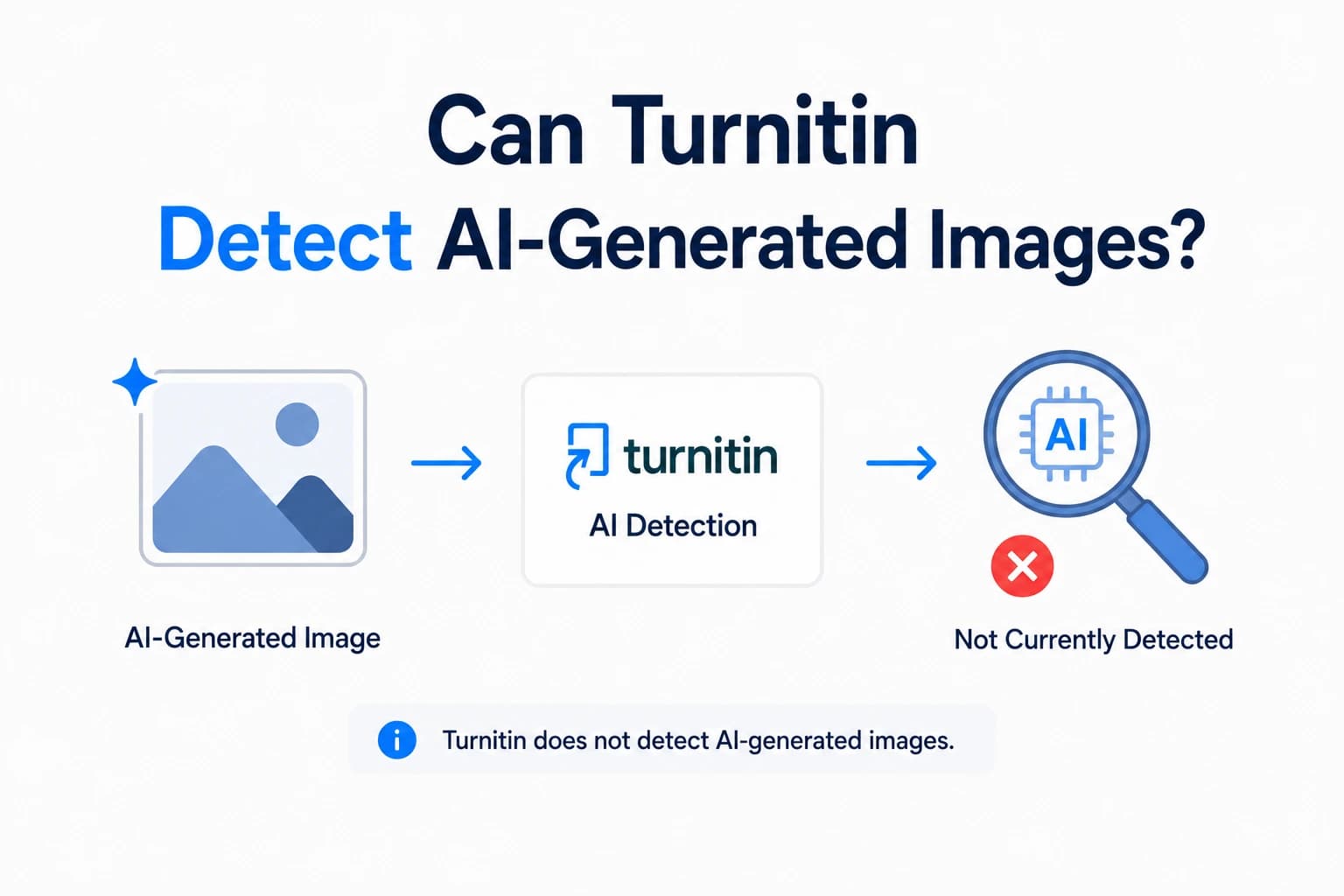
Turnitin cannot detect AI-generated images. Its entire detection system — both the Similarity Report and the AI Writing Report — is built on text analysis. An image embedded in your submission, whether it was photographed, drawn by hand, or generated by Midjourney, DALL-E, or Stable Diffusion, is completely invisible to Turnitin's algorithm. This is not a gap that is about to be patched in a routine update — it reflects a fundamental architectural difference between text detection and image detection. Understanding exactly what Turnitin can and cannot see, and what other mechanisms exist, is worth knowing before you assume images in a submission go unscrutinised.
Why Turnitin cannot see images at all
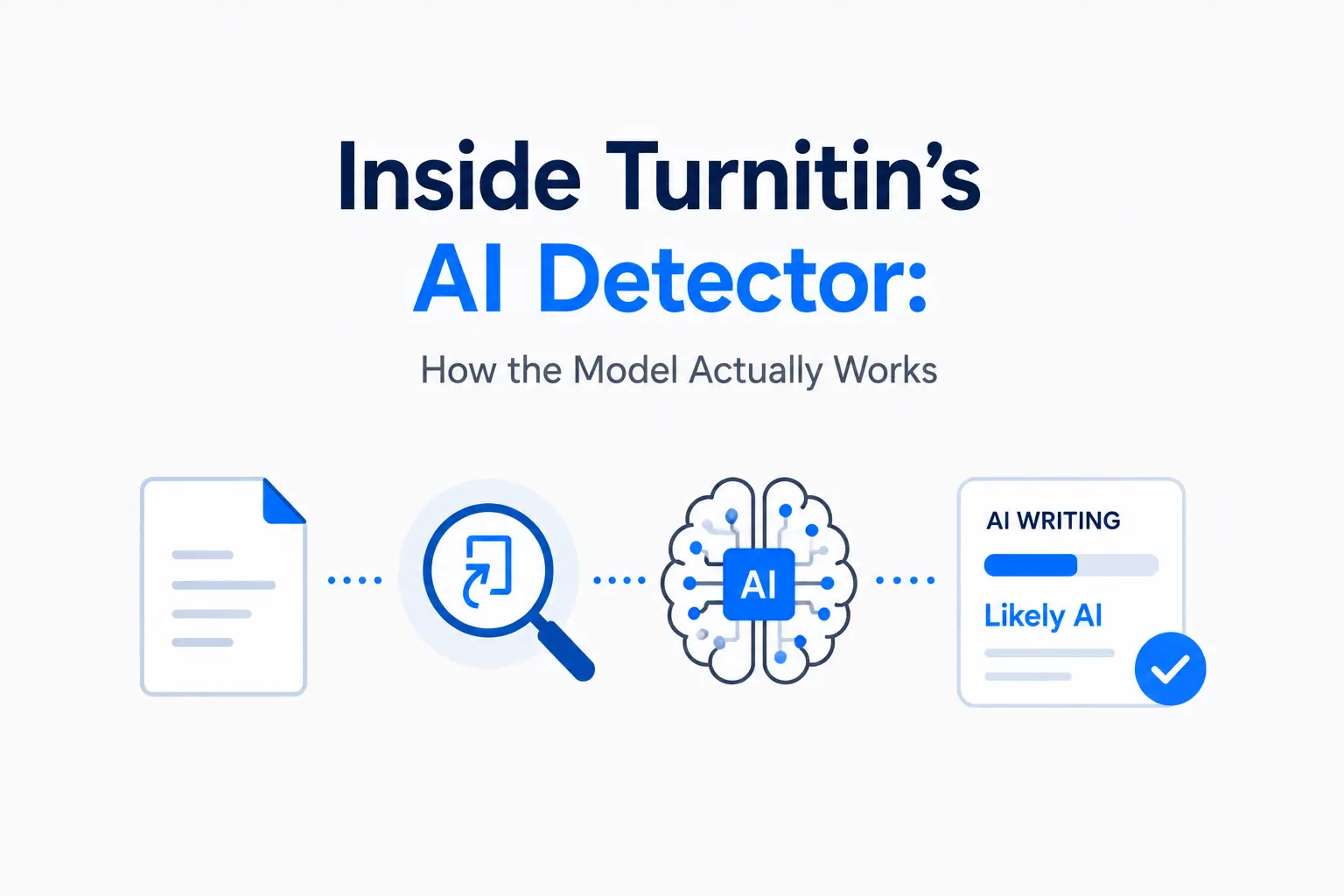
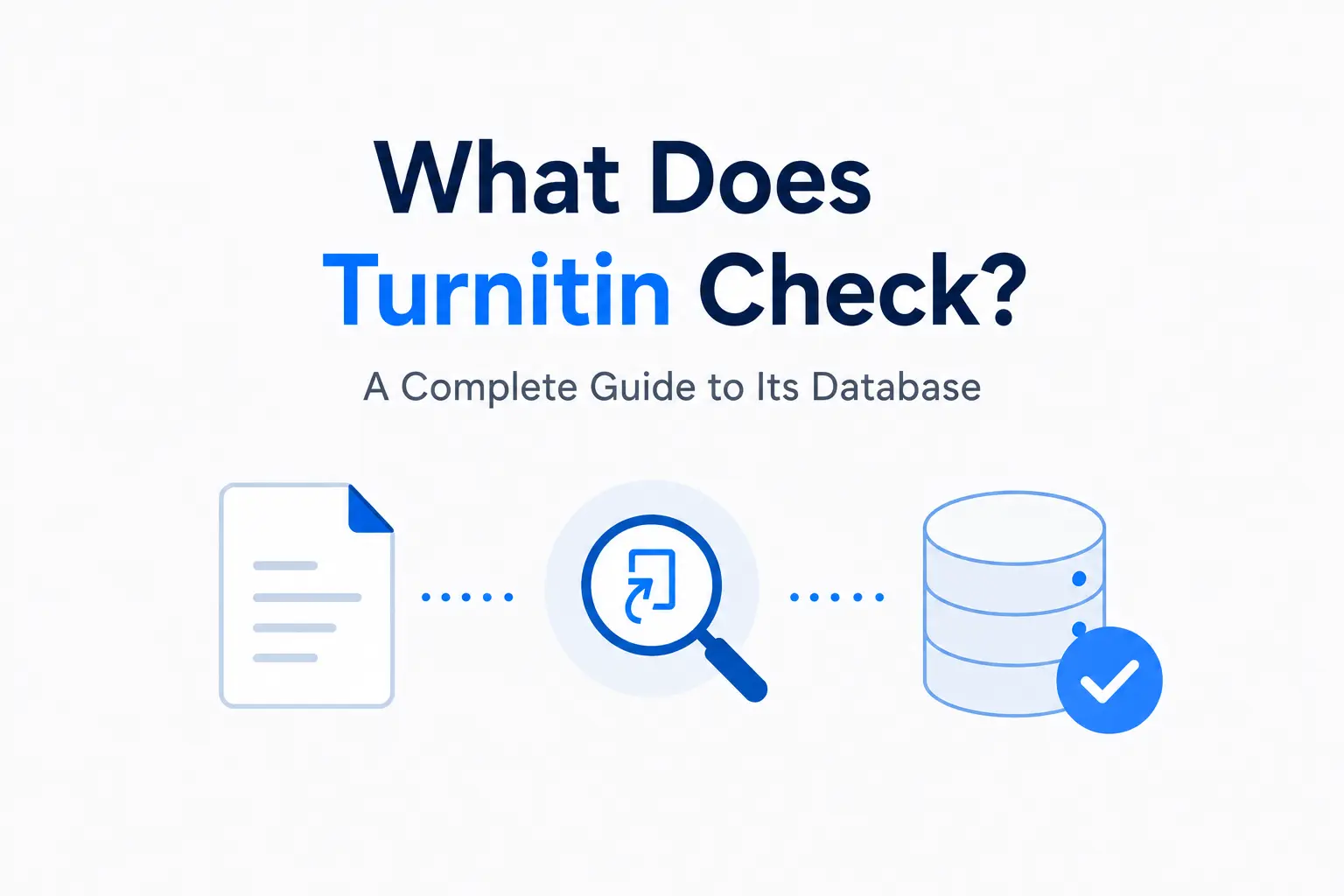
Turnitin is a text extraction and comparison system. When you submit a document, Turnitin extracts every word it can read and runs that text through two separate analyses: the Similarity Report (which matches your text against its database of previously submitted papers, websites, and published content) and the AI Writing Report (which measures the statistical properties of your prose).
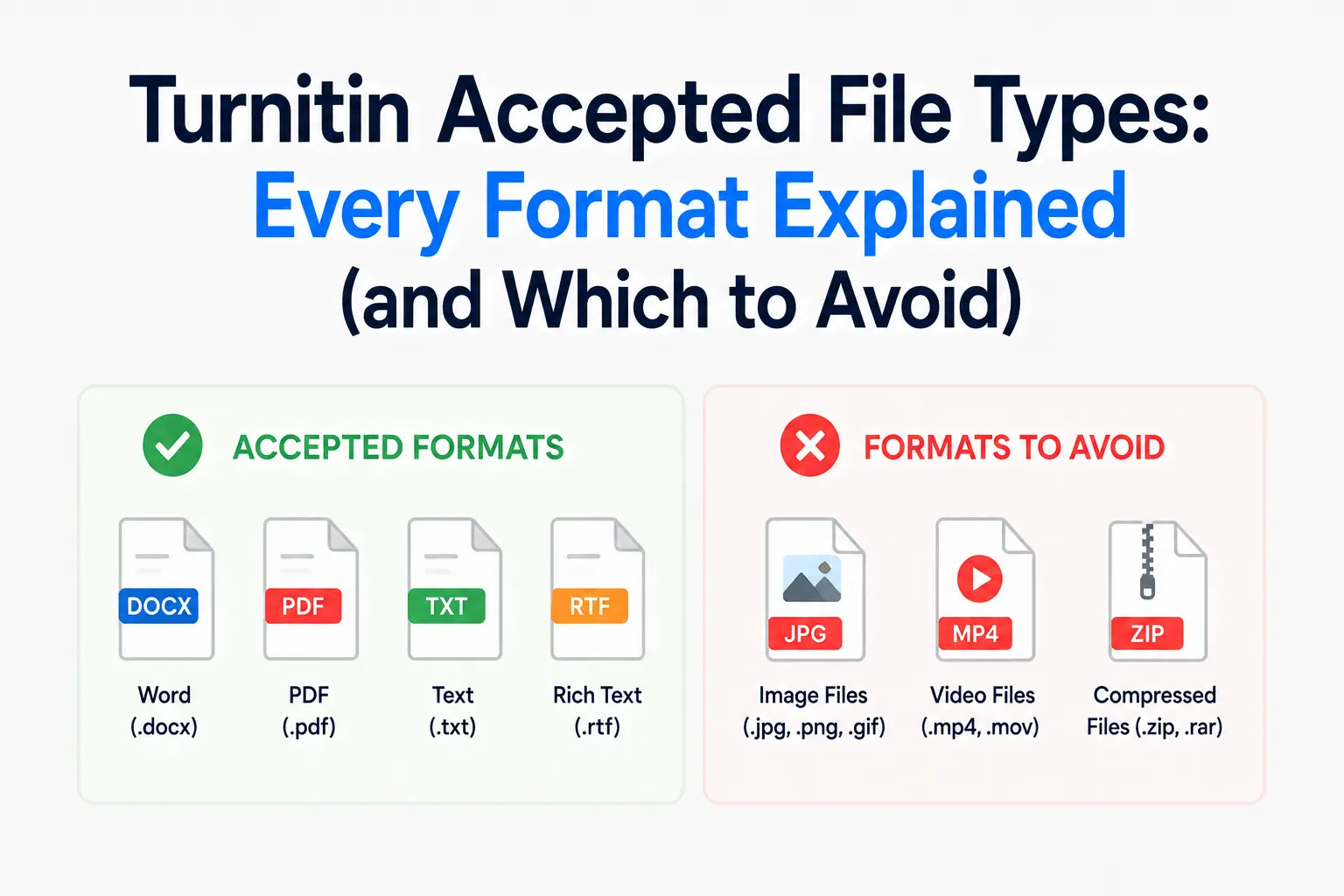
Images are not part of either process. Turnitin's file requirements documentation explicitly states that documents must contain highlightable text — scanned image files and image-only PDFs are rejected outright because there is no text to extract. For documents that do contain text alongside embedded images (a standard Word essay with a diagram, for example), the text is extracted and processed while the image pixels are simply ignored. Turnitin has no OCR capability, no image comparison engine, and no visual pattern recognition system. The similarity score is calculated as matching words divided by total words — images contribute zero to that count.
The AI Writing Report has the same limitation. Turnitin's AI writing detection model documentation defines what it can analyse as “qualifying text — prose sentences contained in long-form writing format.” It explicitly does not detect non-prose content, code, or short-form writing. Images are entirely outside its scope. Our post on how Turnitin's AI detection works explains the perplexity and burstiness metrics that underpin this — metrics that require words to exist in the first place.
Three scenarios where this matters
1. AI-generated creative images in art, design, and architecture submissions
Students in art and design programmes, architecture courses, and creative disciplines who use Midjourney, DALL-E, or Stable Diffusion to generate images for submitted work — portfolio pieces, rendered concepts, visual essays — face zero detection risk from Turnitin specifically. The image files are invisible to it. As our post on what Turnitin checks explains, even the text captions and labels surrounding an image are the only thing Turnitin can read; the visual content itself is not processed.
This does not mean such submissions are risk-free. Institutions increasingly have policies that specifically address AI-generated visual work, and many require disclosure regardless of whether any detection tool is involved. The College Board prohibits AI image generation in AP Art and Design coursework entirely. The National Art Education Association's position statement on AI and visual arts education states that “image generation without proper attribution is a breach of academic integrity akin to plagiarism.” The School of Visual Arts in New York requires students to document which tools were used and what prompts generated each iteration — with or without detection software being involved.
2. AI-generated charts and graphs from ChatGPT's data analysis
ChatGPT's Advanced Data Analysis feature allows users to upload a dataset and generate charts, graphs, bar plots, scatter plots, and statistical visualisations automatically. The output is exported as PNG image files. When a student pastes one of these generated charts into a Word document or PDF and submits it to Turnitin, it is treated as an embedded image — completely outside Turnitin's analysis. There is no “AI-generated chart” detection in any current academic tool.
This is a meaningful gap. A student could submit a lab report or data analysis assignment where every visualisation was generated by an AI tool and the surrounding prose was written by the student — and Turnitin would only analyse the prose. As our post on Turnitin's accepted file types explains, PowerPoint submissions present the same issue: images on slides are not checked at all.
3. AI-manipulated scientific images in research submissions
The most documented and serious version of this problem occurs in academic research: students and researchers generating or manipulating scientific images such as microscopy slides, Western blot results, histology sections, and flow cytometry data. A 2022 study published in PMC on AI-enabled image fraud in scientific publications found that fabricating scientific images “requires only modest technical skills” and that the generative models needed are “easily available on the internet.” Standard Turnitin cannot detect any of this.
For research manuscript submissions, there is one emerging tool that addresses this specifically — covered in the next section.
What actually can detect AI-generated images
Several tools exist for AI image detection, but none are purpose-built academic integrity products integrated into a learning management system the way Turnitin is. They fall into three categories:
Consumer and API detection tools
Independent accuracy testing in 2026 found the following detection rates on raw AI-generated images across major generators:
- Hive Moderation: ~94% aggregate accuracy (Midjourney: 94%, DALL-E 3: 91%, Stable Diffusion: 87%). B2B API, not student-facing.
- Illuminarty: ~91% overall, with a heatmap showing which image regions triggered detection. Free tier available (5 scans per day).
- AI or Not: 88–97% range depending on generator, with a consumer-facing free tier.
- GPTZero: Primarily a text detector that added image scanning as a secondary feature for academic institutions. Accuracy lags the specialist tools above.
- Copyleaks: Launched an AI image detector in November 2025, with plans to expand into audio and video. Independent testing found mixed results including false positives on genuine photographs.
According to Imagera AI's 2026 image detector accuracy comparison, accuracy drops dramatically after post-processing — compression, cropping, filtering, or social media re-upload can reduce detection accuracy to near-zero in adversarial conditions. These tools are useful for a first pass, not a definitive verdict.
Proofig AI and Turnitin PubShield — for research manuscripts only
In September 2025, Turnitin partnered with Proofig AI to launch PubShield, combining Turnitin's iThenticate text analysis with Proofig's image integrity screening. PubShield detects image duplication, manipulation, and AI-generated visuals in scientific manuscripts — specifically life science contexts like Western blots, microscopy, and flow cytometry. It is used by major publishers including Elsevier and Springer Nature.
This is not a product available for undergraduate coursework. It is aimed at institutional research workflows and journal manuscript review — relevant if you are a postgraduate researcher submitting to a publisher, not if you are submitting a lab report to your LMS.
C2PA content credentials and watermarks
As of 2026, every image generated by DALL-E, Midjourney, Adobe Firefly, Google Gemini, and Imagen carries a C2PA (Coalition for Content Provenance and Authenticity) cryptographic manifest — essentially a “nutrition label” embedded in the file metadata recording which tool created it and when. Google's SynthID adds an additional invisible watermark to Google AI-generated images. An instructor who opens the file properties of a submitted image and checks for C2PA metadata would see the origin information — but this requires deliberate, manual verification and the metadata is easily stripped by taking a screenshot or re-saving the file.
What institutions actually do about AI images
Because no automated tool integrates into standard academic submission workflows for image detection, institutions rely primarily on human judgment and process-based assessment:
- Process portfolios. Requiring students to submit draft stages, reference images, working files, and revision history alongside the final submission. An AI-generated image has no equivalent draft process — a Midjourney output has no sketches, no reference photos, no iteration history that a student can produce.
- Viva and critique. Art, design, and architecture programmes typically include studio crits or viva examinations where students discuss their creative decisions, explain their process, and respond to questions about their work. A student who cannot explain the choices behind their submission raises immediate questions.
- Instructor visual familiarity. Experienced instructors in visual disciplines often recognise the aesthetic signatures of AI-generated images — the specific quality of lighting, the characteristic errors in hands and text, the stylistic homogeneity — in the same way that text instructors learn to recognise AI prose. This is imperfect but real.
- Mandatory disclosure policies. Several institutions require students to declare what AI tools were used in any submission, regardless of detection. A student who does not disclose AI image use and is later found to have done so faces an additional honesty violation on top of the original misconduct charge.
Academic publishers handling research manuscripts have moved faster. A 2026 analysis of AI-generated figures in academic publishing found that Cell Press, Nature, and Science have all introduced explicit policies on AI-generated figures — ranging from mandatory labelling (Nature) to a categorical ban on AI-generated figures in primary research data (Science). For coursework submissions, policies are less standardised but evolving quickly: according to HEPI's 2026 student generative AI survey, 92% of full-time UK undergraduates now use AI tools in some aspect of academic work, and 87% of universities updated their AI policies between January 2025 and early 2026.
The practical implication for students
Turnitin's inability to detect AI-generated images does not mean the risk is zero. The risk has simply moved from automated detection to human detection and policy-based consequences. A submission with AI-generated images that clearly do not match a student's prior creative work, or that carries the unmistakeable aesthetic of a generative AI output, creates the same risk of human suspicion that a written submission creates — without Turnitin being involved at all.
For students with legitimate AI image use questions — for example, using AI to generate a diagram to illustrate a concept in a science report, where the diagram is supplementary rather than the work itself — the safest path is the same as for any other AI use: check your institution's specific policy, disclose what you used, and be able to demonstrate that the core intellectual work of the submission is your own. Our post on how contract cheating is detected covers the broader point that human instructors remain the primary detection mechanism for forms of academic misconduct that automated tools cannot catch.
Frequently asked questions
Can Turnitin detect AI-generated images like Midjourney or DALL-E?
No. Turnitin's detection system — both the Similarity Report and the AI Writing Report — is text-only. Images embedded in submitted documents are not processed at all. An AI-generated image from Midjourney, DALL-E, Stable Diffusion, or any other generator is completely invisible to Turnitin's algorithm, regardless of how the document is submitted.
What about charts and graphs generated by ChatGPT?
ChatGPT's Advanced Data Analysis feature generates charts and graphs as PNG image files. When these are embedded in a submitted document, Turnitin treats them as images and does not analyse them. There is no current academic tool that detects AI-generated data visualisations in coursework submissions. Only the surrounding prose text is analysed by Turnitin.
Is there any tool that can detect AI-generated images in academic submissions?
For research manuscripts, Turnitin's PubShield product (in partnership with Proofig AI) detects AI-generated and manipulated scientific images. For undergraduate coursework, no tool is integrated into standard LMS submission workflows. Consumer tools like Hive Moderation, Illuminarty, and AI or Not can detect AI-generated images with 88–94% accuracy on unmodified images, but none are embedded in academic submission systems and accuracy drops significantly after image compression or re-saving.
Do AI-generated images carry metadata that shows they were AI-made?
Yes — as of 2026, all major AI image generators (DALL-E, Midjourney, Adobe Firefly, Google Gemini) embed C2PA cryptographic metadata recording the tool and creation date. Google's SynthID adds an additional invisible watermark to Google-generated images. However, this metadata is easily stripped by taking a screenshot or re-saving the file in a different format, so it is not a reliable detection mechanism in practice.
Ready to check your paper?
Get your Turnitin report in minutes.
Same report your institution generates — delivered privately, fast.