Why Your Turnitin Score Went Up After Resubmitting (And the 24-Hour Wait Explained)
You edited your paper and resubmitted — but your Turnitin similarity score went higher, not lower. Here's why that happens, why resubmissions after the third take 24 hours, and what to do before your next attempt.
You revised your essay, resubmitted it to Turnitin expecting a lower similarity score, and the number went up. Or you tried to resubmit and the report is taking 24 hours instead of the usual few minutes. These are two of the most common confused questions students post on Reddit about Turnitin — and both have straightforward explanations that Turnitin does not make obvious. Here is exactly what is happening and why.
How resubmissions work
Turnitin allows you to overwrite a previous submission with a new version, but there are strict rules on how many times you can do this and how quickly:
- First 3 resubmissions: Reports generate immediately — usually within 10 to 20 minutes.
- 4th resubmission onwards: You must wait 24 hours before a new Similarity Report is generated. This applies to each subsequent attempt after the third.
According to Turnitin's official resubmission guide, the 24-hour delay exists because the system needs time to remove your previous draft from its temporary index. Without the delay, your new version might match against your own old version — producing a misleadingly high similarity score. The wait is a technical safeguard, not a punishment. Our post on how long Turnitin takes to process submissions has the full breakdown on processing times.
Why your score went up after resubmitting
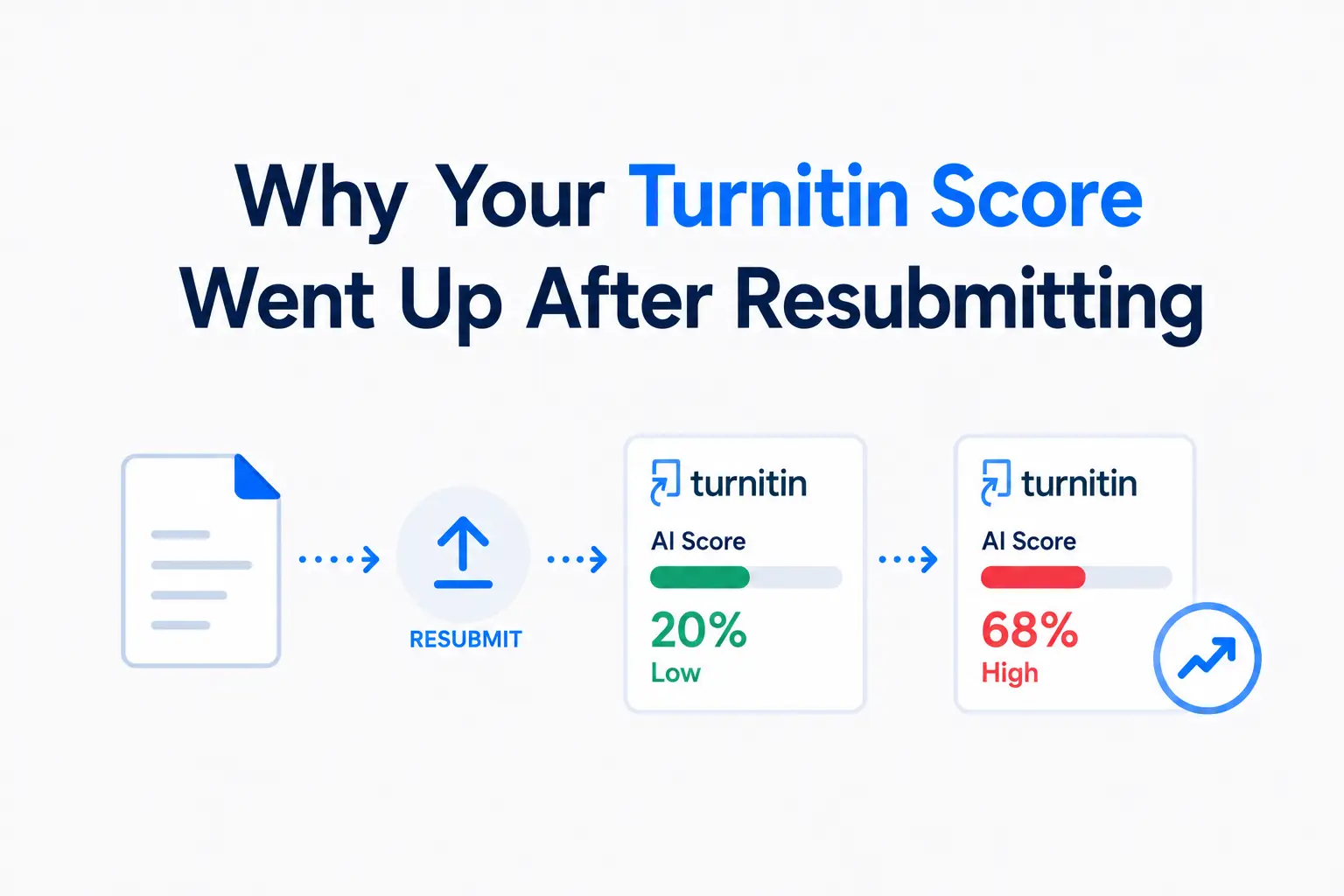
This is the part that confuses most students. You made changes to reduce your similarity score, resubmitted, and the number is higher than before. There are several reasons this happens:
1. You resubmitted too quickly
If you resubmit before the system has fully processed and cleared your previous submission from its index, your new version can match against your own old version — pushing the score up significantly. This is the most common cause. Always wait for the report from your previous submission to fully generate before resubmitting.
2. Your edits matched new sources
Synonym swaps and paraphrasing can inadvertently create matches with different sources in Turnitin's database. If you replaced a phrase to avoid matching Source A, the new phrasing might match Source B instead — or match it more closely than the original did. Heavy paraphrasing does not guarantee a lower score; it can produce a higher one if the reworded text happens to match widely used academic phrasing.
3. Post-deadline collusion checking ran
This is a major and poorly understood cause of score changes. After the assignment deadline passes, Turnitin regenerates all Similarity Reports for the assignment and now compares every submission against every other submission in the same class. If another student submitted work that overlaps with yours — intentionally or coincidentally — both scores rise. This collusion check runs automatically after the due date and can affect your score even if you never resubmitted.
4. Database updates changed what matches
Turnitin's database is continuously updated with new web content, newly published papers, and newly submitted student work from other institutions. A source that was not indexed when you first submitted might be indexed by the time your resubmission report generates — creating a new match that was not there before.
Why minor edits rarely move the needle
A common misconception is that changing a few words per paragraph will meaningfully reduce a similarity score. Turnitin matches text in chunks — it looks for overlapping strings of words, not individual word choices. Changing one word in a five-word phrase still leaves the surrounding context matchable. To genuinely reduce your similarity score, you need to substantially rewrite the matched passages: different sentence structure, different phrasing, different ordering of ideas — not just synonyms.
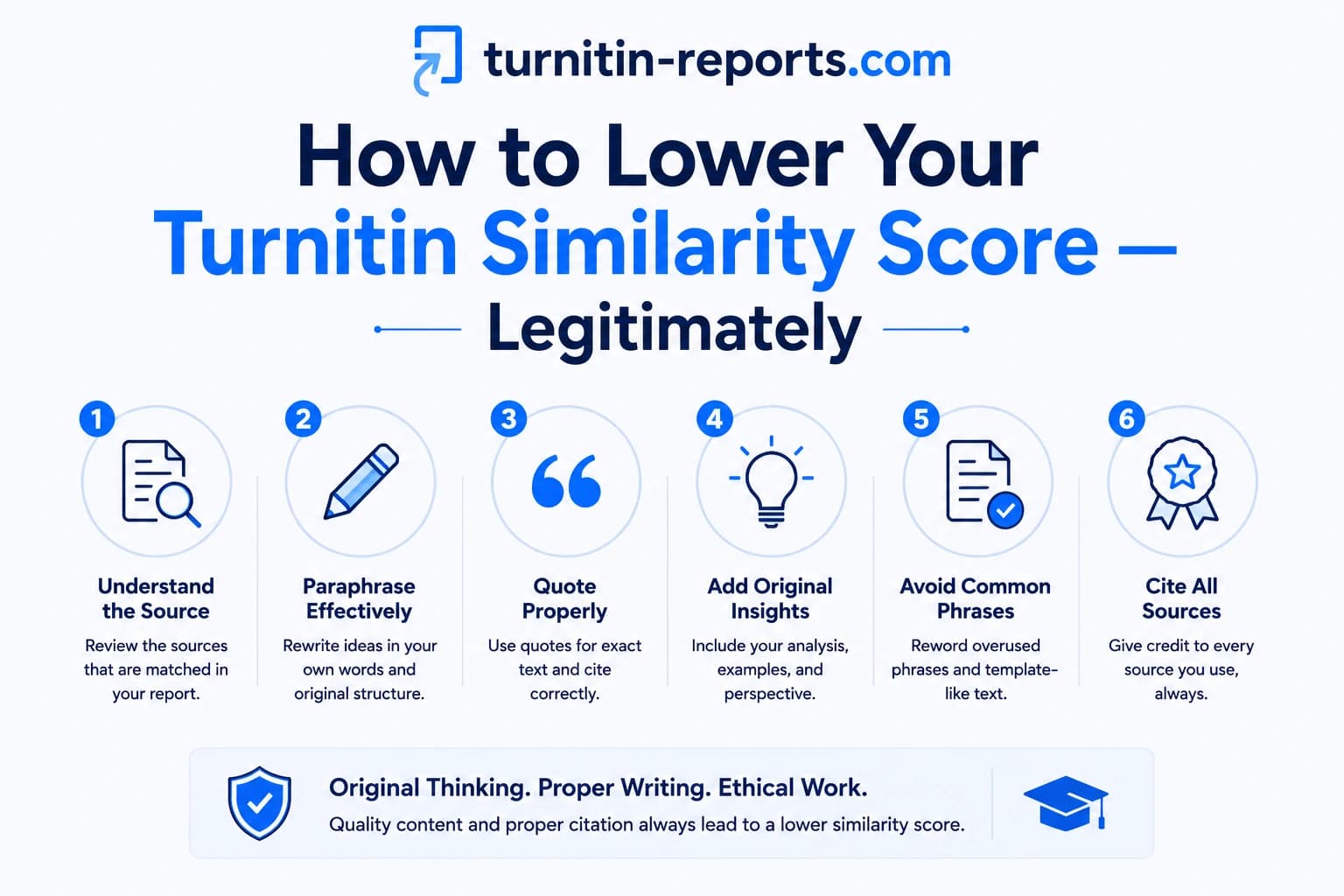
This is also why simply running text through a paraphrasing tool often backfires: the restructured output can match different sources, and the AI Writing Report will flag the paraphrasing separately. Our post on how to lower your Turnitin similarity score covers the techniques that actually work.
What to do before your next resubmission
- Wait for the current report to fully generate before resubmitting. Do not submit again while a report is still processing.
- Check which passages are actually matched in the Similarity Report before rewriting. Target the highlighted sections specifically rather than rewriting the whole document.
- Exclude your bibliography. Toggle the bibliography exclusion filter in your report view to see whether your reference list is driving the score. A long reference list can add 5-15 percentage points to your similarity score. Our guide on understanding your Turnitin similarity score explains how the exclusion filters work.
- Be aware of the submission deadline. If the deadline has passed and your score changed, it is likely the post-deadline collusion check — not anything you did. Contact your instructor and explain that your score changed after the due date regeneration.
Frequently asked questions
Why did my Turnitin score go up after I edited my paper?
Several things can cause this. The most common is resubmitting before the system has cleared your previous version, causing your new submission to match against your own old one. Other causes include your edits matching new sources, post-deadline collusion checking running against classmates' submissions, or Turnitin's database being updated with newly indexed content between your two submissions.
Why is Turnitin taking 24 hours for my resubmission?
After your third resubmission, Turnitin enforces a 24-hour wait before generating a new report. This delay exists so the system can remove your previous version from its temporary index, preventing your new submission from matching against your own old draft. The first three resubmissions generate reports immediately; the 24-hour wait applies from the fourth onwards.
Will resubmitting to Turnitin show my old submission as a match?
It should not, because Turnitin is designed to overwrite your previous submission rather than retain it as a separate entry in the database. However, if you resubmit too quickly — before the previous report has fully processed — the system may not have cleared the old version, causing a temporary self-match. Waiting for each report to fully generate before resubmitting prevents this.
Can my Turnitin score change without me resubmitting?
Yes. After the assignment deadline, Turnitin automatically regenerates all reports for the assignment and compares submissions against each other for collusion detection. If another student submitted work that overlaps with yours, both scores can rise. Turnitin's database also updates continuously, so newly indexed content can create new matches in your existing report.
Ready to check your paper?
Get your Turnitin report in minutes.
Same report your institution generates — delivered privately, fast.