What Is a Good Turnitin Score? What the Percentages Actually Mean
There is no universal Turnitin score to aim for — but under 15% is the widely accepted safe zone for most undergraduate essays, and the colour bands, discipline, and exclusion filters all change what 'good' means for your specific submission. Here's how to read your score the right way.
There is no single correct Turnitin similarity score to aim for — and Turnitin itself says so explicitly. What counts as “good” depends on your institution, your discipline, your assignment type, and whether your instructor has applied exclusion filters. That said, there are well-established patterns across thousands of institutions that give a clear picture of where most scores land, when a score becomes a problem, and what the colour bands actually signal. This guide covers all of it, including the separate question of AI detection — which is an entirely different number with different thresholds.
What Turnitin itself says about acceptable scores
Turnitin's own help centre is unambiguous on this point: “There is no fixed number to receive as a score in your Similarity Report. Every school, instructor, or assignment could have a different amount of matching text that is considered acceptable.” The percentage returned is described as a similarity score, not a plagiarism score — it indicates how much of your paper matches text found elsewhere in Turnitin's database. Whether that match represents plagiarism is a human judgment, not an automated finding.
This means that chasing a specific number — trying to get below 20% as if that were a universal pass mark — misunderstands how the tool is used. As our post on understanding your Turnitin similarity score explains, the score is a starting point for review, not a verdict.
The colour bands and what they signal
Turnitin uses five colour bands to give instructors a quick visual read of where a submission sits. The standard bands used by most institutions are:
- Blue — 0%: No matching text found at all. This is unusual for a well-cited academic paper and can occasionally indicate that the submission did not process correctly.
- Green — 1–24%: Minor or insubstantial similarity. This is the range most properly written undergraduate essays land in. Instructors typically review the source breakdown at this level but rarely escalate.
- Yellow — 25–49%: Medium similarity. Most institutions flag this range for manual review. Whether it is a problem depends entirely on what is driving the score — extensively cited work with a bibliography can land here without any misconduct concern.
- Orange — 50–74%: Medium-to-high similarity. This level attracts serious scrutiny in almost all institutional contexts and usually prompts a direct conversation with the student.
- Red — 75–100%: Extensive similarity. Investigation territory at virtually every institution.
One important caveat: these bands are not universal. Some institutions and LMS configurations use different ranges — SUNY Empire State University, for example, uses 20-point increments (Blue 0–20%, Green 21–40%, Yellow 41–60%, and so on). A paper that appears green at one institution might appear blue at another, depending on which band configuration is active. The colour is a triage indicator for instructors, not a standardised verdict. What matters is the number, not the colour.
What most universities actually consider acceptable
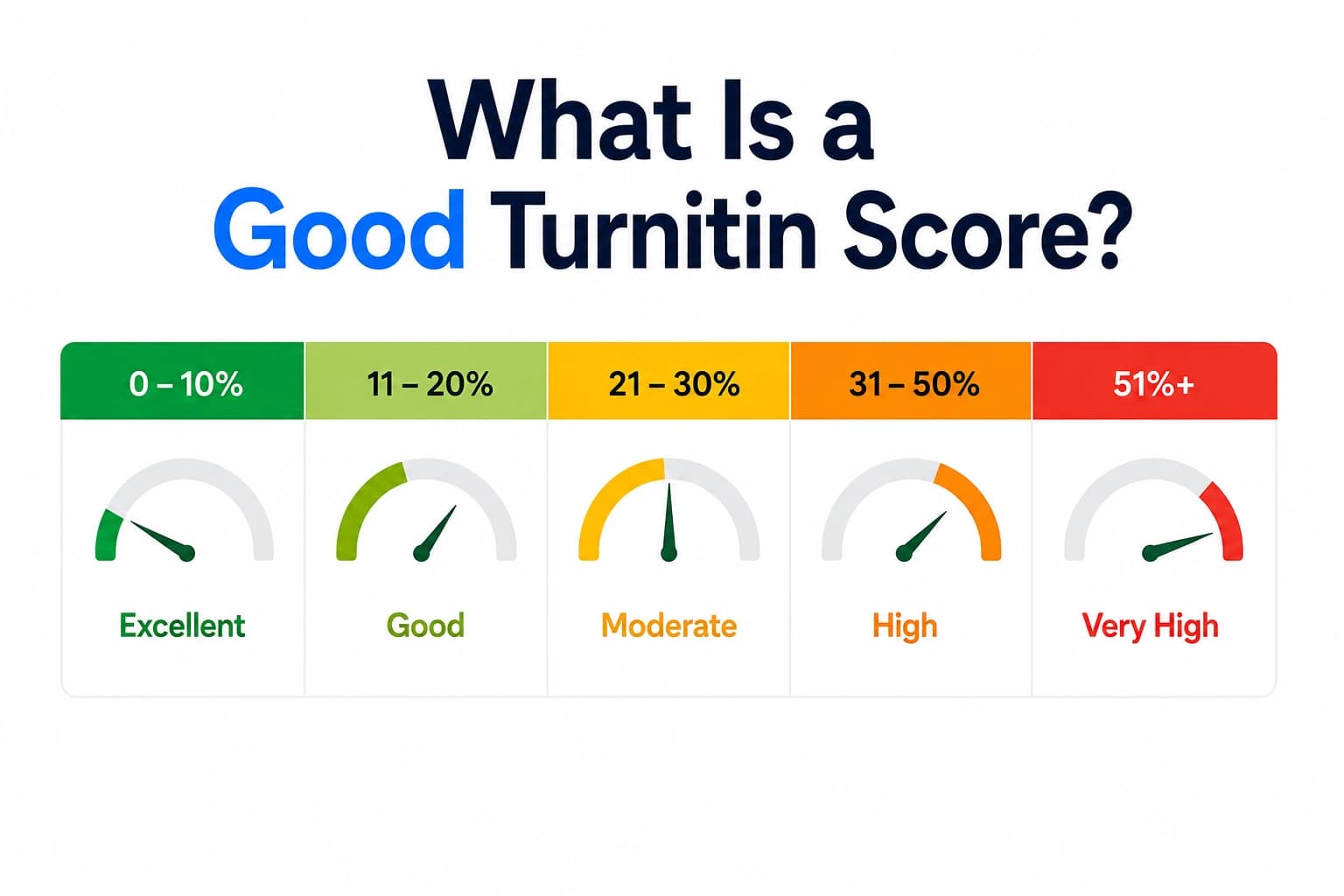
While there is no universal threshold, patterns are consistent enough to offer practical guidance. The broadly reported benchmarks are:
- Under 15%: Widely considered the safe zone for standard undergraduate essays. Most institutions will not initiate any review at this level.
- 15–25%: Warrants a look at the source breakdown. If the score is driven by a reference list and properly cited quotations, it is unlikely to be a concern. Unexplained prose matches at this level are more problematic.
- Above 25%: Majority of universities flag for manual instructor review. Not automatic misconduct, but requires explanation.
- Above 40–50%: Serious territory at almost every institution.
A small number of institutions do publish explicit thresholds. Boston University's Graduate Medical Sciences programme states that the similarity index must be below 20% for dissertation submissions, with anything above requiring revision and resubmission. The University of the West Indies guidelines describe below 15% as indicating plagiarism has probably not occurred, and above 25% as high. Geneva College requires the AI Writing Indicator to be below 25% for resubmissions.
Many more institutions explicitly reject numerical thresholds. The LSE's Turnitin policy states directly: “No similarity score (%) threshold should be used within Departments. The similarity score (%) is flawed.” The University of Leeds, University of Warwick, and University of Reading all publish similar guidance — the score is context-dependent and academic judgment, not the number, determines whether misconduct has occurred.
How discipline changes everything
The most important contextual factor is subject area. A 25% score means very different things in different disciplines:
- Law: Case law citations, statute quotations, and legal precedent wording are verbatim by nature — this is how legal writing works. Law students legitimately run 25–30% similarity with correctly cited work. A lower score in a law essay can sometimes indicate undercitation.
- Medicine and nursing: Clinical guideline language, drug dosage protocols, and standard procedure descriptions use fixed terminology that cannot simply be paraphrased. Baseline similarity is higher in medical writing than in humanities.
- STEM and lab sciences: Method sections, reagent descriptions, and standard protocols repeat across submissions within the same discipline. A biology lab report will structurally resemble other biology lab reports in ways that inflate similarity scores without indicating misconduct.
- Humanities and social sciences: Original argument and close analysis are the primary outputs. Higher similarity attracts more scrutiny here than in STEM, because less of the content has a legitimate reason to match existing sources.
- Creative writing: Expects near-complete originality. Even 10% can be considered high in this context.
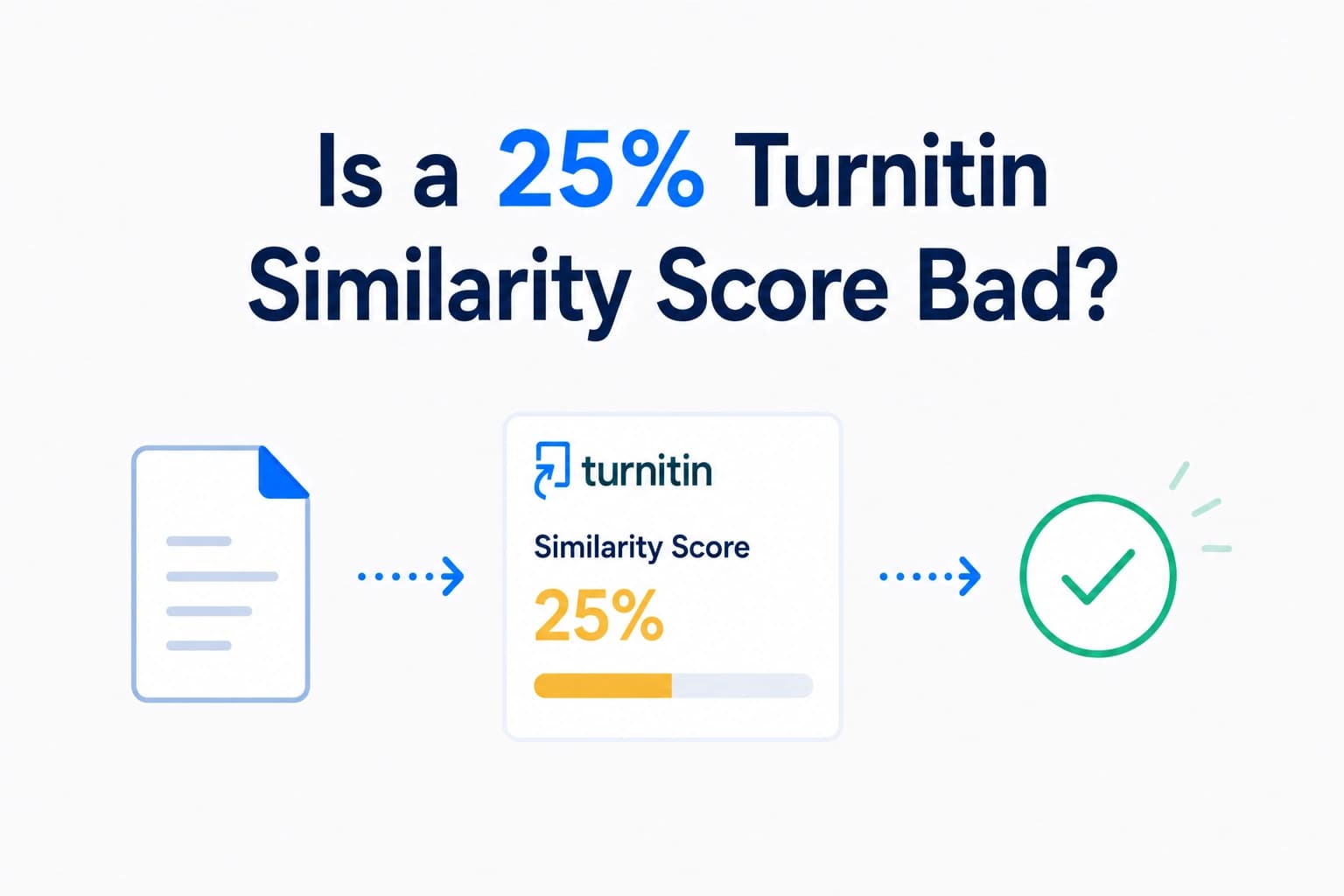
Our post on whether 25% is bad on Turnitin covers this discipline variation in more detail, with specific examples of how instructors in different fields interpret the same number differently.
How exclusion filters change what “good” means
This is one of the least understood aspects of Turnitin scores, and it matters significantly for interpreting your number. Instructors can apply up to three exclusion filters that reduce what is counted in the similarity percentage:
- Bibliography exclusion: Removes your reference list from the calculation. A bibliography alone typically adds 5–10 percentage points to any well-cited paper. Toggling this filter off can drop a 22% score to 12–14% instantly.
- Quotes exclusion: Removes text in quotation marks. An essay that legitimately quotes primary sources extensively can drop significantly with this filter applied.
- Small matches exclusion: Filters out matches shorter than a configurable word threshold (usually 8 words), removing common academic phrases and boilerplate language.
The practical implication: two students with identical papers can see different scores depending on whether their instructor applied these filters. If you are comparing your score to an institutional threshold, ask your instructor whether filters are applied. A raw score of 22% without filters is a very different situation from a filtered score of 22%. Our post on what Turnitin checks beyond body text explains these filters in full detail.
Similarity score vs AI detection score — two completely separate systems
A point that causes significant confusion: the similarity percentage and the AI Writing Report percentage are entirely independent. They measure different things using different methods and do not influence each other.
The Similarity Report compares your text against Turnitin's database and reports what percentage matches existing content. A paper can score 0% similarity — entirely original, never submitted anywhere — and still score 90% on AI detection, because it was generated by ChatGPT.
The AI Writing Report analyses the statistical properties of your prose — looking for the predictable word choices and uniform sentence structures characteristic of language model output. It does not compare against a database of known AI text. It measures how your writing reads, statistically. As our post on how Turnitin's AI detection works explains, this is fundamentally different from similarity detection.
For the AI Writing Report, the practical thresholds work differently:
- Below 20% AI detected: Turnitin displays an asterisk (*%) rather than a number. Turnitin's own guidance states the signal below 20% is too unreliable to report.
- 20–39% AI detected: Displayed; warrants scrutiny depending on institutional policy. Many institutions treat this as a conversation starter rather than a finding.
- 40%+: High risk; most institutions flag for review.
- 50%+: Considered problematic at almost every institution.
You need to be “good” on both numbers — and they require completely different approaches to address. A low similarity score tells you nothing about your AI score, and vice versa.
What a good score actually looks like in practice
A properly written undergraduate essay from scratch — well-cited, with a bibliography, some direct quotations, and standard academic phrasing — typically scores around 10–15% similarity before exclusion filters and 3–8% after bibliography and quotes are excluded. A dissertation or thesis with more extensive engagement with primary literature will sit slightly higher, typically 10–18%.
The most important thing is not the absolute number but what is driving it. A 22% score where the entire match is your reference list and three properly cited quotations is a better result than a 9% score where two unattributed prose passages match a source you used. Instructors who review reports regularly know this — they look at the source breakdown, not just the headline percentage. Our post on what Turnitin checks explains what goes into the database and why some sources match more than others.
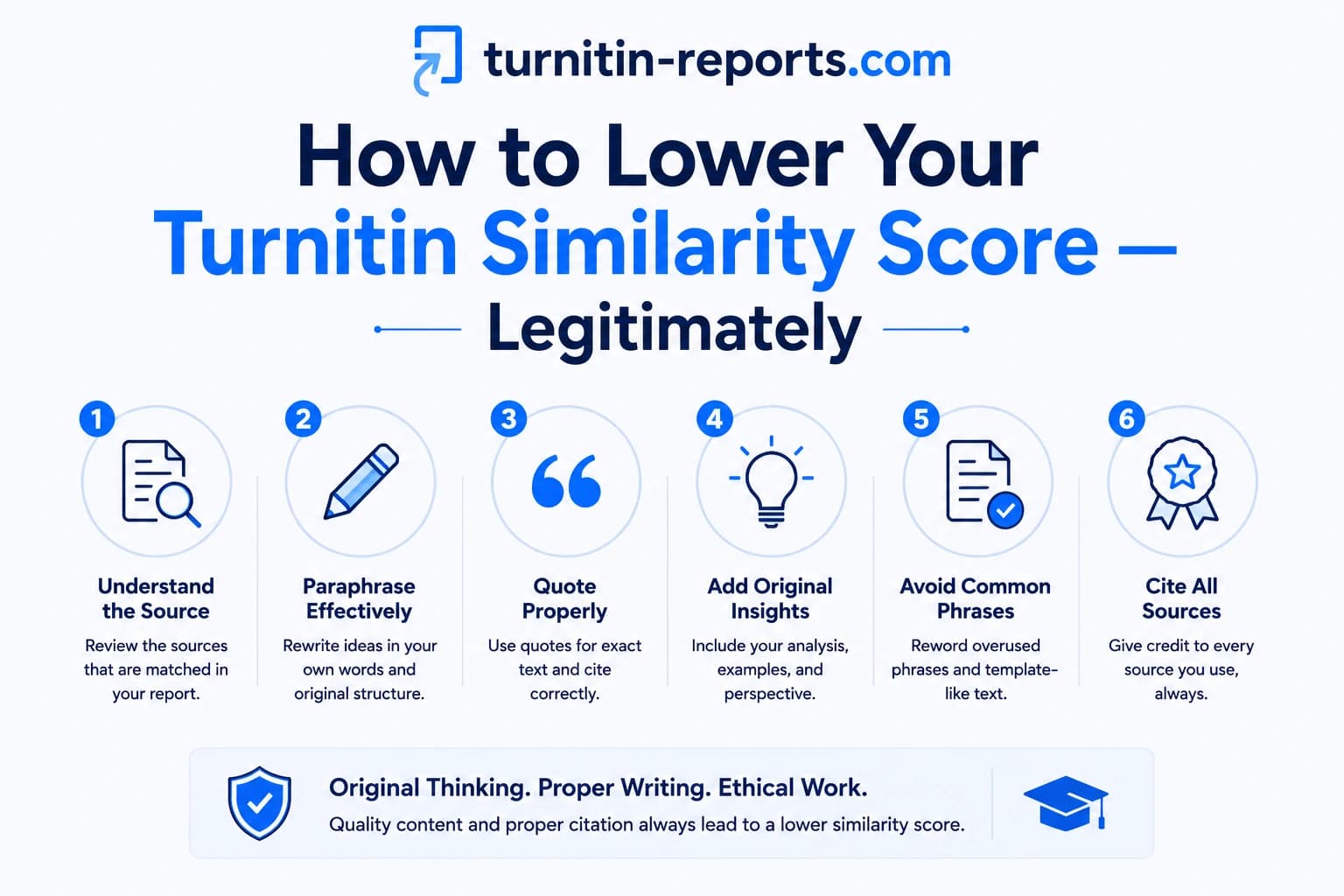
If your score is higher than expected, the most productive response is to open the full report, identify what is driving the matches, and address those specifically — whether that means adding missing citations, rephrasing undercited passages, or simply understanding that your reference list is inflating the number. Our guide on how to lower your Turnitin similarity score walks through each of those steps.
Frequently asked questions
What is a good Turnitin similarity score?
Under 15% is widely considered safe for most undergraduate essays at most institutions, with scores between 15–25% warranting a review of the source breakdown. There is no universal acceptable score — Turnitin itself states that every institution and instructor sets their own standard. What matters more than the number is what is driving it: a 22% score built entirely from a bibliography and cited quotations is not a concern; a 10% score with two unattributed passages from your sources is.
What do the Turnitin score colours mean?
The standard colour bands are: Blue (0% — no matches), Green (1–24% — minor similarity), Yellow (25–49% — medium, warrants review), Orange (50–74% — high similarity), Red (75–100% — extensive similarity). These bands vary between institutions — some use 20-point increments rather than this distribution — so the colour is a rough triage indicator, not a standardised verdict. Always look at the number and the source breakdown rather than relying on the colour alone.
Does a high Turnitin score automatically mean plagiarism?
No. Turnitin's own guidance is explicit that the similarity score is not a plagiarism score. It measures textual overlap with existing content — which can come from properly cited quotations, a reference list, standard academic phrasing, or genuinely plagiarised passages. Whether a high score represents plagiarism is determined by the instructor reviewing the source breakdown, not by the number itself. Many universities explicitly prohibit using a similarity score as the sole basis for a misconduct finding.
Is the AI detection score the same as the similarity score?
No — they are completely independent systems. The similarity score compares your text against Turnitin's database. The AI Writing Report analyses the statistical properties of your prose for patterns consistent with AI generation. A paper can score 0% similarity (entirely original, never submitted before) and 90% AI detection (because it was generated by ChatGPT). The two numbers do not influence each other and need to be read separately.
Ready to check your paper?
Get your Turnitin report in minutes.
Same report your institution generates — delivered privately, fast.
Related articles